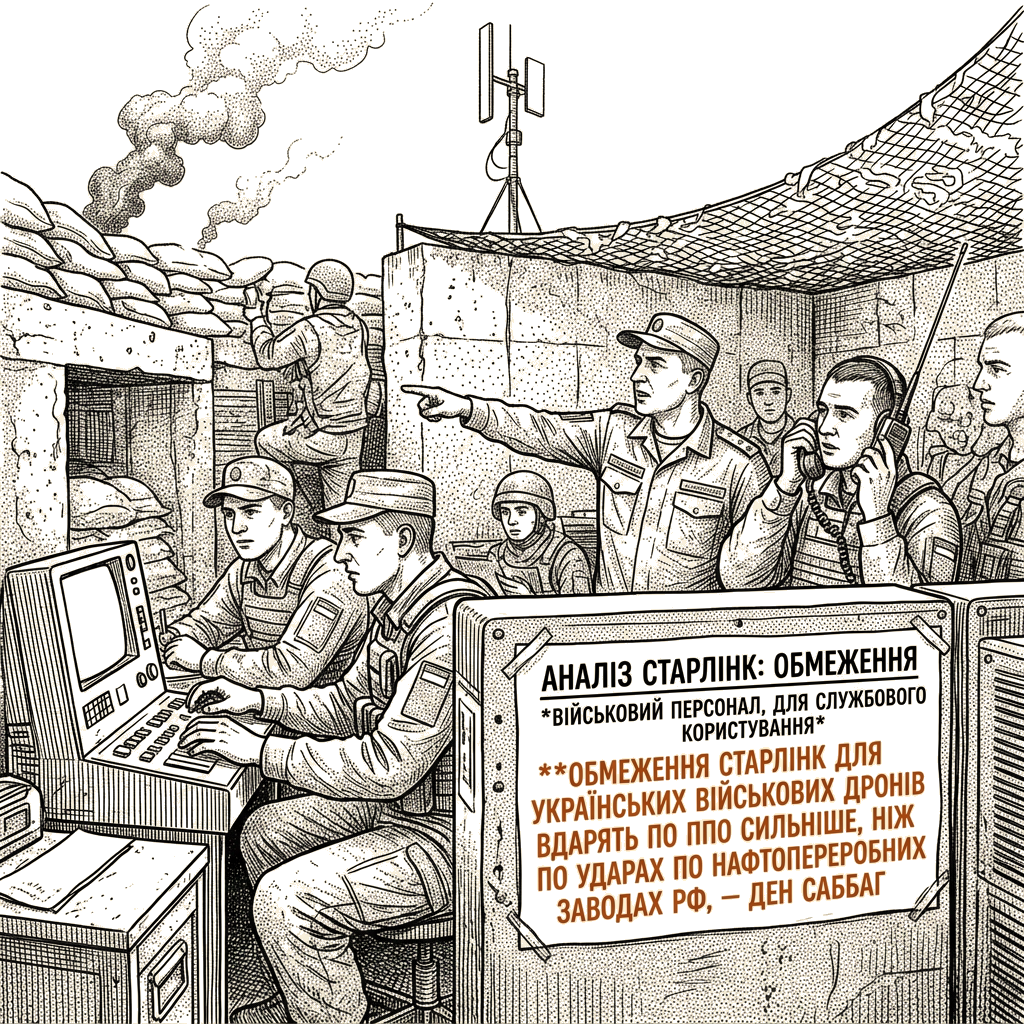
Starlink throttling coincided with two-night allied missile-warning gap
The Guardian published an analysis on Wednesday by its defence and security editor Dan Sabbagh arguing that Starlink restrictions imposed on Ukrainian military drones would hit Kyiv’s air defences harder than they would disrupt deep strikes on Russian oil refineries, and warning the curbs risked worsening an already-rising civilian death toll. The restrictions took effect Tuesday night without warning.
Ukraine’s military found that Elon Musk’s Starlink mobile-internet system, supplied by Musk with the approval of the US military, had stopped working on its drones flying faster than 160 km/h (100 mph), the stated limit, Sabbagh wrote. In practice, drones flying over 80 km/h could no longer communicate. The curbs apply to anything military moving faster than 50 mph, he noted.
Sabbagh identified air-defence interceptors as the most consequential use of Starlink, citing Serhii Beskrestnov, President Volodymyr Zelenskyy’s military technology adviser. Starlink underpins the most effective system for downing Russia’s new jet-powered Shahed drones, which travel at least twice as fast as traditional piston-engined Shaheds, Beskrestnov emphasised. Ukraine’s air force said the country’s interception rate of Russian drones had dropped to 60% in September before recovering to 75%.
The analysis drew a sharp distinction between deep strikes and mid-strike operations. Starlink has long been disabled inside Russia’s internationally recognised borders and is not used for the long-range missions targeting Russian oil refineries about which Trump has expressed concern, Sabbagh reported. “There’s no meaningful effect on deep-strike operations,” one Ukrainian soldier told The Guardian, conceding that mid-strike drone operations into Russian-occupied territory could see as much as a 30-fold drop because the alternatives are 30 times more expensive. Commanders are “replanning everything”, the soldier added, aiming to find ways to continue missions using different technologies and techniques.
The Starlink throttling arrived alongside a two-night absence of allied ballistic-missile warnings, Sabbagh reported. Russia bombed three power plants supplying Kyiv overnight, aiming to cut heating and electricity to the capital. According to Zelenskyy, for a second consecutive night no warning came from Ukraine’s western allies of the incoming ballistic missiles, and no air-raid alert was issued. The second warning absence specifically coincided with the unexpected throttling of Starlink, the analysis said.
The immediate assumption in Kyiv was that the White House was again trying to pressure Ukraine into accepting an unfavourable deal with Russia, Sabbagh wrote. Trump said Tuesday that no intelligence-sharing had been paused, and NATO Secretary General Mark Rutte made similar comments Wednesday. Sabbagh noted it is possible the lack of ballistic warning was coincidental.
Beskrestnov urged caution on Monday, posting: “Friends, this is not the first time that the launch of an S-400 has not been detected. We should not jump to conclusions.”
The analysis pointed to a March 2025 precedent. The last time Trump paused intelligence-sharing was shortly after his Oval Office confrontation with Zelenskyy, when Trump told the Ukrainian leader: “You don’t have the cards.” Ukraine rapidly lost a chunk of territory it had occupied in Russia’s Kursk region before sharing was restored.
Sabbagh catalogued Russian strikes on civilian infrastructure in recent days. Russia has bombed two bridges in Kyiv, gas stations, city-centre buildings and out-of-town warehouses, the analysis said, showing “little restraint” while struggling to win the conventional war.
Oleksandra Matviichuk, a Ukrainian human rights activist, told The Guardian: “Without that protection, Russian drones will strike residential buildings, hospitals and schools like targets in a shooting gallery.”
Zelenskyy visited London on Wednesday, where Sabbagh reported he was seeking pressure on the United States from senior UK political figures, including Andy Burnham, to keep any Starlink pause and intelligence-sharing disruption from developing into a deeper crisis.