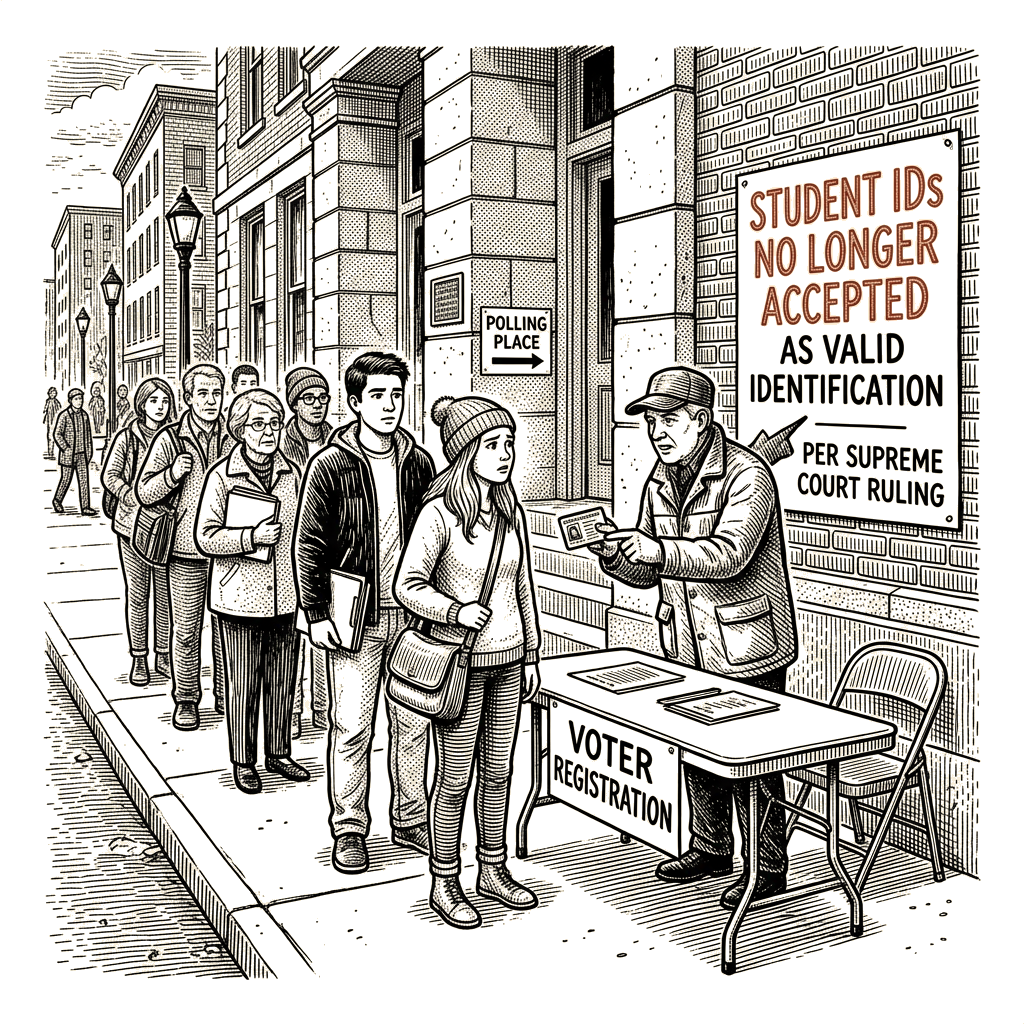
Ketanji Brown Jackson’s dissent centered on accurate state election information
The case began with a New Hampshire law enacted in the spring that removed student IDs from the list of forms election officials would accept when someone requested a ballot. The statute already restricted the cards as a primary source of identification, while guidance from Republican New Hampshire Secretary of State David Scanlan said student IDs could be used when people sought ballots.
In its brief, unsigned order, the Supreme Court granted the state’s emergency request. Citing precedent, the order said a federal judge should not have ordered voting-rule changes so close to the Nov. 3 election. “Here, the District Court did not point to anything that would justify deviating from that principle,” the order said.
Justice Ketanji Brown Jackson was the sole dissenter. “I would not disturb a clearly justifiable federal court order issued to ensure that the public receives accurate information about a State’s electoral processes,” she wrote.
The ruling means voters cannot use student IDs as backups to establish their identities. New Hampshire’s existing restriction on using the cards as primary identification also remains in place.
The nonprofit voting-rights group Coalition for Open Democracy challenged the law, arguing that it unlawfully burdened the right to vote and discriminated against young voters. U.S. District Judge Joseph Laplante initially declined to block it.
Laplante reconsidered the case earlier this month and put Scanlan’s guidance on hold. He ruled that the guidance went beyond state law because it said student IDs could be used when people sought ballots, even though the law barred them as a primary source of identification.
A separate New Hampshire provision allows people to establish their identities with “any other evidence that reasonably establishes that it is more likely than not that the person is who they claim to be.” Under Laplante’s ruling, election officials could still consider a student ID while determining whether someone was a valid voter, but the Supreme Court’s decision prevents the card from serving as backup proof of identity.
The 1st U.S. Circuit Court of Appeals in Boston declined to stay Laplante’s ruling, prompting New Hampshire to ask the Supreme Court to intervene. The high court granted that request Thursday, leaving the state unable to use student IDs as either primary identification or backup proof when voters request ballots.