New legislation, executive action and a referendum remain possible
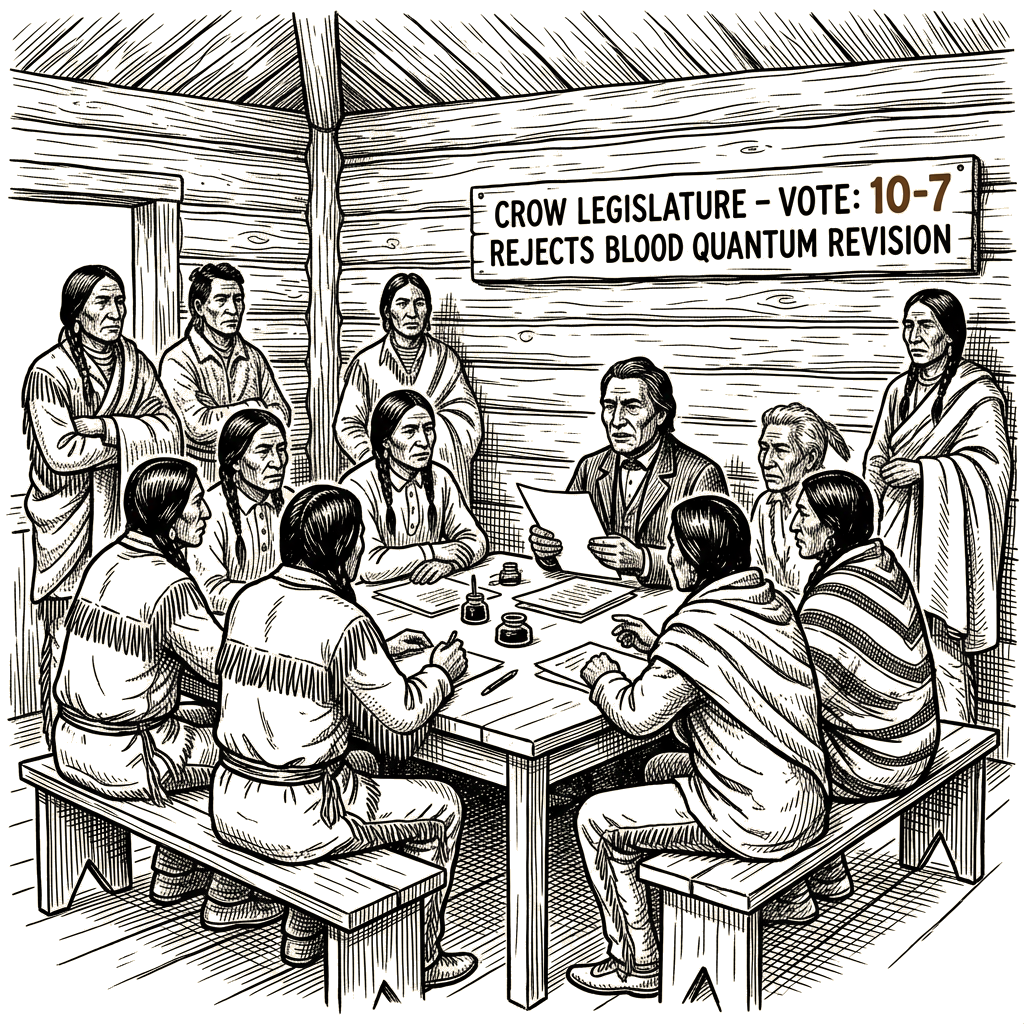
The Crow Tribe’s Legislature voted 10-7 on Wednesday to reject Chairman Frank White Clay’s blood quantum proposal after nearly two hours of impassioned debate. The bill would have revised the tribe’s enrollment standard and effectively made more people eligible for tribal citizenship. Some senators opposed changing blood quantum at all, while others said the proposal did not go far enough and offered only a temporary fix.
The Crow Tribal Legislative Branch is one of three branches of tribal government and comprises 18 senators. Under the tribe’s current enrollment policy, an individual must “possess one-quarter Crow Indian blood” to enroll as a member. White Clay’s proposal would have considered all living current members to have 100% Crow “blood.” It would have affected the lives and membership status of more than 14,000 enrolled Crow tribal members and made thousands of descendants more likely to qualify for membership and the services attached to it.
Blood quantum assigns a fractional value to a person’s tribal ancestry. The measure is central to individual identity and remains highly controversial. Most tribes nationwide use a blood quantum calculation to determine citizenship. Tribal enrollment can determine eligibility for certain health services, the ability to vote in tribal elections and whether a person can qualify for educational scholarships, among other rights and privileges. Enrollment numbers can also influence federal funding for tribal programs.
With each new generation, it becomes harder for a tribe using blood quantum to maintain its membership as tribal members marry non-Natives or people from other tribes. A California Law Review article contends that the limits “threaten to jeopardize the existence of Native nations, as you cannot have a nation without citizens.”
In Montana, most tribes use blood quantum to determine citizenship, but the Chippewa Cree and Northern Cheyenne tribes use lineal descent, which determines membership through ancestry. The Blackfeet and Fort Belknap Aaniiih and Nakoda tribes have also initiated community discussions about potentially changing enrollment requirements.
On Wednesday afternoon, White Clay and tribal attorney Majel Russell made their pitch at a table surrounded by members of the tribal Legislature. White Clay and Russell argued that blood quantum became central to federal policy in the late 19th century. In their account, from 1887 to 1934, the federal government divided tribal land into allotments for distribution to individual tribal members, using blood quantum to determine eligibility, with assimilation through private property ownership as the goal.
Russell said federal agents made “significant errors,” including assigning different blood quantum values to children with the same parents, and called the practice “arbitrary.” She presented the bill as “the most viable option” for addressing the issue promptly, while other reforms would require a constitutional referendum and a more burdensome political process.
White Clay and Russell argued that the tribe has faced declining enrollment since 2023. Without a blood quantum revision in the coming decades, they said, the tribe could eventually cease to exist as a political entity. White Clay said the bill would benefit young people whose parents are enrolled but who are not enrolled themselves. “Everything about them is Crow,” he told lawmakers. “They live here. They work here. Their culture is here. But, just by a little bit, they’re not Crow. When we hold on to Blood quantum, our tribe has an expiration date.”
Sen. Darwin Spotted Sr. said more liberal enrollment requirements could bring more people into competition for fewer resources in a federal system where resources are already scarce. “Right now, we’re fighting for one big pot, all of us Native Americans in the U.S.,” he said. White Clay and Russell argued that federal funding is often calculated based on a tribe’s population, bringing more resources with a larger membership. Spotted said he was skeptical of that argument and described the Trump administration as particularly unpredictable.
Sen. Dean Don’t Mix said he appreciated how the legislation would benefit the tribe but worried that broader membership could make future revisions to the tribe’s Constitution harder because amendments require support from a significant portion of the tribe’s citizens. Don’t Mix said the bill was “passing the buck” to future generations to contend with the issue. “I want to go back to the drawing board,” he said.
Sen. Jason Kills Pretty Enemy said the alleged errors Russell described should be corrected before the tribe considered changing the blood quantum standard. “What are you guys going to do about those that were illegally enrolled?” he said. Sen. Velma Pickett supported adopting a lineal descent policy and said the proposal did not resolve the underlying issue. “This isn’t the only option,” she said. “This isn’t a step away from blood quantum, it only extends the expiration date.”
Sens. Lesley Kabotie, Josie Passes and Glenn Plenty Hawk were among the bill’s most vocal supporters. Kabotie characterized the opposing arguments as rooted in fear and said revising blood quantum exercised the tribe’s sovereignty while helping secure its future. Kabotie said: “Blood quantum is not a legitimate deciding factor of whether Apsaalooké people walk the face of this Earth or not. Our decision is to decide that as long as the grass grows, the rivers flow, there shall be recognized, enrolled members of the Apsaalooké Nation that America and everybody else will have to deal with. We need to assure that.”
Passes similarly characterized the opposition as “fear-based” and urged lawmakers to consider the reservation’s children. She described several children enrolled in other tribes who lived on the reservation, danced traditional, spoke the language and sang. “That’s their identity, but on paper, they’re not enough,” she said. “They are one tick mark away, two tick marks away. We’re telling them that they are not Crow and we are not considering them.” Passes said the legislation would send young people the message that “you matter. You’re Crow. I see you, and you count.”
After the 10-7 vote, several lawmakers said the bill was dead but the debate over blood quantum was not over. White Clay could bring another piece of legislation before the Legislature or issue an executive order revising blood quantum. The tribe could also change its membership requirements through a constitutional referendum. Standing in the chamber after the vote, White Clay said some senators had voted out of fear. “I just believe that they’re scared of change,” he said. “They fear these new things. Maybe the next generation won’t.”