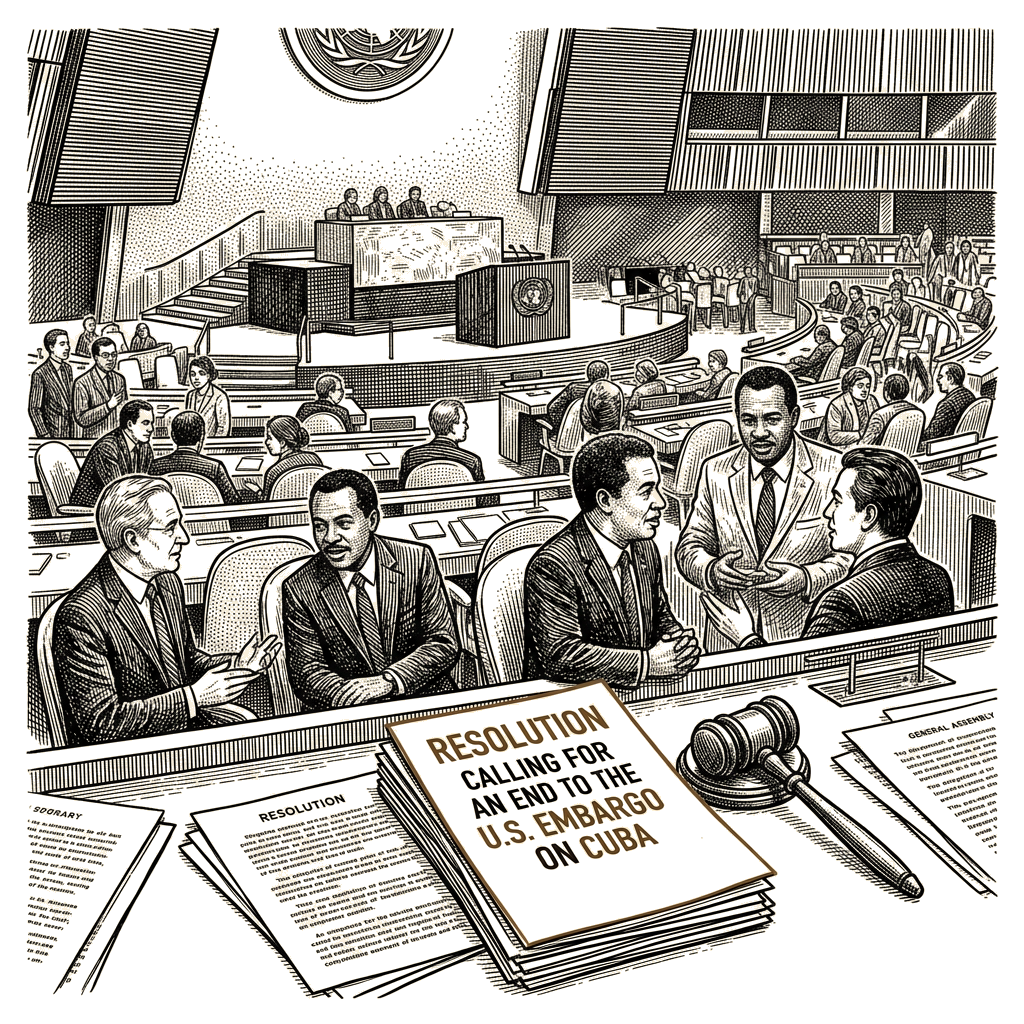
Support fell by 35 votes as governments changed positions
The General Assembly approved the Cuban-sponsored measure on Wednesday with 130 votes in favor, 17 against and 25 abstentions. Another 21 countries did not participate. The 130 favorable votes were 35 fewer than the 165 recorded in 2025, when seven countries voted against and 12 abstained. Both the opposition and abstention totals increased significantly this year.
The result nevertheless gave Cuba a majority in the General Assembly. The resolution, titled “Necessity of ending the economic, commercial and financial embargo imposed by the United States of America against Cuba,” calls for ending the restrictions and challenges their extraterritorial effects. Although approval represented diplomatic support for Cuba’s position, the measure is nonbinding and does not require Washington to change its sanctions policy.
Before the vote, Cuba accused Washington of conducting an intense diplomatic campaign to persuade other governments to reject the resolution or abstain, amid growing U.S. pressure on the Cuban government.
In Latin America, Argentina, Colombia, Costa Rica, Ecuador and Paraguay voted against the resolution. Chile, Peru, Honduras and the Dominican Republic abstained. Brazil, Mexico, Uruguay, Nicaragua and Panama were among the countries in the region that maintained their support for Cuba.
Colombia, which supported the measure in 2025, switched to opposition. Chile, Peru and Honduras moved from supporting the resolution to abstaining, while Costa Rica and Ecuador, which abstained in 2025, voted against it.
The shift also extended to Europe, where Germany, Italy and Latvia abstained after departing from their previous positions.
During the debate, Cuban Foreign Minister Bruno Rodríguez Parrilla condemned the economic and humanitarian consequences of U.S. sanctions. Havana says the restrictions limit access to fuel, medicine and food. In a statement posted on X, Rodríguez accused Washington of waging an economic campaign aimed at bringing about regime change. “The consequences fall on people, limit their fundamental human rights, affect third countries and turn the population’s essential needs into instruments of political coercion,” Rodríguez said.
He also described U.S. fuel restrictions as equivalent to a naval blockade and accused Washington of collective punishment and genocide. Those were allegations made by the Cuban government. Rodríguez nevertheless called the resolution’s approval by a majority of General Assembly members “another victory for Cuba.”
U.S. Ambassador to the United Nations Mike Waltz rejected Cuba’s arguments and blamed much of the island’s economic crisis on its government’s policies. In a post on X, Waltz criticized the conduct of Cuban representatives during the U.N. debate. “Faced with tough questions about their corrupt failures and blatant hypocrisy, the Cuban regime can only resort to pounding desks and physical intimidation,” Waltz wrote. He wrote that “Today nearly triple the number of nations voted no, abstained, or just chose not to vote-turning their back on Havana’s sham resolution at the UN.”
The vote came amid a deepening economic and energy crisis in Cuba, marked by prolonged power outages, fuel shortages and difficulties maintaining essential services. Cuba retained a General Assembly majority, but the drop in favorable votes left the embargo resolution with less international backing than in 2025.