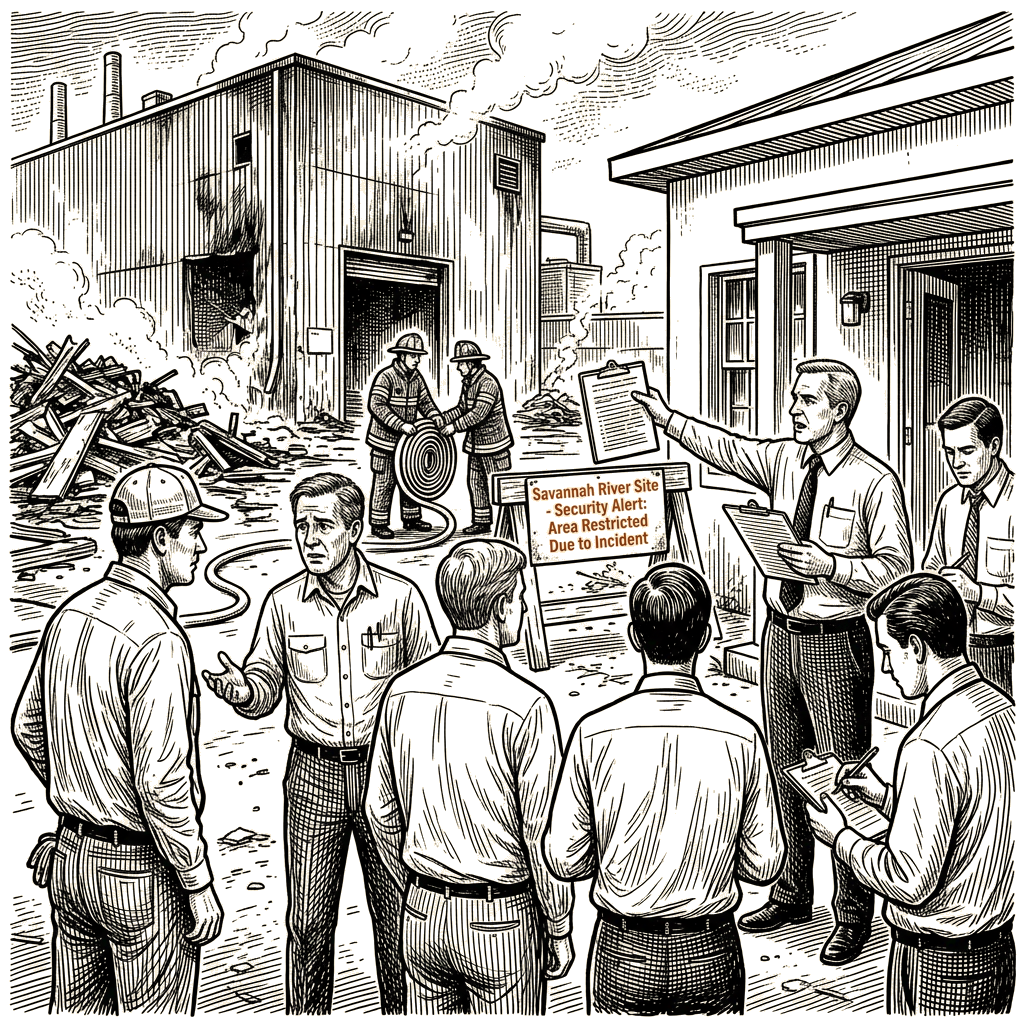
DOE says no radiological release; emergency lifted about five hours later
Nuclear watchdog groups on Thursday demanded a thorough accounting of a fire at the Savannah River National Laboratory in South Carolina, noting the surrounding site contains nuclear material and that U.S. officials are ramping up efforts to build a core nuclear weapon component there.
The U.S. Department of Energy said the fire at the lab on Wednesday did not release any radiological material or expose employees to radiological contamination. There is no risk to the public or the environment, the agency added in a brief email statement on Thursday.
The fire prompted the declaration of a “site area emergency,” restrictions on rail, boat and air traffic, the closure of barricades to incoming traffic and the sheltering of employees, according to a news release from the Savannah River Site Emergency Response Organization. The emergency declaration was lifted about five hours later.
A site area emergency occurs when any release of radioactive or other hazardous material is expected to exceed safety limits at a short distance, or when there is an actual or potential threat to the integrity of a nuclear weapon, component or test device that may adversely impact the health and safety of workers in the immediate area — but not the public — according to a DOE emergency guide.
Edwin Lyman, director of nuclear power safety at the Union of Concerned Scientists, said the “stringent precautions” taken Wednesday raise the possibility that officials were concerned the fire could spread to an area with radiological material. “What were they so concerned about that they would close the airspace over the plant?” he told The Associated Press. “It is mysterious, and I think the public deserves to know.”
The Savannah River Site is a massive complex covering hundreds of square miles where the federal government once produced materials used in nuclear weapons, primarily tritium and plutonium-239. The laboratory sits in the site’s northwest corner, near the edge. The site opened in the early 1950s as the Cold War was heating up; today it is used for environmental stewardship and cleanup, along with nuclear waste management and disposition of nuclear materials.
U.S. officials have announced approval of plans to construct a new facility on the site that will be used to build plutonium pits, a core component of a nuclear weapon.
Dr. Dylan Spalding, a senior scientist in the Global Security Program at the Union of Concerned Scientists, said the fire “underscores that the risks from nuclear weapons production sites are not hypothetical.” “The public is owed clear accounts of what happened at SRS last night, whether there was any release of radioactive materials, and what the NNSA is doing to ensure the safety of SRS workers and the community,” Spalding said in a statement, referring to the National Nuclear Security Administration.
Dave Lochbaum, former director of the Nuclear Safety Project at the Union of Concerned Scientists, said determining the cause of the fire is key to ensuring future safety at the site, but that determination could take time. “They don’t want to jump to a conclusion that later turns false,” he said in a phone interview. “That kills their credibility.”
Tom Clements, director of the Savannah River Site Watch, said in a statement that U.S. officials should conduct a “rigorous review” of the status of current fire protection at Savannah River facilities, as well as the fire protection being planned for the pit plant.
Arnie Gundersen, chief engineer with Fairewinds Energy Education, said the many hours before the emergency was ended gave him pause. “This was bigger than the blown fuse in your house and you smell a little smoke and it ends,” he said. “They’re dealing with some nasty chemicals, and there should be provisions in place to prevent that.”