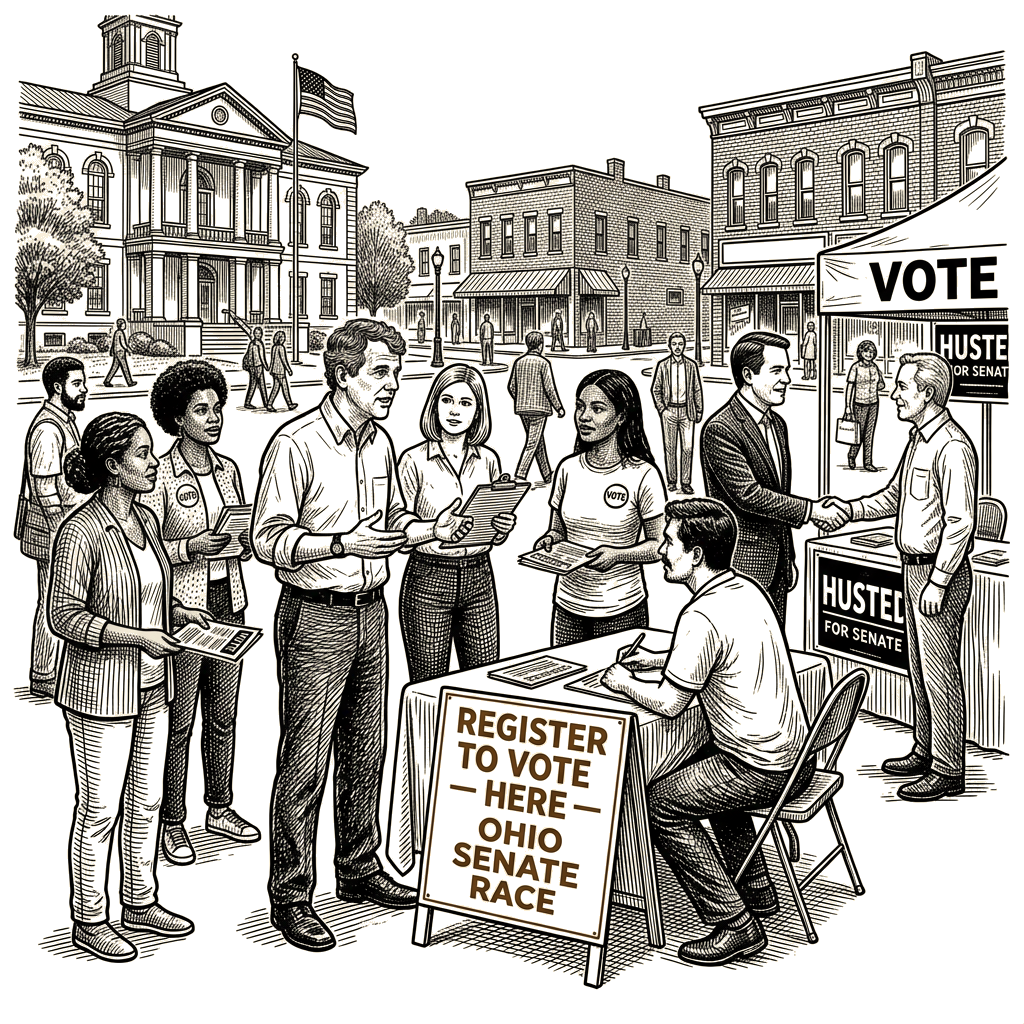
Democrats see Ohio as crucial to their Senate control push
The Ohio Senate seat formerly held by Vice President JD Vance is up for grabs Tuesday as Republican Sen. Jon Husted, 59, faces a stiff challenge from Democrat Sherrod Brown, 73. Husted has held the seat since his January 2025 appointment, while Brown is trying to return after Republican Sen. Bernie Moreno defeated him two years earlier. The winner will serve the final two years of the six-year Senate term Vance won in 2022. The race is among the country’s most hard-fought and costly Senate contests.
Both candidates are political veterans. Husted is a former lieutenant governor, while The Associated Press described Brown as one of Ohio’s most successful politicians and the only nonjudicial Democrat to win an Ohio statewide race in 18 years. Brown’s status prompted Democrats to rally around his comeback bid after Moreno defeated him in a bitter campaign. Tuesday’s contest is Ohio’s third U.S. Senate race in as many election cycles without a political newcomer, unlike the races won by Moreno and Vance, and the campaign has been among the most expensive in the country.
Data centers are another point of contrast between the campaigns. Brown and allied groups criticized Husted over his role as Republican Gov. Mike DeWine’s point person in attracting data centers to Ohio. Trump and Vance repeatedly visited the state to campaign for Husted, pressing a positive message on artificial intelligence data centers that aimed to reverse one of Husted’s key campaign vulnerabilities.
Brown and allied groups also criticized actions Husted took to help pass a nuclear plant bailout at the heart of a long-running $60 million bribery investigation. Husted has never been accused of any crime associated with that investigation.
Husted also received campaign donations from retail magnate and billionaire Les Wexner, who employed the late Jeffrey Epstein to manage his fortune. The Associated Press described Epstein as a sexual predator. Husted said he donated all available Wexner donations to an anti-sex trafficking charity.
The Associated Press reported that Husted and supportive interest groups attacked Brown for positions he took over his 32 years as a congressman and senator and portrayed him as part of the Democratic Party’s “far-left flank.” The Associated Press also wrote: “Viewed as one of the Senate’s most liberal members when he served, Brown considers himself an old-fashioned populist.”
Brown has long embraced pro-union, pro-working class positions such as federal pension guarantees, “Buy American” budget provisions and other policies that foster what he promotes as “the dignity of work.” Husted presented himself as a fiscal conservative who favored income tax cuts and cutting regulatory red tape. He accused Brown and Democrats of being for “crazy stuff.” One Husted ad noted that Husted was 7 years old and playing pee wee football when Brown first went to Congress. Another cited Brown’s vote in favor of the bank bailout of 2008, nearly two decades ago, to portray him as beholden to Wall Street.
The campaign cast Brown’s opposition to a federal ban on certain kinds of health care for transgender people as support for “sex change surgery for minors” and “irreversible surgery on kids.” Brown’s position is that those decisions should be made by patients and their families rather than the government.
Democrats see Ohio as crucial to winning Senate control even though the state has faded as a national bellwether following a recent rightward shift. The race is taking place amid widespread dissatisfaction with rising prices and the Iran war, while President Donald Trump’s low popularity complicates his ability to promote candidates such as Husted.
Tuesday’s result will determine who represents Ohio for the final two years of Vance’s term. The seat carries added significance because Democrats view Ohio as crucial to their effort to win Senate control.