Federal Reserve rate hike expected after October labor growth beats forecasts
US consumer prices rose 0.4% from September to October, according to the Bureau of Labor Statistics, slightly above economists’ expectations but below September’s 0.6% increase. Gasoline costs dipped during the month as the pace of price increases cooled.
Monthly CPI and missing year-over-year benchmark
The consumer price index, or CPI, measures the price of a basket of goods and services. The Bureau of Labor Statistics did not release the CPI report’s usual year-over-year inflation figure because data were not collected in October 2025 during the government shutdown.
In its Nov. 10, 2026 vintage, FRED’s year-over-year core CPI series stood at 2.57% and its PCE price index stood at 3.65%. Those separate measures supplied context on underlying inflation and the gauge the Federal Reserve prefers, but they did not replace the missing year-over-year CPI reading.
The Guardian reported that higher energy costs driven by the Iran war had been the main factor behind increased inflation, which had remained above an annualized 3% since the war started in late February. Inflation reached 4.2% in May, a three-year high, before fluctuating between 3.4% and 3.7%. Energy prices continued to rise slightly in October, but the increases were smaller than in September.
Gasoline, diesel and consumer sentiment
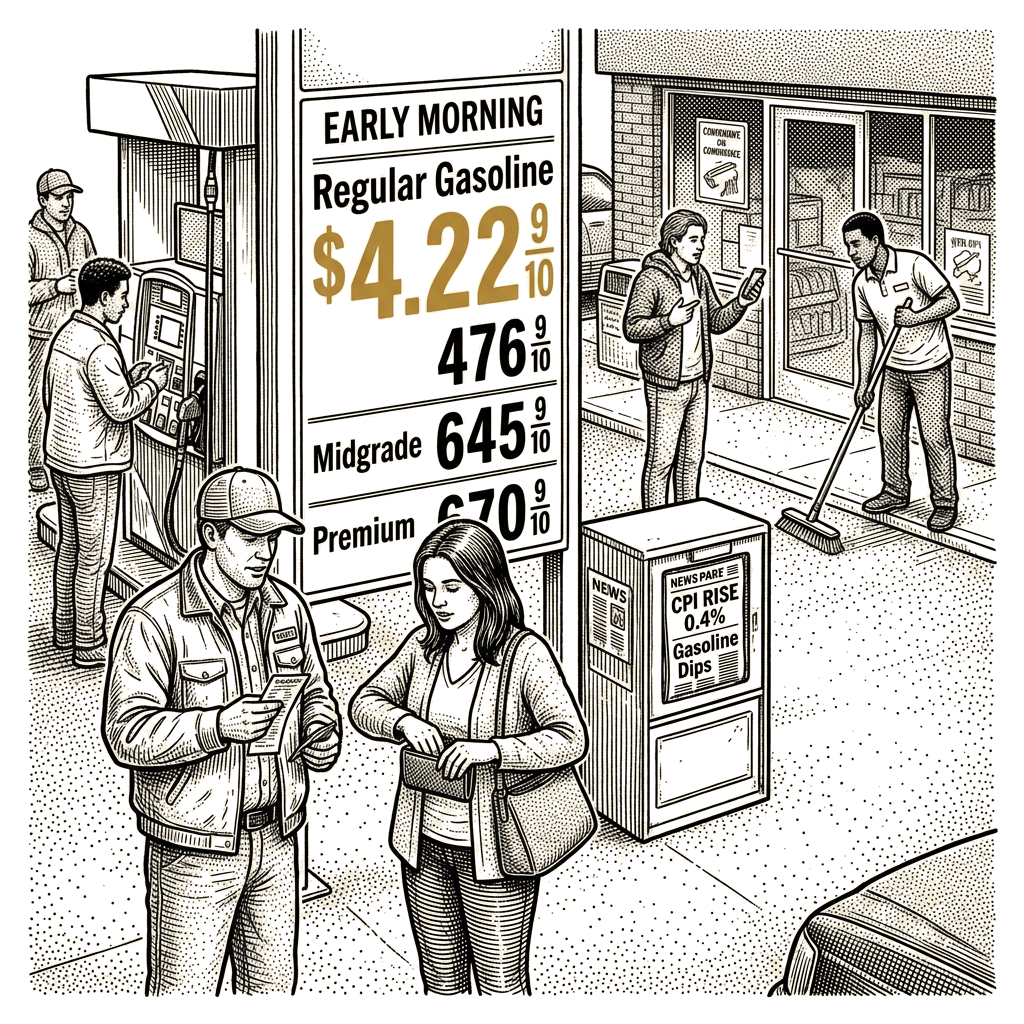
AAA data cited by The Guardian showed the average gasoline price falling from $4.41 a gallon at the beginning of October to $4.22 during the month. Gasoline remained more than $1 a gallon above its year-earlier price. On Monday, the average price at the pump fell below $4 for the first time since July, and gasoline prices continued to drop.
A photograph credited to Christina House, Los Angeles Times/Getty Images, showed Jesus Salgado of Lincoln Heights putting gas in his tank at a 76 gas station in Los Angeles, California, on 14 October 2026, as gas prices rose to nearly $7 a gallon. The nearly $7 local price was distinct from AAA’s $4.22 average for the month.
Diesel, used to power trucks, farming equipment, buses and trains, remained nearly $2.50 a gallon higher than a year earlier, although its price had been declining since October.
Consumer sentiment increased slightly at the end of October as gas prices eased, according to the University of Michigan’s Survey of Consumers. At the same time, the US stock market was dipping as investors voiced skepticism over the influx of AI spending.
“While sentiment lifted for lower- and middle-wealth consumers, it fell 5% for those with the largest stock portfolios in the wake of a relatively turbulent period in stock markets,” said Joanne Hsu, the director of the Surveys of Consumers, in a statement. “Moreover, consumers’ comments revealed growing anxiety over a possible AI bubble.”
Federal Reserve decision and labor market
The Federal Reserve raised interest rates in September for the first time since 2023 and was expected to hike rates again at its next meeting in December. The central bank’s target inflation rate is 2%, which it considers a stable pace of price increases. Higher rates slow the economy by making borrowing more expensive and can slow inflation.
The Guardian reported that growth in the labor market surpassed economists’ expectations in October, while the unemployment rate remained relatively steady, hovering just above 4%. The Guardian said the labor-market result gave the Federal Reserve more room to raise rates, but inflation’s close connection to energy prices left it unclear how much and how quickly a rate hike could ease prices.
Federal Reserve Chair Kevin Warsh said the central bank was dedicated to making sure price increases ease up. On 28 October, he said, “Our job is to ensure that relative price changes in some sectors do not broaden across the economy, and that inflation expectations remain as they are anchored.”
Midterm election and household costs
The Guardian said the midterm election would give Democrats control of Congress and was largely seen as a rebuke of Republicans over high prices. In their postmortem of the midterms, Republicans, including JD Vance, specifically pointed to frustration over increased gas prices as a reason the party fared so poorly in the election.