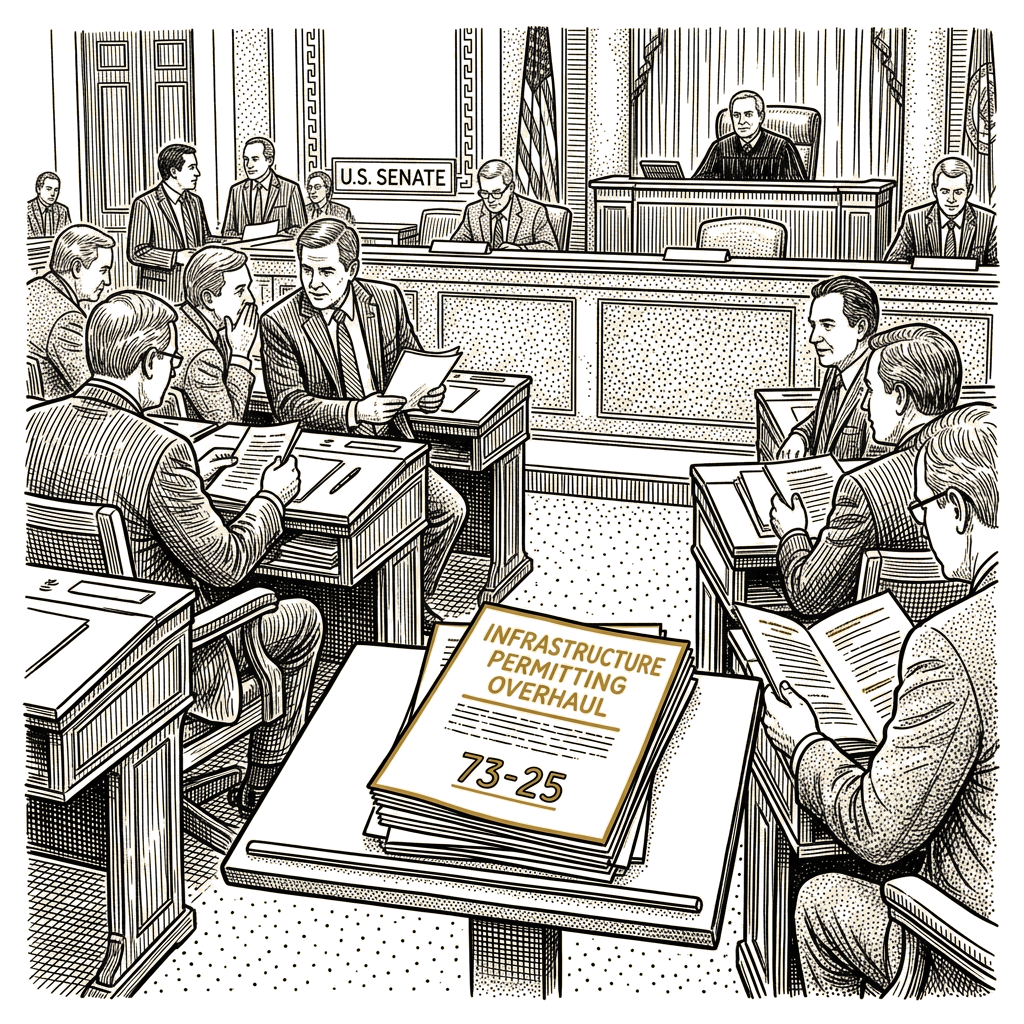
If passed, bill would speed big-project reviews and require datacenter energy payments
The Senate voted 73-25 on Monday to formally take up the bipartisan permitting bill. The procedural step advanced the legislation but did not enact it.
The Guardian described the proposal as aimed at speeding permitting reviews for datacenters and other infrastructure projects. Senators and President Donald Trump have pushed it as a way to meet growing demand for electricity and other forms of energy, while projects in those sectors face years-long delays before reaching the grid.
The bill’s proposed changes would shorten the timeline for starting big energy projects—both clean-energy and fossil-fuel projects—and make sure data centers pay for the energy they use. The Guardian reported that anger over AI datacenters and rising electricity costs helped usher in a wave of Democrats pledging restrictions on large, energy-hungry structures.
The Guardian’s report included a photograph of Meta datacenters near Social Circle, Georgia, credited to Mike Stewart/AP.
Donald Trump urged senators to vote for the measure in a social media post Sunday, calling it a “BIG WIN for U.S. ENERGY INDEPENDENCE and DOMINANCE.” He wrote that the bill would “ensure that we can build Pipelines, Mines, and Power Plants faster than ever before, lowering Energy Costs for American Families”.
Major industry groups representing developers in clean energy and in the oil and gas sector support the bill.
The bill’s four main champions — Republican Sens. Shelley Moore Capito of West Virginia and Mike Lee of Utah, and Democratic Sens. Martin Heinrich of New Mexico and Sheldon Whitehouse of Rhode Island — released a detailed set of amendments Saturday designed to bolster support. The two Democrats and two Republicans lead the chamber’s energy and environment panels and negotiated the agreement weeks before the election.
The four senators said Americans were tired of paying more in utility bills while projects that could lower costs sat stuck in the planning phase for years. “Americans can’t afford to wait for lower electricity prices. We need to pass this bill now,” Heinrich said.
If passed, the bill would save households billions on electricity costs, create jobs, cut emissions and force big corporations to pay their full share for datacenter energy instead of pushing energy costs on consumers, Heinrich said.
Capito called the bill “a win for America” and said, “We cannot let this moment pass by. The reality is this, over the next several years, we will have no choice but to increase our national energy production. This is an unprecedented opportunity … to come together to show the American people we are listening to you.”
Many environmental organizations have opposed the measure because they say it would lock in fossil-fuel development, weaken environmental safeguards and make it harder for communities to challenge energy-project approvals. The Sierra Club and National Wildlife Federation strongly opposed the bill in recent days, citing concerns about its limits on judicial review and changes to the National Environmental Policy Act and Endangered Species Act.
The National Environmental Policy Act, known as NEPA, requires agencies to consider a project’s possible impacts and allows the public to be heard before approval. Supporters of an overhaul say that process causes years-long delays in federal permitting.
Some critics said the permitting bill as proposed could lead to a vast increase in exports of liquefied natural gas and facilitate a “reckless” build-out of datacenters powered by natural gas. Hakeem Jeffries, the House minority leader and a New York Democrat expected to become speaker in January, criticized the bill last week. His office said the measure “falls short” in a number of areas.
The vote was the first major congressional action since last week’s election. The legislation has received bipartisan support, but midterm results could complicate its passage during the lame-duck sessions.
Democrats won the midterm election. Some Democrats say the party should use its stronger position in the next Congress to pass legislation that produces needed clean energy while limiting expansion of oil, natural gas and mining.
The Senate’s 73-25 procedural vote advanced the bill, but the measure has not passed. The legislation has received bipartisan support, midterm results could complicate passage during the lame-duck sessions, and environmental organizations oppose key changes.