Six-month renewals, SNAP costs and school tax credits also change
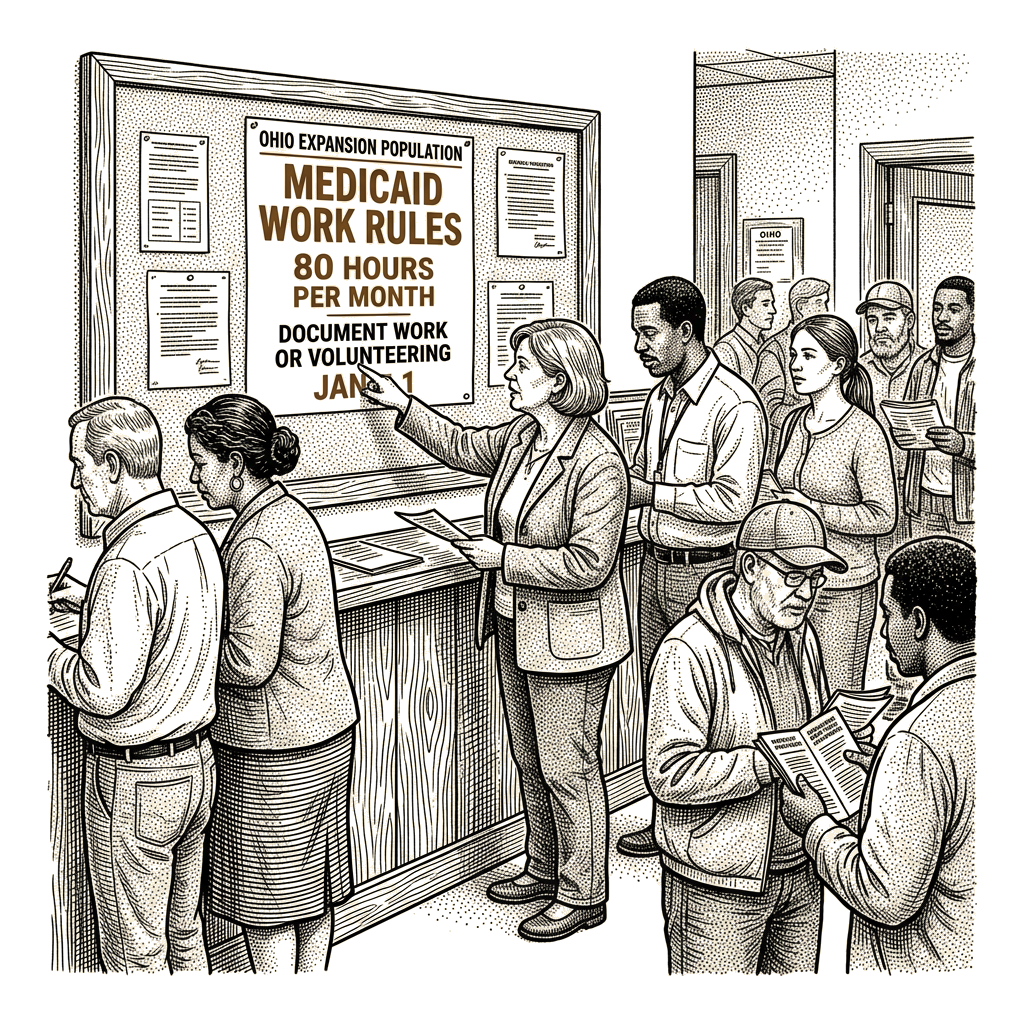
Ohio will begin enforcing a federal Medicaid work requirement on January 1, requiring adults ages 19 to 64 in the state’s expansion population to show 80 hours of work or volunteer activity in a given month to maintain coverage. The requirement is one part of the One Big Beautiful Bill Act, which President Trump signed into law on July 4, 2025, and whose provisions are scheduled to phase in through 2035. Other looming changes include six-month Medicaid renewals, new coverage restrictions for some legally present immigrants and a larger federal tax credit for donations to private school scholarship organizations.
The requirement applies to people who gained coverage through the Affordable Care Act’s Medicaid expansion. About 700,000 Ohioans are in that population, whose members earn less than 138% of the federal poverty limit — roughly $22,000 for an individual and $44,550 for a family of four. Tara Britton of the Center for Community Solutions said Medicaid is the only coverage for many of them: workers may have jobs that do not offer insurance, may not qualify for coverage because they hold several part-time jobs, or may find private insurance unaffordable.
The One Big Beautiful Bill Act paid for more than $900 million of its tax breaks by cutting into Medicaid. Adding work requirements saves an estimated $336 million, while moving to six-month renewals saves another $60 million. Britton said those savings would come mainly from people losing coverage.
“Folks are stuck in this administrative process and end up losing coverage a lot of times inappropriately,” Britton said. “That’s where the savings come from.”
Federal officials offered states an optional six-month delay in enforcing the work rules, but Ohio said it would proceed on schedule. The U.S. Centers for Medicare and Medicaid Services announced the option late last week. Ohio Department of Medicaid spokesperson Stephanie O’Grady stressed the guidance “provides limited enforcement flexibility for states, but it does not eliminate the work required to determine eligibility.”
“Ohio is on track to implement the requirements on January 1,” O’Grady said.
Ohio has wage data that can readily verify eligibility for about 80% of affected workers, Britton said. The state lacks necessary data for the remaining 20%, a group of about 155,000 Ohioans.
“They see no other data in any other system that shows that they are either meeting work requirements or meet one of those exemptions,” Britton said. “Those are the folks that we are concerned will fall through the cracks.”
Britton said some of those people might be experiencing homelessness or have a health exemption that reaches farther back than officials are checking. State records might also contain only an old address.
Starting January 1, Medicaid recipients must renew their coverage every six months instead of annually. The change will occur on a rolling basis. Someone whose annual renewal fell in October, for example, would move to the six-month timeline beginning in October 2027.
Britton worried the shorter timeline could come as a shock for the 155,000 Ohioans who are not interacting much with state officials. “When an acute issue comes up and someone ends up in the emergency room, that may be where they discover they haven’t renewed,” she said. “Could be that they’re going to get a maintenance medication, and that’s when they find out that they have lost coverage.”
A Medicaid participant who loses coverage because of the work requirement could also face difficulty purchasing replacement insurance because the law bars access to premium tax credits.
Immigrants who are in the United States legally, including refugees, asylees and people with temporary protected status, lost access to Medicaid in the previous month. In January, they will lose access to premium tax credits and Medicare as well.
Other provisions will affect public benefits and energy policy. Student loan deferments will expire in July 2027 for borrowers who claimed economic hardship or unemployment. In October, states must begin covering a portion of the Supplemental Nutrition Assistance Program, or SNAP, based on their error rates. Ohio’s 2025 error rate would shift 5% of program costs onto the state, or approximately $160 million, according to the Ohio Job and Family Services Directors’ Association. At the end of the year, the bill would eliminate tax credits for renewable energy projects and components.
News From The States reported that incoming Democratic majorities in Ohio and Washington, D.C., were preparing a new legislative agenda. The outlet said the Medicaid provisions were significant enough that those majorities may try to force the Trump administration to accept legislative changes. The outlet reported that absent those changes, many vulnerable populations would see a diminishing safety net as they move into 2027.
Ohio lawmakers created a tax credit for donations to scholarship-granting organizations in 2021. Under state law, the attorney general must verify that the groups are nonprofits using most of their funding for scholarships, with priority for low-income students. Ohio taxpayers can receive a credit of up to $750. During 2024, the most recent tax year on record, filers claimed $35.5 million in credits — $10 million more than state officials projected for fiscal year 2027.
Starting in January, the federal government will roll out a larger version of the credit worth up to $1,700. Piet van Lier, deputy director of the advocacy group Honesty for Ohio Education, said the federal government should not emulate Ohio’s program, calling the money “foregone revenue.”
“That money will not be collected by the government to be used for critical services, whether it’s special needs, special education, or Title One for lower income children in public schools,” van Lier said. “This is money that the government won’t have to spend on education and other important things that we rely on the government for.”
Van Lier said he supports school choice but opposes directing public funding to private school vouchers. Students can pair a voucher with a scholarship, he said, causing tuition funding to leave with the student while taxpayers contribute less to the state.
“It’s part of the ongoing weakening of support for public education,” van Lier said. “We’re taking what is really a public good, a common good, and making it into sort of a consumer asset.”
Private schools receiving scholarship funding can choose which students to enroll, van Lier said. He expressed concern that children with special needs or lower academic achievement could have fewer enrollment opportunities than other groups.
Access also remains uneven geographically, van Lier said. Eight Ohio counties have no private options, while more than half the state’s counties have only four or five or fewer small schools. He said that leaves students in large parts of Ohio with relatively few alternatives.