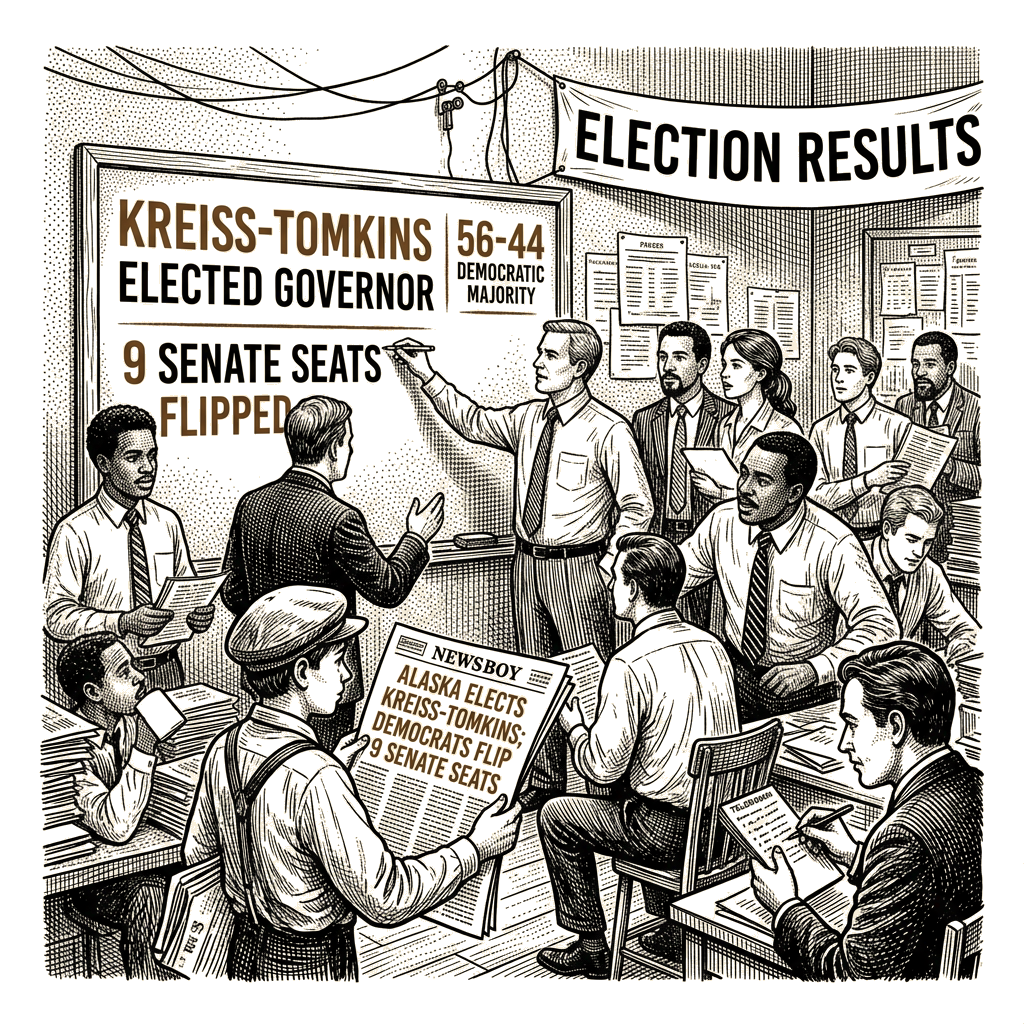
Alaska had not elected a Democratic governor since 1998
Democrats finalized the 2026 Senate map with nine flips, the most since 1958, and emerged with a 56-44 majority, the Associated Press reported. Jonathan Kreiss-Tomkins defeated three Republicans, including one endorsed by Donald Trump, to become Alaska’s first Democratic governor since 1998. Mary Peltola defeated two-term Republican Sen. Dan Sullivan in the Senate race, making Alaska the last U.S. Senate contest resolved in the 2026 midterms.
Republicans entered the midterms with a 53-47 majority, while Democrats emerged with a 56-44 margin. Democrats had already retaken control of the chamber and won Senate campaigns in conservative states including South Carolina, Texas, Kansas and, most recently, Mississippi before Alaska.
Peltola’s victory completed a political comeback in a state President Donald Trump repeatedly won by wide margins. She previously represented Alaska’s lone House seat, making her the first Alaska Native to serve in Congress. She lost her bid for a second full term to Begich in 2024 but became central to Democrats’ plans to retake the Senate in 2026. Peltola will be the fifth Democrat since statehood to represent Alaska in the Senate; the most recent was Mark Begich, whom Sullivan defeated in 2014.
In a statement on social media, Peltola said there “is no greater honor than having Alaskans’ support in our fight to take on corporate greed, lower costs and put Alaska first. Thank you, Alaska. Let’s get to work.” Messages seeking comment were left with both campaigns Tuesday night.
Former state lawmaker Jonathan Kreiss-Tomkins also defeated three Republicans, including one endorsed by Trump, to become governor. Alaska had not elected a Democratic governor since 1998. The Associated Press had not yet called the state’s U.S. House race, where independent candidate Bill Hill was challenging Republican Rep. Nick Begich.
In the campaign’s final stretch, Peltola faced allegations that members of her team helped recruit retired teacher Dan J. Sullivan to run in order to siphon votes from the incumbent. Trump called for Peltola’s prosecution after The New York Times first reported the allegation less than a week before the Nov. 3 election. Peltola denied any involvement. Days before the election, she told supporters in Juneau, “I knew nothing about any other candidates on the ballot except for me and the incumbent.”
Dan J. Sullivan denied any contact with Peltola’s campaign or that he was running at Democrats’ behest. He had not responded to Associated Press messages since The Times’ article was published. The Times report was based partly on text messages, other documents and interviews with Peltola’s former campaign manager, who was fired shortly before the open primary and later sought to recant her statements. The second Sullivan had already been on Trump’s mind; Trump referred to him multiple times during a rally in support of the senator in mid-October.
Later, the Justice Department filed a lawsuit that Trump said he ordered. It sought to block certification of the race if the incumbent were to lose, pending an investigation into possible voter confusion. Peltola called the lawsuit “flagrant corruption.” A federal judge dismissed the case, but the Justice Department appealed.
Attorneys for Alaska sought dismissal, saying officials should be able to conduct the election “without unwarranted interference by the United States.” They also argued that the ballot was designed to distinguish the two Sullivans as much as possible and that Alaska’s ranked-choice voting process would allow any voters who might be confused to rank them. The Justice Department also confirmed the existence of a criminal investigation, but Alaska’s U.S. attorney would not say what potential crimes authorities were looking into.
Peltola finished first in the primary with 49.5% of the vote, followed by the incumbent with 41.4%. Dan J. Sullivan finished a distant third with about 2.5% but advanced to the general election as one of the top four finishers. Dan J. Sullivan was listed on both ballots as Daniel J. Sullivan Jr., with no party affiliation, while the senator was listed as Dan S. Sullivan, Republican and incumbent.
During the campaign, Peltola tapped into Alaskans’ frustrations with high fuel prices and other costs. Those concerns hit especially hard in remote communities that rely on diesel for electricity and heat and are often only accessible by air or water. Her campaign peppered social media with photos of her travels around the state as she sought to separate herself from national Democrats and build a coalition of support around a platform of “Alaska first.”
“Alaskans who know me know that I’m not liberal or radical,” Peltola said. “I am only interested in working for Alaska and working for the best interest of Alaskans, in as nonpartisan of a way as I possibly can.”
The race attracted heavy spending by outside groups and at times turned negative, with the campaigns accusing each other of spreading lies. Trump and Vice President JD Vance made separate trips to the state in the month before the election in support of the incumbent.
“Lower 48” became something of an insult bandied by both sides. Sullivan and his supporters tried to align Peltola with “Lower 48 liberals” who want to restrict oil and gas drilling, mining and other resource development in the state. Peltola said that while she would work with Trump to get things done for Alaska, “I will never put any Lower 48 politician before Alaskans. That’s the difference between Dan and me.”
When Sullivan took issue with Peltola reading off note cards during a debate — “You can’t cue-card your way to the Senate,” he told reporters — Peltola said she simply was prepared. She also pushed back against Sullivan’s assertion that she was ineffective during her time in the House, saying she worked well with him as part of the state’s three-person delegation in Washington. Peltola postponed two days of campaign events in late October after her campaign said she suffered minor injuries in a car accident in Anchorage.
Peltola, who is Yup’ik, emphasized her Alaska roots and resurrected the “fish, family and freedom” tagline from her prior campaigns. She spoke about growing up in western Alaska, fishing for salmon on the Kuskokwim River with her father and spending parts of the summer at fish camp with her children and late husband, who died in September 2023.
She said the fish and wildlife that Alaskans long relied on to fill their freezers for the winter were becoming harder to find. The changes were forcing people to buy more food and other staples at the store — supplies that must be barged or flown in — and deal with “crushing prices,” she said. Peltola also said she saw members of Congress who were “more focused on their stock portfolios” than helping ease those costs and vowed to push back against the billionaire class.