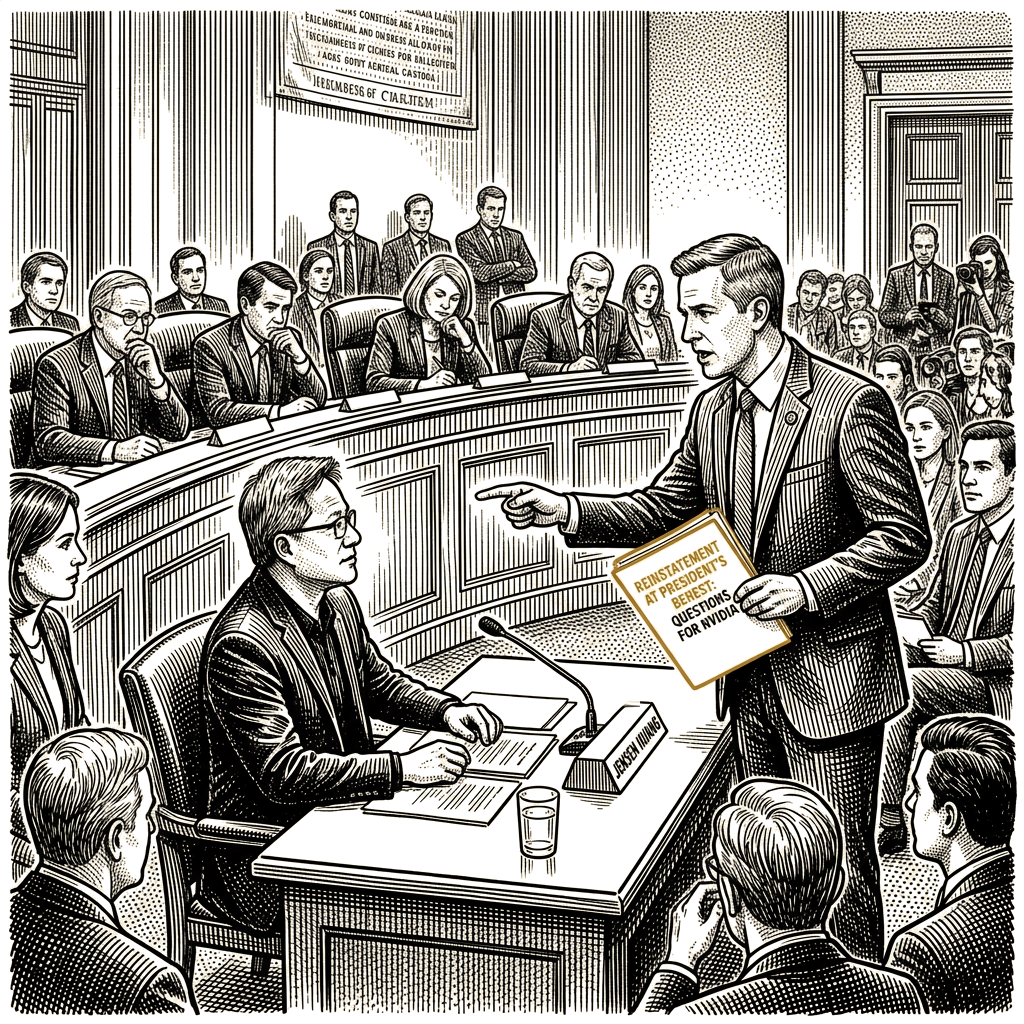
Huang expected at Senate hearing and one interview with three House committees
Members of Congress from both parties sharply criticized Nvidia’s board’s surprise decision on Monday to reinstate Jensen Huang as chief executive at President Donald Trump’s behest. Trump said the board did “what we wanted them to do.” Lawmakers also questioned Nvidia’s comment that the U.S. had said there was no security risk, placing the administration’s role and potential national-security lapses at the center of a new phase of congressional scrutiny.
Outgoing Republican Sen. Tim Scott, the chairman of the Senate Banking Committee, announced that Huang will testify publicly before the panel on Dec. 3. Democratic Sen. Elizabeth Warren, the incoming chair, said the Trump administration needs to explain what role U.S. officials played in what she called a “reckless” decision. Huang is also expected to sit for one interview with three House committees next week, along with his public hearing before the Senate panel.
Rep. Robert Garcia of California, the incoming chairman of the House oversight committee, said Trump’s direct involvement with Nvidia’s decision-making “raises serious national security and corruption questions.” Garcia added, “We must investigate these actions.” Rep. Jim Himes of Connecticut, who is expected to become chairman of the House Intelligence Committee, said Huang’s reinstatement does not change his expected testimony on Capitol Hill. Himes said in a statement: “Though the NVIDIA Board of Directors may be convinced that reinstating Mr. Huang ‘poses no national security risk,’ the Congress still has questions that require answers.”
Nvidia was already facing sharp congressional scrutiny after Huang acknowledged a relationship with a Chinese businesswoman whom U.S. officials believed to be a spy. The reinstatement sharpened questions about the administration’s role in a company central to the AI economy. Democrats are mounting investigations into the Trump administration, particularly Commerce Secretary Howard Lutnick, who has close ties with Nvidia. Treasury Secretary Scott Bessent earlier this month said he was frustrated by the Commerce Department’s delay in placing restrictions on Nvidia chip exports to Megaspeed, the company whose CEO, Alice Huang, was involved with Jensen Huang.
Nvidia is among the world’s most valuable publicly traded companies and is central to the AI economy. Lawmakers are asking whether the company has been selling chips to China in violation of U.S. export controls intended to protect certain technology at the core of the AI race. Earlier this year, members of Congress urged the Commerce Department to “suspend or reconsider” Nvidia’s export licenses to China and to conduct a full national security review, according to a release earlier this month from Warren and Sen. Jim Banks of Indiana, a key Republican on the Senate Banking Committee.
In a November statement, Warren and Banks wrote: “Since then, NVIDIA has reportedly received approvals to export hundreds of thousands of advanced AI chips to China, including to companies tied to China’s military, all while attempting to influence the debate over chip controls in Washington, D.C.” The senators also said Nvidia CEO Jensen Huang’s confirmation of a relationship with a suspected spy for China’s intelligence service made the national-security concerns more urgent and raised important questions Nvidia had to answer.
While senior Republican lawmakers were mostly quiet on Huang’s return to Nvidia, several Republicans — particularly those leaving Congress — spoke more forcefully Monday. Texas Sen. John Cornyn, who lost his seat after Trump endorsed his Republican primary opponent, questioned Nvidia’s comment that the U.S. said there was no security risk. “No national security risk? Based on what?” Cornyn posted. He asked on X whether the FBI had done a defensive briefing of Huang to conclude there was no risk. “If not, why not?” Cornyn asked.
Nebraska Rep. Don Bacon, who is retiring from Congress, wrote on social media that the U.S. cannot say it wants to win the AI competition and then give China its best technology. “Congress needs to get to the bottom of who approved high end computer chips sales to China,” Bacon wrote. Republican Rep. Bill Huizenga of Michigan, who lost reelection to a Democrat, posted ahead of the announcement but after Trump’s call for Huang’s reinstatement: “Ummm… she was, and is, a spy. How about we get serious about making sure China doesn’t steal US company technology?”
Utah Sen. John Curtis asked similar questions. “Who in our government weighed in? What did they tell the board?” Curtis asked. “And on what basis did the board conclude there was no risk?”
Democrats are preparing to examine national security and political corruption in Washington more deeply as they take over the committee gavels in January. Delaware Sen. Chris Coons, who is poised to become chairman of the Senate Foreign Relations Committee when Democrats take the majority, posted: “The guy who was having an affair with a Chinese spy while working relentlessly to help China get access to as many AI chips as possible? Really?”
Arizona Sen. Ruben Gallego, a Democrat, said Congress should investigate “what stock positions took place before the announcement.” Oregon Sen. Ron Wyden, who will chair the Senate finance committee and serves on the Senate intelligence committee, said Huang’s reinstatement showed that under Trump and his administration, “our national security is for sale.” “In January, Democrats will hold this corrupt administration accountable,” Wyden said.