Roth: Myanmar judgment forecloses displacement or insurgency defense in Gaza
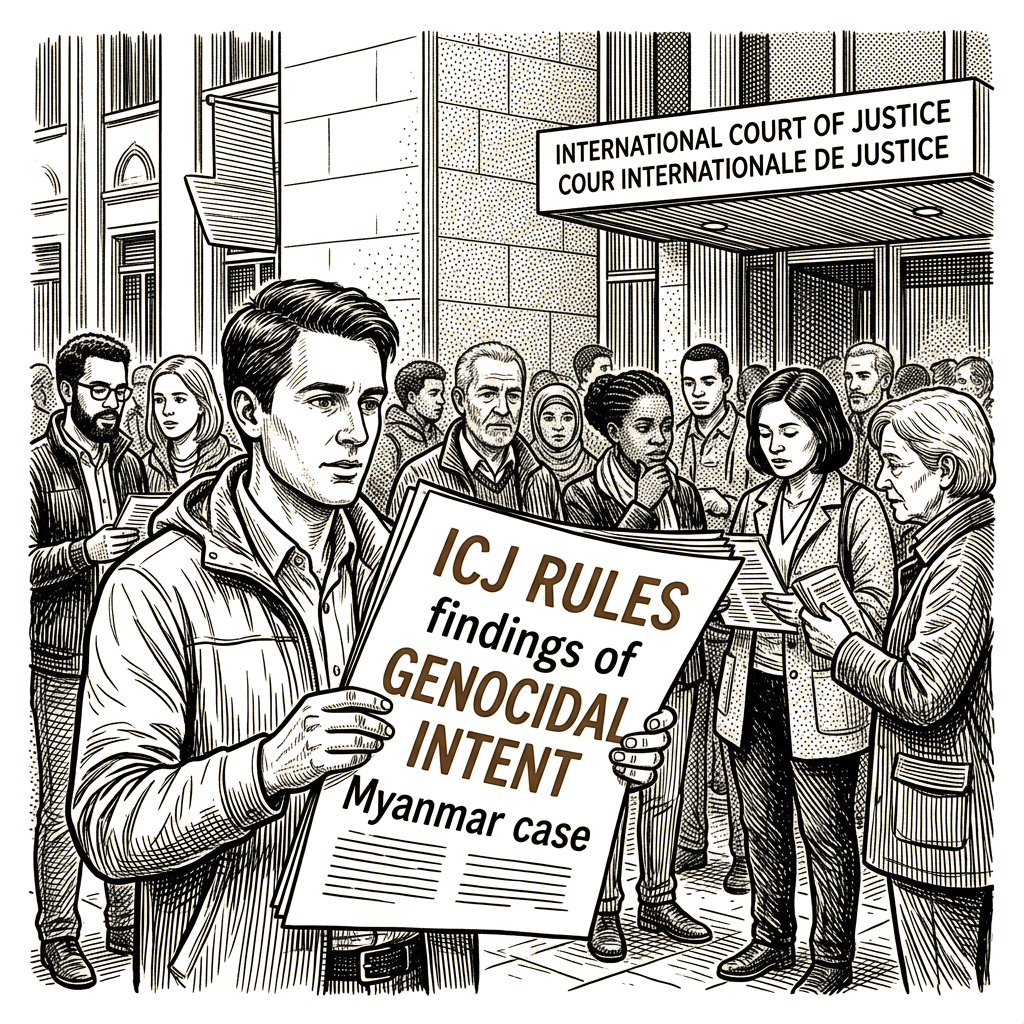
Last Thursday, the International Court of Justice found that Myanmar committed genocide against the Rohingya. By a vote of nine to six, the court said genocidal intent may exist alongside other intentions, provided those intentions are not incompatible with genocidal intent. Kenneth Roth, a Guardian US columnist, a senior fellow at Yale University, a former executive director of Human Rights Watch and the author of Righting Wrongs: Three Decades on the Front Lines Battling Abusive Governments, wrote that the judgment forecloses the argument that forced displacement or an insurgency can negate genocidal intent in South Africa’s genocide case against Israel over Gaza.
Roth described the Rohingya as one of the world’s most persecuted minorities and said the ruling recognized their plight. He also wrote that the ruling resonates in Gaza, where the same court is now more likely to find that Israel committed genocide against Palestinians. Roth wrote that this possibility had incensed the Donald Trump administration and urged it to “think twice before attacking another international tribunal.”
The intent standard the Myanmar court applied
The case turned on intent. Genocide is defined in a widely ratified treaty as the intent to destroy a protected group — in the Myanmar case, a religious and ethnic minority — “in whole or in part.” Roth wrote that there was ample proof the Myanmar army committed systematic murder, torture, rape and arson against the Rohingya, but that the central question was whether those acts carried the required intent. Roth wrote: “In theory, genocidal intent can be proved by the statements of senior officials, but most are smart enough to use less incendiary language.” As a result, intent usually must be inferred from conduct.
In rulings on genocide cases brought by Bosnia and Croatia against Serbia in 2007 and 2015, the ICJ held that intent could be deduced from conduct when “the only reasonable inference to be drawn from that conduct is one of genocidal intent.” Roth said the language had suggested to some that genocidal intent could not be found to coexist with another intent. He wrote that the restrictive interpretation appeared built on genocides designed to kill a group “in whole,” pointing to the Holocaust and the genocide in Rwanda, where, after a certain point, the aim was to kill every possible Jew or Tutsi.
Roth asked what about genocide aimed at destroying a group “in part,” which can arise when genocide is not the sole goal of mass atrocities but a means to another end, such as ethnic cleansing. He wrote that, under that interpretation, the Serbia rulings would perversely suggest that mass forced displacement — a crime against humanity — could serve as a defense to allegations of genocidal intent, a result he called nonsensical.
Roth wrote that, in the Myanmar case, the court, by a vote of nine to six, interpreted the standard “more sensibly.” Citing general principles of criminal law, it ruled that dual intents were possible. “Genocidal intent may exist alongside other intentions, provided that such intentions are not incompatible with the existence of genocidal intent,” the court said. The “only reasonable inference” language, Roth explained, did not mean genocide had to be the sole intent; there must be no reasonable understanding of the evidence that disproves genocidal intent, even if a parallel intent also existed. Roth’s assessment was that the ICJ did not lower the standard and instead interpreted it in the most sensible way possible to ensure that the commission of parallel mass atrocities could not become a defense to genocide.
Myanmar’s counterinsurgency and displacement claims
The case stems from the Myanmar military’s 2017 “clearance operations.” Roth described the campaign as using murder, torture, rape and arson to kill at least 10,000 Rohingya and send more than 700,000 fleeing to neighboring Bangladesh. He described the Rohingya as a Muslim minority that had long faced severe discrimination in Myanmar, where the dominant Bamar ethnic group tends to be Buddhist and to have lighter skin.
Roth wrote that Myanmar has 135 recognized ethnic groups but does not recognize the Rohingya as a 136th, and that a 1982 law denied most Rohingya citizenship despite their deep roots in the country. He described Aung San Suu Kyi, awarded the Nobel peace prize in 1991 as an icon of her country’s quest for democracy, and wrote that she did not call the group Rohingya, preferring the term “Bengali” to suggest they were foreigners who had immigrated from Bangladesh. In 2019 she traveled to The Hague to defend the Myanmar military from the genocide charge.
Roth wrote that her actions reflected her fellow citizens’ vilification of the Rohingya. He also wrote: “She also evidently hoped that by ingratiating herself with the military, it might allow her to become president despite a constitutional ban because her husband and two sons are British.” Roth wrote that instead the military overthrew the country’s “fledgling democracy” in 2021 and has detained her since.
Myanmar told the court that its intent was not to commit genocide but to mount a counterinsurgency operation against a rebel group in the part of western Myanmar where most Rohingya lived. The court discounted that explanation because the army committed atrocities even in places where there was no insurgency and engaged in what it described as gratuitous atrocities, including raping women, killing children, burning villages and attacking fleeing civilians.
Myanmar also asked the court to consider the possibility, never admitted, that its aim was forced displacement rather than genocide. Roth noted that this paralleled the ICJ’s earlier finding, on the evidence against Serbia, that Serbia did not have genocidal intent. In the Myanmar case, the court held that so long as the only reasonable inference from the evidence was that Myanmar intended genocide, it did not matter that the evidence also reasonably supported the conclusion that Myanmar sought to forcibly displace the Rohingya or to fight an insurgency. Genocide, in the court’s reading, can be a means to an end rather than only an end in itself.
Roth applies the ruling to Gaza
Like the Myanmar case, the genocide case brought by South Africa against Israel before the ICJ is likely to turn on the question of intent, Roth wrote. Comparing the Israeli army with its Myanmar counterpart, Roth wrote: “Similar to its Myanmar counterpart, the Israeli army gratuitously killed and harmed Palestinian civilians – indiscriminately bombing neighborhoods, attacking Hamas fighters knowing that there would be disproportionate civilian dead and wounded, shooting hungry Israelis as they ran for food, bombing housing blocks knowing many civilians remained inside, and creating conditions of starvation and deprivation that were incompatible with sustaining life.”
Roth wrote that the Israeli government did not attempt to kill all 2 million Palestinians in Gaza, only enough to persuade the rest to accept “voluntary emigration,” as an Israeli minister put it. He asked whether that attempted crime of mass forced deportation could undermine an inference from these atrocities of genocidal intent and whether Israel’s military campaign against Hamas — described as ruthless and indifferent to the requirements of international humanitarian law to spare civilians — could serve a comparable role in negating genocidal intent.
Roth said the original ICJ language in the Serbia cases had left open the possibility that this defense might work. “The Myanmar judgment makes clear it will not,” he wrote, adding: “The intent to commit genocide can coexist with the intent to forcibly displace or to fight an insurgency.” He suspected genocidal intent could be established in the Gaza case and said that if the only reasonable conclusion from the totality of the evidence was that Israel possessed genocidal intent, the ICJ would find that Israel, like Myanmar, committed genocide. That was Roth’s legal argument, not a court finding.
Roth wrote that, anticipating the ruling, Trump’s ambassador to the United Nations threatened the ICJ judges last month with sanctions akin to those imposed on judges of the International Criminal Court if they “were to lower the legal threshold for proving genocide.” The ICJ mainly resolves civil disputes between states, including how to apply the Genocide Convention, while the ICC prosecutes individuals.
The Biden administration had already found that Myanmar committed genocide against the Rohingya. Roth noted that the Trump administration, which has never repudiated that conclusion, said it was “examining” the ruling. Roth asked whether Trump, as he considered sanctions against another international court, wanted to be seen as defending the Myanmar military, which he described as brutal, terrorizing people across Myanmar and ruthlessly quashing their hopes for democracy.
Remedies and enforcement
The ICJ ordered Myanmar to take various remedial steps for the Rohingya, including reparations, restoration of citizenship, the possibility of safe return to the country and prosecution of offenders. The court has no power to enforce its ruling. Roth said that task falls to the UN Security Council, where action is likely to be stymied by China’s and Russia’s veto, and to other governments, whose pressure so far has been ineffective.
Roth wrote: “There was cheering among Rohingya in their refugee camps in Bangladesh.” He said the importance of the court’s acknowledgment of the group’s plight should not be minimized, and added that the ruling increases the odds that Palestinians in Gaza “will have their moment of recognition.”