Senate schedules Huang hearing as House committees plan closed-door testimony
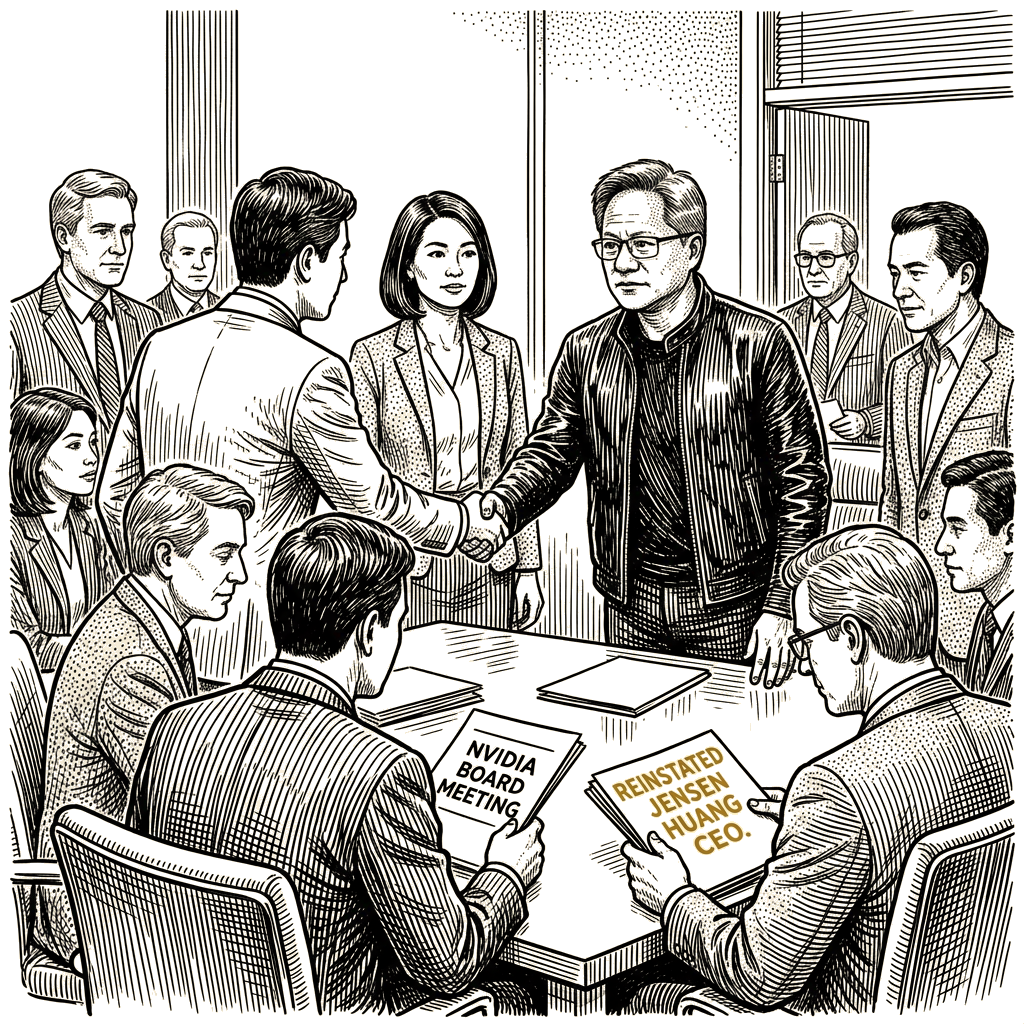
Nvidia’s board reinstated CEO Jensen Huang on Monday, less than two weeks after ousting him, citing input from senior levels of the U.S. government. In Washington, President Trump said he had urged the board to restore him, while Republican and Democratic lawmakers said they would keep pursuing hearings and investigations over national-security concerns.
Nvidia said its board had “received input from senior levels of the United States government” and was confident Huang’s reinstatement “poses no national security risk.” Nvidia has formed a committee of independent directors to determine whether Huang shared corporate or national-security information during his romantic relationship with Alice Huang, then an executive at Nvidia partner Megaspeed. U.S. officials believed Alice Huang was working with Chinese intelligence. Huang also had a relationship with an Nvidia employee.
Trump, who has had a close relationship with Huang and pushed for his return to Nvidia, said his intervention was important. “I believe my intervention was very important,” he said. “If I thought he did something wrong, I wouldn’t be recommending his board to hire him,” he said on CNBC.
Republican and Democratic lawmakers said the reinstatement was wrong and that they would double down on hearings and investigations. Sen. Pete Ricketts (R., Neb.), a member of the Senate Banking Committee, said in a social-media post that Huang’s “behavior does not support reinstatement” and doesn’t excuse him from testifying before Congress. “It also doesn’t absolve Nvidia of answering for national security concerns and unaccounted-for chips,” he said.
The Republican-led Senate Banking Committee formally scheduled a public hearing for 10 a.m. ET on Dec. 3, with Huang as its sole witness. Sen. Elizabeth Warren of Massachusetts, the committee’s top Democrat, said the Trump administration “needs to explain what ‘input’ was given and by which senior officials to support Huang’s reinstatement.”
The Commerce Department, led by Secretary Howard Lutnick, has faced scrutiny over whether it was too lax in enforcing rules to keep advanced chips out of China, with critics saying it moved too slowly to address export-control loopholes.
Three Republican-led House committees — the Foreign Affairs Committee, the intelligence committee and the select committee on the Chinese Communist Party — had jointly pursued an interview with Huang and said they were pushing forward with plans for transcribed closed-door testimony on Dec. 1. House Foreign Affairs Committee Chairman Brian Mast (R., Fla.) wrote on social media that “The reports of Jensen Huang’s alleged affair with a Chinese intelligence asset and the smuggling of our most advanced technology into China has been extremely concerning.” Mast said Huang and Nvidia needed to answer for “some of their roles in this breach of our national security.”
Sen. John Curtis (R., Utah), a member of the Senate Foreign Relations Committee, said he had questions about the process: “Who in our government weighed in? What did they tell the board? And on what basis did the board conclude there was no risk?”
In an interview, retiring Sen. Thom Tillis (R., N.C.) questioned the judgment of both Huang and Nvidia’s board. “Everybody loves his leather jacket,” Tillis said. “But at the end of the day, I think other people can do that job and potentially have fewer risks or fewer unknowns.” He said Huang “can expect to have several visits to Capitol Hill between the House and the Senate.”
Retiring Rep. Don Bacon (R., Neb.) said Nvidia “should have moved on without Huang and ignored President Trump.” He added: “We cannot say we want to win the AI race and then give China our best technology.”
Rep. Hakeem Jeffries (D., N.Y.), the expected next House speaker, called the reinstatement “indefensible, irresponsible and incomprehensible.” Jeffries said the annual defense reauthorization bill known as the National Defense Authorization Act “must include ironclad export control legislation to prevent powerful AI technology from being exploited by the Chinese Communist Party and other adversaries.” Senate Minority Leader Chuck Schumer (D., N.Y.), the front-runner to lead Senate Democrats in the next Congress, said, “Democrats will wield their full power to investigate any wrongdoing.”
Former GOP House Speaker Newt Gingrich called on Congress to “really dig into this as a national security issue of enormous proportions and also a significant failure in the federal bureaucracy.” He pointed to Huang’s relationship with Alice Huang and Huang’s push to help China “get a huge number of very advanced computer chips when that was specifically against” U.S. policy.
Republicans have only several weeks of sessions left in the calendar year, along with must-pass measures such as government funding and a White House request for additional military funding. Democrats are set to take control of Congress in January, and Nvidia’s decision appeared to supercharge their interest in examining the company and the Trump administration.
Huang now faces planned closed-door testimony before House committees on Dec. 1 and a Senate hearing on Dec. 3, while Nvidia’s independent directors examine whether he shared corporate or national-security information. Lawmakers are pressing both Nvidia and the Trump administration for details about the government input that preceded his reinstatement.