Rep.-elect Richard Ojeda pushes colleagues to record meetings with lobbyists
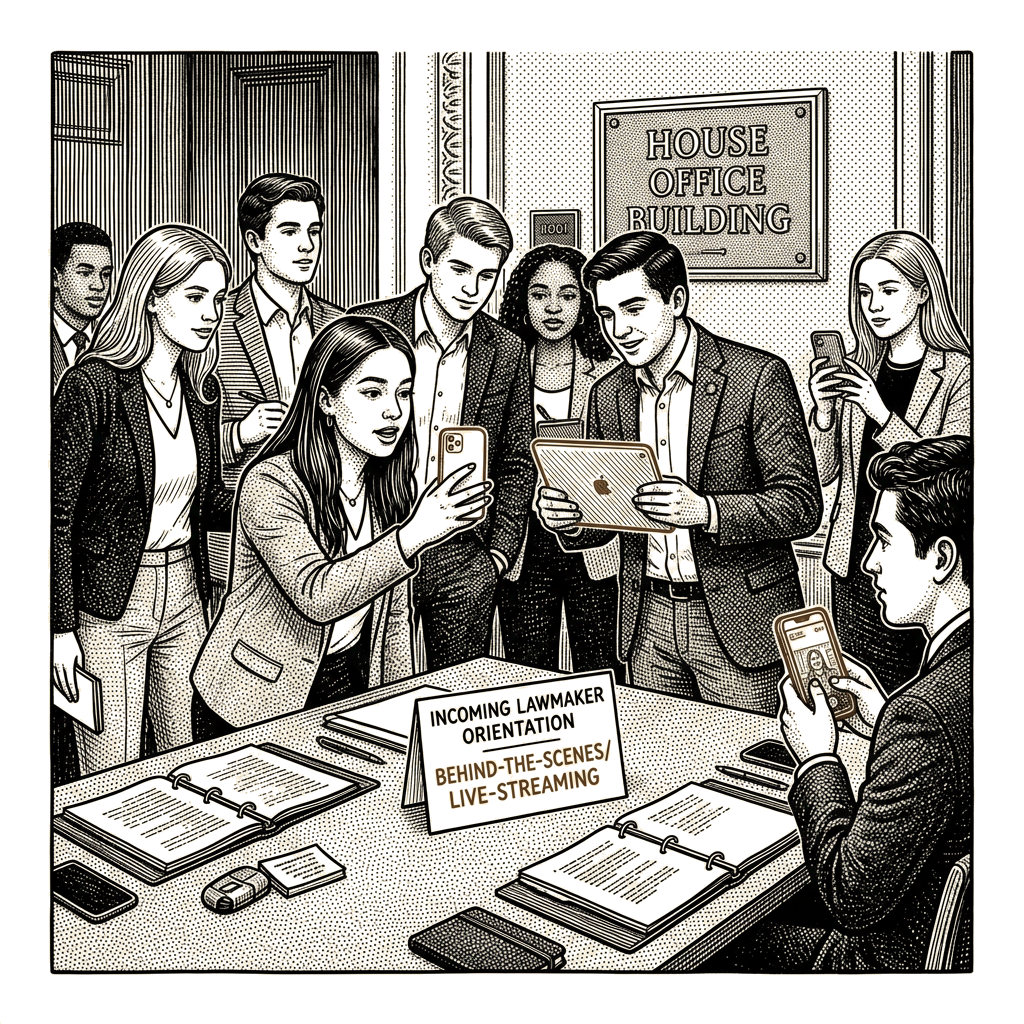
As more than a hundred incoming lawmakers moved through the unfamiliar network of tunnels and hallways beneath the Capitol for orientation this month, many had cameras trained on themselves, and The Wall Street Journal described the scene as a far cry from the clubby era of secret deals struck out of public view. An influx of millennial and Gen Z lawmakers is using social media to provide a behind-the-scenes look at Capitol Hill, and some incoming lawmakers are using online posts to show office lotteries, orientation activities and meetings with high-profile colleagues.
There will be more than 120 new members — mostly Democrats — in the House and Senate next year, the largest influx in decades. About 40% of the new House and Senate members are millennials, and a handful are from Gen Z, according to an analysis by Quorum Analytics based on election results as of earlier this month.
Politicians have increasingly used their phones to build their personal brands and give social-media followers a behind-the-scenes look at Capitol Hill, while also giving them a platform to challenge powerful — and often older — party leaders, according to The Wall Street Journal. The arrival of 30- and 40-somethings in the new Congress is supercharging those efforts, with newcomers working to shed light on once-arcane or secretive parts of the job.
Rep.-elect Dan Koh of Massachusetts, 41 years old, who had worked at the Huffington Post as Arianna Huffington’s chief of staff, put the case for openness this way. “I think the era of smoke-filled rooms and obscurity should be over in D.C.,” he said. “Bluntly, as someone who’s from maybe a different generation than some of my peers on the Hill, I think voters are hungry for transparency and hungry for information.”
Rep.-elect Rebecca Bennett of New Jersey, 39, has posted direct-to-camera video recaps about orientation, walking followers through activities such as her approach to staff-recruitment interviews and explaining why a desire for more space led her to choose an office in the Rayburn building. “We’ve got a lot of millennials in office now,” she said. “We did a lot of selfies. People are excited to get to work.” She said the goal is to “peel back the curtain on what actually goes on in Washington.”
Many Democratic freshmen are embracing a social-media-first approach to their first weeks, featuring meet-and-greets with other incoming members and showing off gas masks in safety training while fitting in various selfies in their new surroundings — a style pioneered by figures such as departing Rep. Lauren Boebert of Colorado.
Terri Towner, a political-science professor at Oakland University in Rochester, Mich., said new members are typically the most active social-media posters. “You are trying to establish yourself, you’re trying to introduce yourself to your audiences,” Towner said.
The most viral moments so far came from the lottery for offices, in which numbers are drawn out of a bin, much like a game show; the lower the number, the better. Incoming Republican Rep. Mark Teixeira, who represents a central Texas district between San Antonio and Austin, picked the worst number possible. “105,” he announced to the room, throwing his hands up in mock excitement as colleagues stood up, cheered and high-fived him, according to a video he posted online shortly afterward. Another video of Rep.-elect Manny Rutinel of Colorado went viral after he selected the number 69 and remarked, “Worked like a charm.”
Rep.-elect Richard Ojeda of North Carolina posted a compilation of pictures of him meeting and embracing high-profile colleagues such as Reps. Alexandria Ocasio-Cortez of New York, Maxine Waters of California and Jamie Raskin of Maryland. Ojeda said his work to put himself in front of voters was key to his upset of Rep. Richard Hudson, the departing National Republican Congressional Committee chair. “You want to use every opportunity that you can to make sure that you get your voice out and that people get to see your face,” Ojeda said in an interview.
Now almost in office, Ojeda is pushing his colleagues to wear cameras when meeting with lobbyists for big business, and said he won’t accept such meetings unless the conversation can be heard by his constituents. The Wall Street Journal characterizes the demand as one for radical transparency.
Democrat Jake Johnson, 43, posted a video from in front of the Capitol building. “Feels a lot like the first week of school,” he said in the video. He is ahead by about 300 votes in his race in Minnesota, which hasn’t been called.
None of the incoming members has taken office yet, and the class’s online activity is uneven: the far smaller group of incoming Republicans has posted more restrained accounts than their Democratic colleagues, and at least one race among the most active posters — Johnson’s in Minnesota — remains uncalled. The lawmakers who have explained their approach point to two things: that voters are hungry for transparency and information, and that a new member has to introduce himself or herself to an audience.
MSI previously reported that more than 100 newly elected members arrived in Washington for freshman orientation, and that the incoming Democratic freshmen opened orientation focused on costs and investigations. This story follows that same orientation period from a different angle, documenting the office lotteries, meet-and-greets and direct-to-camera videos that have made the class’s first weeks visible to the public. As covered in Freshman Democrats open orientation focused on costs and investigations and More than 100 new lawmakers arrive for freshman orientation, the class’s arrival and its stated agenda were documented earlier; what is new here is the scale of the social-media disclosure that has followed.