Federal police cocaine seizures in the Amazon rose to 28% in 2024
The motorized canoe pushed off the bank below Tabatinga, its crew of soldiers scanning the Solimões River with rifles at the ready. A suspicious passenger ferry was approaching, and only days earlier troops on that stretch of river had found several kilograms of cocaine stuffed inside life jackets aboard a similar vessel. Shouts pierced the humid night air — “Over here! Quick!” — as another patrol boat intercepted a pair of illegal fishermen carrying thousands of dollars’ worth of glistening pirarucu, a strictly protected Amazonian fish, gutted at their bare feet.
When the passenger ferry finally arrived, the squad stormed aboard with a sniffer dog, darting through a maze of colorful hammocks strung between the overhead beams. The boat was clean, and the soldiers said fishermen must already have tipped off gang members upriver about their checkpoint.
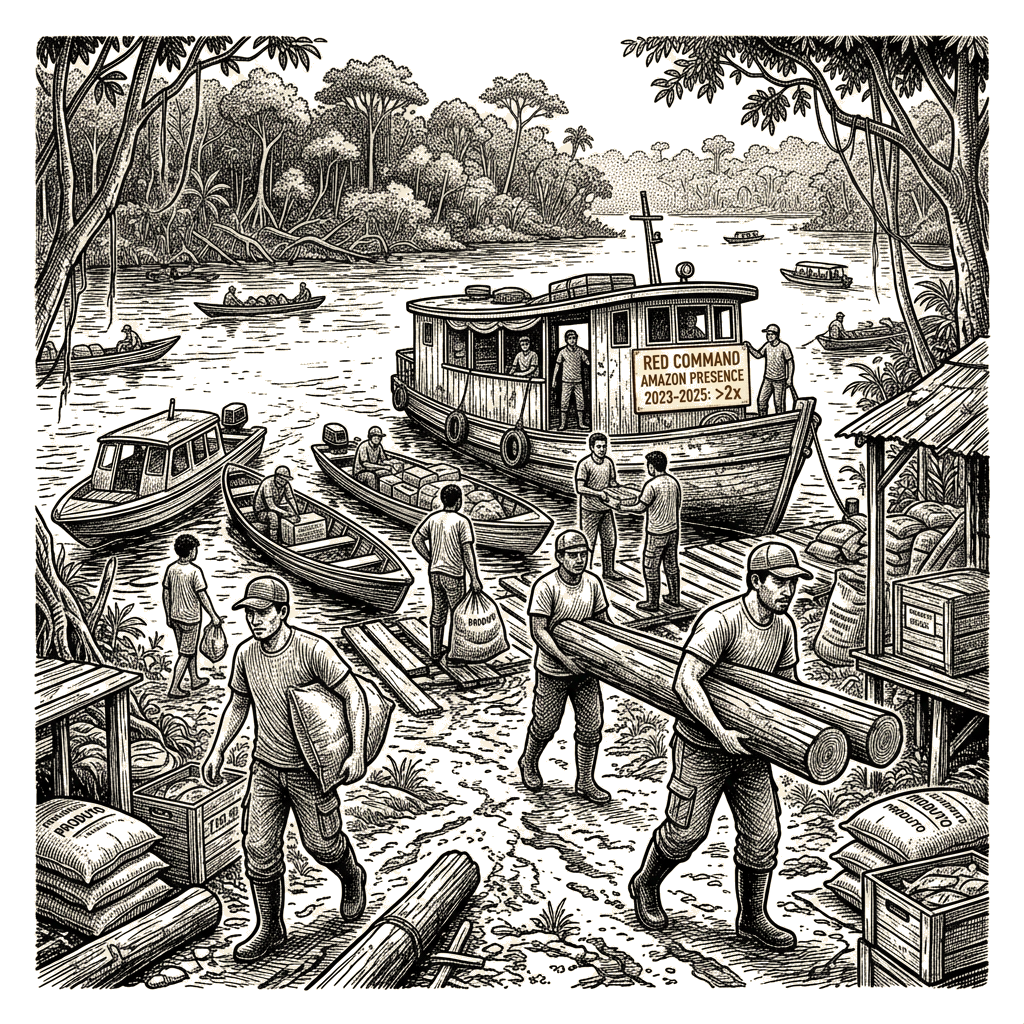
The activity in Tabatinga reflects a broader shift across the region. The Red Command, one of Latin America’s most powerful criminal organizations, more than doubled its reach across the Brazilian Amazon in just two years, holding a presence in 286 municipalities in 2025 and ranking as the dominant criminal group in 202 of them, according to the Brazilian Forum on Public Security, a nongovernmental research group, in data compiled with the Instituto Mãe Crioula (2025).
Enforcement figures show the same shift. In 2019, just 11% of the cocaine seized by Brazilian federal police was found in the Amazon; by 2024, that figure had risen to 28%. Organized crime has expanded into remote territories around the world — jungles, borderlands, deserts and stretches of open ocean — using geography and weak institutions to build businesses in drugs, illegal mining, logging and human smuggling, and the Amazon is among the most consequential of those spaces because cocaine from Colombia, Peru and Bolivia flows through jungle waterways east across Brazil to Atlantic ports that serve as gateways to Europe, Asia and Africa. The same waterways carry illegal gold and the timber of ancient, virgin forests, and the region’s criminal groups have extended their reach across vast stretches of wilderness where the government has little presence.
“The Amazon basin has become one of the world’s most significant criminal economic frontiers,” said Robert Muggah, head of the Igarapé Institute, a Rio de Janeiro-based policy group that studies crime. Muggah estimated that more than 30 armed groups now compete for territory across the region, with Brazilian gangs among the most powerful.
The Red Command grew out of a prison on a tropical island off Rio de Janeiro in the 1970s, when Brazil’s military dictatorship locked up leftist militants alongside bank robbers. With an estimated 20,000 to 30,000 members and operations stretching beyond Brazil into neighboring countries, the Red Command is the second-largest criminal organization in the Americas, according to the Igarapé Institute, surpassed only by its great rival, the First Capital Command, or PCC. Combating the Red Command is hard enough in its birthplace and stronghold, Rio de Janeiro, and the vastness of the Amazon makes it nearly impossible at times, authorities say. Moving closer to cocaine producers has allowed Brazilian gangs to muscle out middlemen and capture a greater share of the profits, while satellite internet services such as Starlink have made it easier to operate deep in the jungle. The Wall Street Journal noted that while President Trump has focused on securing U.S. borders and cracking down on Mexican cartels, Brazilian crime syndicates have quietly expanded across South America, forging ties with Colombian militants and drug gangs in Peru, Bolivia and Paraguay.
In Tabatinga, a border city where the Brazilian army maintains a battalion, the Red Command is in charge. “We are in the eye of the hurricane. There is every kind of crime happening here on the border,” said Lt. Col. Rodrigo Pedroso, commander of the Brazilian army battalion in Tabatinga. “It all starts here.” Even the army, the most visible expression of state power there, admits its forces are stretched thin. On a recent mission to blow up a traffickers’ airstrip in the forest, troops became embroiled in a shootout after stumbling upon Spanish-speaking drug mules making their way through the undergrowth on foot. Soldiers wear balaclavas on patrol despite the humid, 90-degree heat, fearing that locals could identify them to gangs and put their families at risk of brutal retaliation.
There are no major highways in the border region, and rivers are often the only way to move people and goods. Pedroso’s unit polices a strategic chokepoint some 20 miles east of Tabatinga, where the Solimões narrows enough for troops to inspect passing boats. He said the position has been effective at containing the Red Command and has made it riskier for traffickers to move large shipments of cocaine toward Brazil’s Atlantic ports. The river works against that effort: flowing out of Peru past Tabatinga toward Manaus, where it meets the Rio Negro to form the Amazon River, the sediment-laden Solimões constantly shifts course, opening new channels through the forest, and new passages can appear overnight, allowing traffickers to slip past checkpoints before authorities know they exist. Army officials said the annual low-water season, around September and October, leaves many smaller waterways impassable and strands cocaine on the Peruvian side of the border, giving Brazilian forces a window to raid trafficking sites near the border from the air before the rains return and the rivers reopen.
Security forces here are chronically short of money and equipment. Brazil’s states shoulder most policing costs, leaving poorer states with fewer resources, even as the vast distances and difficult terrain make policing in the Amazon exceptionally expensive. In Amazonas, the largest of the nine states that make up Brazil’s Amazon region, some 11,000 police officers patrol an area equivalent to the size of Mongolia. Maj. Jonatas Soares, the military police chief in Tabatinga, said officers went a year without an armored boat to patrol the rivers against gangs carrying assault rifles. “The river was at the mercy of these guys,” Soares said. When a boat finally arrived, it was an aging hand-me-down already put to heavy use in Manaus, and in other parts of the forest police have resorted to chasing drug traffickers in wooden fishing boats.
Borders compound the problem for enforcement. Traffickers can slip between Brazil, Colombia and Peru and place themselves beyond the reach of authorities in any one country, and pursuing them across borders requires police to coordinate with foreign counterparts, a painfully slow process involving often-conflicting laws, bureaucracies and chains of command. One of the region’s most powerful Red Command leaders, known as “Lobo,” or Wolf, is believed to be hiding across the border in Peru, police say, where growing coca, the raw ingredient for cocaine, is legal. Environmental crime runs through the same channels. Brazil requires pirarucu, the protected fish, to be tagged when legally caught, but fishermen can claim untagged fish came from Colombia even when they were caught illegally yards away in Brazilian waters, and in parts of the border region even locals sometimes struggle to know which country they are in.
But even in the cities of the Amazon, police are struggling to maintain control in a region where criminal gangs call the shots. In Tabatinga, the letters CV — the Portuguese initials for Red Command — are scrawled across everything from houses to schools, and no one dares scrub them off. On a recent patrol through Vila Verde, one of the city’s most troubled neighborhoods, military police came upon a crowd of angry residents occupying an empty patch of land beside their homes. Police said gangs had used the lot to take captives and bury bodies, and residents had begun cordoning off plots and erecting makeshift homes to claim the land themselves. Officers fired into the air to clear the crowd. By the next day, the residents were back.
Soares says his officers are doing what they can, but the odds are stacked against them. “Where the state is absent, a parallel power takes over,” Soares said. “It’s the law of the jungle.”