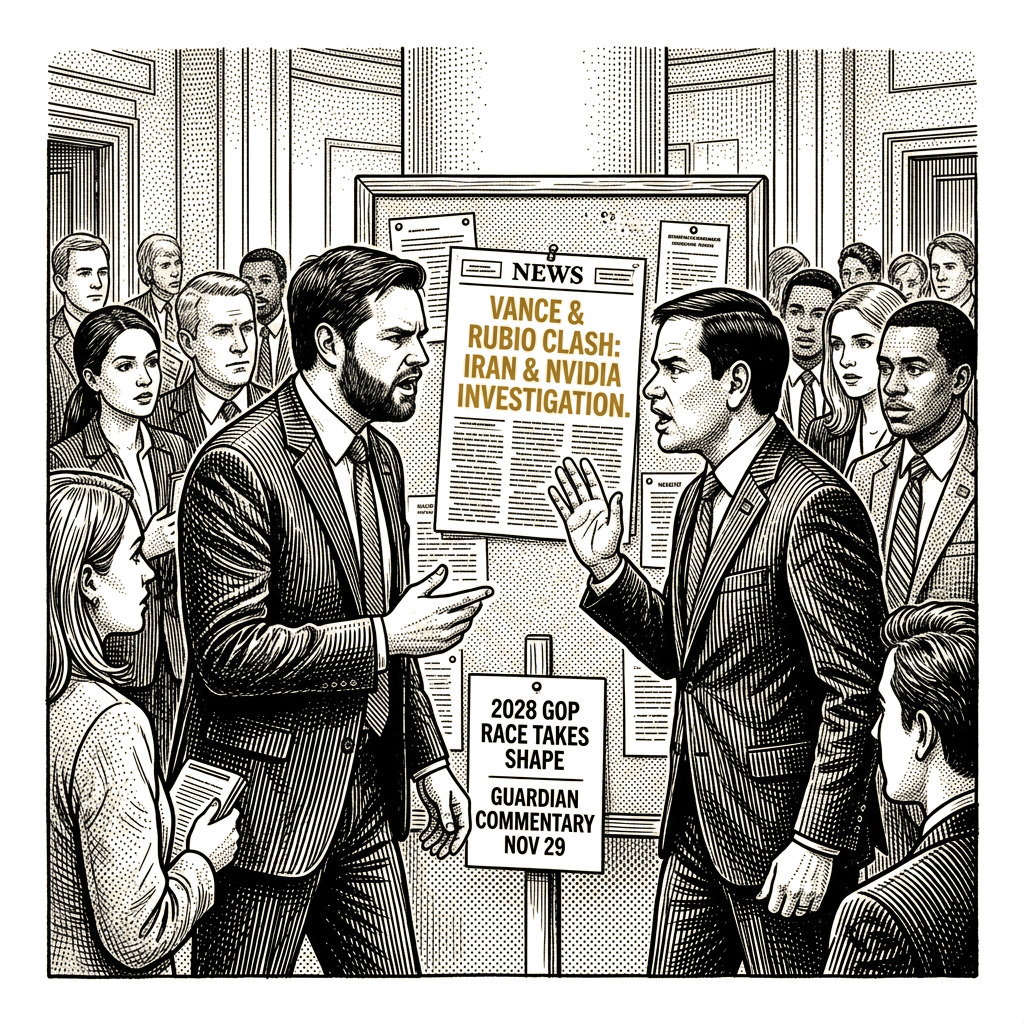
Their split may shape an emerging 2028 Republican presidential race
A Guardian commentary published November 29 presents Vice President JD Vance and Secretary of State Marco Rubio as the men most likely to fight for the 2028 Republican presidential nomination. Bloomfield says the contest remains unsettled because neither man is certain to run and both could wait until 2032. What has developed now is a concrete policy split: Republicans lost both the House and Senate in the November midterms, and the two men have taken opposing positions on the war in Iran and the spy case involving Nvidia executive Jensen Huang.
Bloomfield says the divide was visible throughout the first two years of Trump’s second term. He uses the February 2025 Oval Office meeting with Ukrainian President Volodymyr Zelenskyy, which he called an ambush, as his central illustration. In the columnist’s account, Vance gleefully berated Zelenskyy while Rubio sat mutely with his shoulders slumped. The scene illustrates what Bloomfield sees as the difference between a more isolationist Vance and a more interventionist Rubio.
During his pre-midterm tour, Vance tended to deliver the same stump speech in each state. Bloomfield said the speech emphasized that the economy was in better shape than the media claimed, Trump was a great leader and the Democrats were crazy, while leaving Iran unmentioned. Vance’s opposition to the war had not been secret in Washington, but he made it public the morning after the Republican defeat, writing, “the reason we lost is the war.”
Bloomfield interpreted the post-election statement as partly aimed at drawing a line between Vance and Trump, but chiefly at Rubio. Vance did not name the secretary of state. He wrote, “If you’d like to argue it was worth it, that losing the Senate for the next six years was worth it, then do so,” Vance wrote. “Argue it was a worthwhile cost to pay. Agree or disagree, that’s at least honest.” Bloomfield said the statement sounded like an argument Vance could deploy in a primary debate in Iowa in 12 months.
Bloomfield said Vance’s principal target was Rubio, who, along with Trump and Pete Hegseth, had become the public face of a conflict supported by just 30% of Americans. The columnist described Hegseth, styled “secretary of war,” as likely to face impeachment in January. Bloomfield also noted that Rubio had once called Trump a “conman” and mocked his lack of foreign-affairs knowledge, writing that any admission the Iran war was a disaster would itself represent a major U-turn for Rubio.
Rubio’s role in the second dispute centers on allegations involving Jensen Huang. Rubio raised the alarm that the Nvidia chief was having an affair with someone suspected of being a Chinese spy. He oversaw the drafting of a highly classified memo outlining the evidence and reportedly personally briefed President Donald Trump on Air Force One. The memo alleged that the suspected spy, Alice Huang, was a senior executive at a company buying Nvidia’s advanced AI chips and was illegally smuggling them into China.
Bloomfield said the explosive allegation eventually led to Jensen Huang’s resignation, a huge dip in the AI-fueled stock market and fears that China had been able to leap ahead in the race for AI supremacy.
Trump then personally intervened to ensure Huang returned to his post. Vance backed that decision, spoke to Huang by phone and lobbied the Nvidia board to take him back. Vance publicly dismissed the accusations against Huang as “based on anonymous reporting, not on actual evidence.” Bloomfield said Vance again did not name Rubio, but portrayed the intervention as a way to sharpen the contrast between the two men.
In Bloomfield’s assessment, Rubio’s foreign-policy record leans toward imperial expansion. The columnist said Rubio had consistently supported U.S. foreign-policy decisions, including the wars in Iraq and Iran, and had long opposed Vladimir Putin. Bloomfield also placed Rubio at the center of a revived Monroe Doctrine aimed at American control of the western hemisphere. Rubio oversaw the abolition of USAID, pulled funding from dozens of UN agencies and vowed to demolish the International Criminal Court “brick by brick.” In the same passage, Bloomfield warned that there was time before Trump leaves office for Vance and Rubio to oversee an invasion of Cuba.
Vance presents a different mix, according to Bloomfield. The columnist described him as more reluctant to use American military force but equally willing to engage in political interference abroad. Vance campaigned for Viktor Orbán, met with the Alternative für Deutschland and repeatedly supported Marine Le Pen. Bloomfield argued that a Vance victory could turn the global far-right revolution that some Trump allies had threatened into a reality, and described Vance as more organized and more ideological than Trump.
The race itself remains possible rather than settled. Bloomfield cited Trump’s low approval rating and said it would make more sense for both men to run in 2032, when they could face a struggling Democratic incumbent. If they do run, he wrote, the contest would be as much about U.S. conduct abroad as about domestic policy.
The disputes have nevertheless placed the candidates on clear sides of two consequential issues. Vance has publicly opposed the Iran war and dismissed the Huang allegations as unsupported, while Rubio has overseen the war and the memo that raised the spying claims. Bloomfield characterized both alternatives as dangerous in different ways and warned that a Republican succession moving either toward isolationism or toward imperial expansion could make MAGA 2.0 destabilizing for the rest of the world.