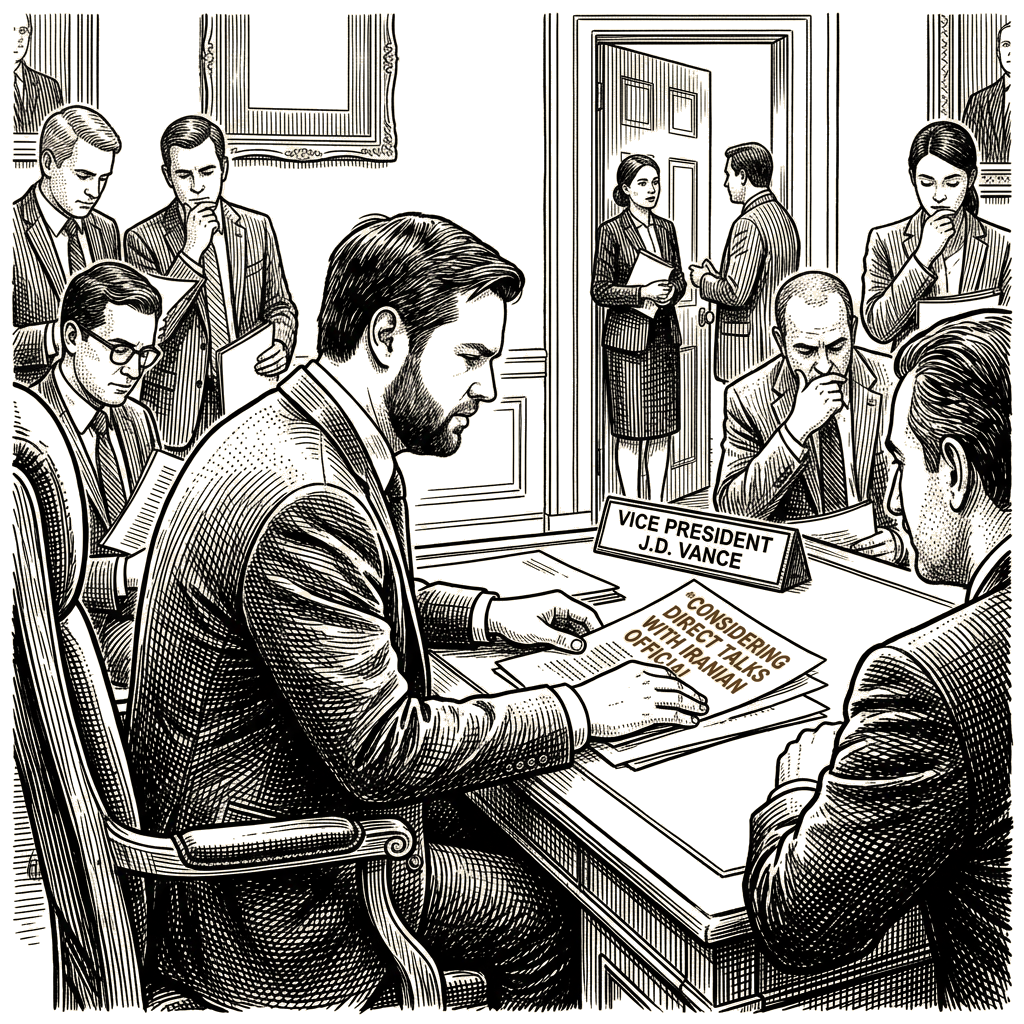
October letter asked Iran’s security chief Mohsen Rezaei for a meeting
Vice President JD Vance is considering face-to-face talks with a top Iranian security official as he emerges as the lead U.S. negotiator with Iran, U.S. and Middle East officials and people familiar with the negotiations said — an effort to end a war that officials described as a drag on the Republican Party.
President Trump told top aides and counterparts in recent days that he is open to Vance restarting talks with Iran and has empowered him to negotiate, U.S. and Middle Eastern officials said. U.S. officials stressed that discussions about sending Vance to meet directly with Iranian officials remain preliminary.
Vance sent a letter in October to Mohsen Rezaei, the hard-line secretary of Iran’s top security body, asking for a meeting. No date has been set, and the countries are talking through mediators and allies about what comes next. Such a meeting between the vice president and top Iranian security officials would be unusual and would show the lengths Vance is willing to go to try to end the war, officials and people familiar with the planning said.
Vance has taken a more active role in Iran diplomacy in recent weeks than special envoys Steve Witkoff and Jared Kushner, who are also negotiating to end the war between Russia and Ukraine, U.S. officials said. Positioning himself as the primary interlocutor with Iran is politically risky for Vance, some of those officials said: it could make him the face of another round of peace talks that ends in failure if Iran refuses significant concessions, or he could emerge as the victor who ended an unpopular conflict.
Trump in recent weeks has privately criticized the June memorandum of understanding that Vance helped negotiate and questioned whether it was a costly mistake, two officials said, arguing that it gave Iran critical time to regroup and rake in oil revenues before the U.S. imposed a naval blockade. A White House official denied that Trump had second thoughts about the memorandum and said the negotiators had operated in good faith. A spokesman for Vance declined to comment.
Within the White House, Vance has set himself apart by publicly blaming the war for Republicans’ midterm losses. Trump said he understood Vance’s position but would do it again. Other cabinet officials, including Secretary of State Marco Rubio and Defense Secretary Pete Hegseth, have defended the president’s decision to go to war, saying Trump had no other option to prevent Iran from acquiring nuclear weapons. Iran denies seeking an atomic bomb, though it holds a stockpile of highly enriched uranium. A White House official said only Trump knows what his next move on Iran will be.
Vance met with the Qatari prime minister on Monday morning, and the two later met with Trump and other White House officials in a meeting the president called excellent. Doha has been considered as a possible venue for the next phase of negotiations if Vance and Iranian officials agree to meet, people familiar with the discussions said.
Iran’s demands have complicated U.S. efforts to restart talks. Iranian officials see the midterm loss as an opportunity to drive a hard bargain, and they want the U.S. to lift the blockade, release frozen assets, and ease oil sanctions as a precondition for renewed talks, according to people familiar with their thinking. Rubio rejected the terms on Tuesday. “The Iranian demands are totally unrealistic. We expect that could change, and if it does, we’ll be prepared for diplomacy,” Rubio said.
Mediators have proposed immediate measures to build confidence between the two sides, Middle East officials said. They include the U.S. pulling back its aircraft carriers far enough to reduce the risk of major strikes and easing the blockade on Iranian ports. In exchange, Iran would allow 25 tankers to cross the Strait of Hormuz, the officials said.
Iranian diplomats are privately expressing doubt that a deal is within reach. They are concerned Trump may still attack to vindicate his previous decision to go to war, and they have noted that previous talks were halted by Israeli and U.S. strikes. Some Middle East mediators also remain skeptical that a deal can be reached in the coming days, citing more aggressive messages relayed to them via officials from Iran’s Islamic Revolutionary Guard Corps. Other Middle East officials worry that Ahmed Vahidi, the hard-line commander in chief of the Guard, holds more sway than the less hawkish Rezaei and could undermine any talks with the U.S.
Rezaei has escalated his own rhetoric in recent days as rumors of a possible meeting with Vance gained momentum, dismissing any negotiations as “imaginary talks” and insisting that Iran “won’t remove even a single particle of enriched nuclear material from the country.” Those remarks may help him maintain his position: conciliatory moves by Vance’s interlocutor during earlier talks in Islamabad — parliamentary speaker Mohammad Bagher Ghalibaf — led to Ghalibaf being sidelined.
Trump threatened strikes again on Monday afternoon from the White House, saying the U.S. was maintaining the status quo on the blockade but could still change course. “Iran, I hope we’re going to be able to make a deal with them,” Trump said, before adding that the U.S. was moving another aircraft carrier into the region and was “loaded up to the gills” if necessary.
Vance’s previous push for peace — talks with Iran in Switzerland in June — resulted in a pause in fighting and a memorandum of understanding, but secured no Iranian commitments to limit its nuclear program or relinquish its control over shipping through the Strait of Hormuz.
Within the administration, the debate over what comes next has shifted from whether to reignite the war to whether to restart peace talks or simply maintain the naval blockade and sanctions on Iran until its leaders are ready to make a viable peace deal. “At this point, the economic campaign and the pressure and the devastation that our economic campaign is having on the Iranian regime is working so well that the president really doesn’t have any need to conduct major combat operations,” Rubio told reporters Tuesday on the sidelines of a Group of Seven foreign ministers meeting in Paris. He added that the U.S. military remains ready to confront Iran if it crosses any red lines.
Rubio and new White House chief of staff Stephen Miller are supportive of maintaining the pressure campaign on Iran and waiting for Tehran to fold, two U.S. officials said.