Qatari mediators race to stave off a new American operation
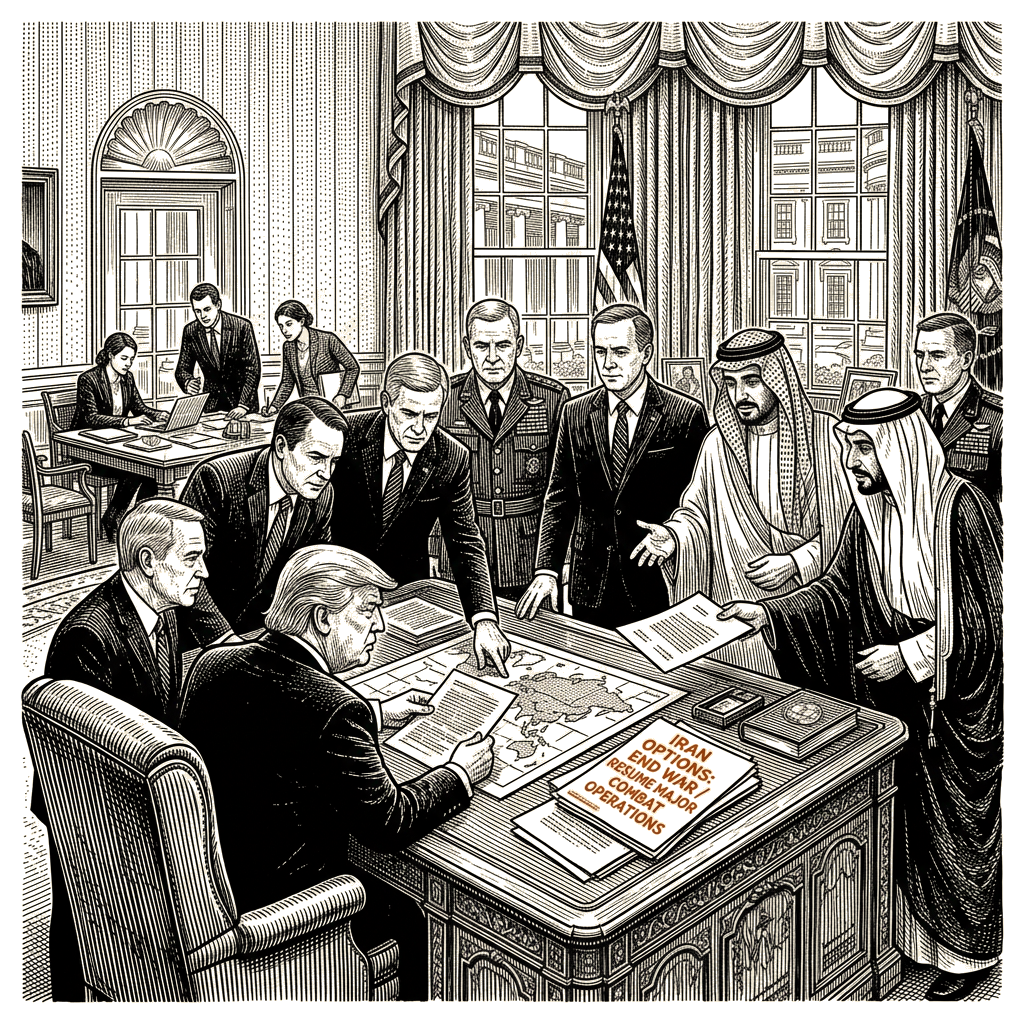
With the midterm elections behind him, President Trump’s advisers and foreign allies have been racing to shape his decision on whether to end the war with Iran or reignite it, U.S. officials said. Voters soundly repudiated the war at the ballot box, and Trump has toggled since Tuesday’s returns between dismissing the electoral rebuke and feeling chastened by it, officials said. He has yet to definitively signal what he will do, often expressing a desire for diplomacy and fresh attacks in the same breath.
The counsel is divided. Vice President JD Vance questioned whether the war was worthwhile on social media, and before that post told the president he intended to blame the Republican defeat on the war, U.S. officials said. Special envoy Steve Witkoff, like Vance, has sought Trump’s continued backing for diplomatic efforts to reach a deal that would end the war and reopen the Strait of Hormuz, officials said. Other outside advisers have called Trump with the message that it is time to end the war.
Defense Secretary Pete Hegseth and U.S. Central Command chief Adm. Brad Cooper, by contrast, have supported a return to major combat operations during recent briefings on military options, U.S. officials said. Several hawkish outside advisers have called Trump since Election Day to argue that his legacy depends on forcing Iran to surrender its nuclear program, which would let the president boast the political sacrifice was worth the cost, U.S. officials and another source familiar with the discussions said. Secretary of State Marco Rubio and Treasury Secretary Scott Bessent have advocated a middle course: tightening sanctions and continuing the blockade on Iranian trade, officials said.
Foreign allies are split as well. Israeli Prime Minister Benjamin Netanyahu is still pushing for renewed strikes, while Gulf allies are more skeptical. Qatari officials said Friday they had launched an 11th-hour attempt to stave off a new American operation and bridge the gaps between the two warring parties to open the Strait of Hormuz and lift the U.S. blockade. “Our mediators are working as we speak to avoid another wave of escalation in the region,” Qatari Prime Minister Sheikh Mohammed bin Abdulrahman al-Thani said at an event in Oxford, England.
Qatari ruler Sheikh Tamim bin Hamad al-Thani spoke with Trump on Friday, and Gulf officials said there were signs that both sides were looking for an off-ramp. Iranian officials are set to return to Doha in the coming days, possibly as early as Saturday, to discuss the prospective deal, the officials said. Gulf foreign ministers have been attempting to arrange either a call with Trump or a high-level meeting in Washington to make the case for a deal, people familiar with the discussions said.
The deal under discussion would shrink the timetable for preliminary talks from 60 days — the term of the June memorandum of understanding — to two days, to move almost immediately into nuclear negotiations, according to people familiar with the discussions. One of the people said the compressed timetable could give Trump a face-saving way to begin to wind down the war. It is unclear whether Iran would accept such a deal.
Trump signaled a decision is close. “Now we will make a decision,” he told reporters on Thursday. “I would rather not destroy the rest of the country if possible, but maybe I will have to. You’ll know soon enough.” Speaking to reporters this week, Trump said he had “no choice” but to suffer the political cost of targeting Iran’s nuclear program. “If I had to do it again, I’d have to do it again, because, long term, it’s the only answer,” he said. In the meantime, explosions were reported Friday evening on Qeshm Island in the Strait of Hormuz after what a U.S. official described as small-scale strikes — part of several such strikes in recent weeks that U.S. officials have cautioned don’t signal a return to full-scale combat operations.
The Pentagon, meanwhile, has spent weeks preparing for the alternative. Hegseth and Cooper have advised Trump that resuming attacks — this time targeting Iranian energy infrastructure, nuclear facilities and missile and drone arsenals — is the only way to make Iran surrender its nuclear material, U.S. officials said. If Trump heeds those advising him to “finish the job,” the Pentagon stands ready to execute his orders swiftly, U.S. officials said, though the ideal time frame to resume operations begins later this month, when additional equipment arrives in the Middle East.
The USS Theodore Roosevelt carrier strike group, armed with dozens of jet fighters, is steaming toward the region from the Pacific, according to a U.S. official. It will spend a few days in Singapore starting Friday for a port call and isn’t expected to arrive in the Middle East for at least another two weeks. An additional Marine expeditionary unit is expected to join roughly 20 other ships already operating in the region later this month, officials said. The U.S. has also moved a Patriot air-defense system to Israel, relocated personnel away from bases considered vulnerable to Iranian retaliation, and deployed additional ships, munitions and troops to the region.
Officials have told Trump that no course is without risk. Iran is threatening to expand its retaliation beyond the Middle East if attacked. But if Trump signals an intention to get out, Tehran could extract greater concessions in talks or push for a seizure of the Strait of Hormuz.
Analysts said each path carries a price. “The Democratic success in the midterms exacerbates the predicament facing the president,” said Suzanne Maloney, an Iran expert and foreign-policy vice president at the Brookings Institution. The options available to Trump “will likely only compound the strategic and economic price that Americans have already paid,” she said. Some experts say it isn’t clear that additional strikes would force Iran into a deal, especially after Iran’s government has survived eight months of war. Behnam Ben Taleblu, a senior fellow at the Foundation for Defense of Democracies think tank, said he thinks Trump should “hold the line,” allowing time for sanctions and the blockade to work. “I think the president at this moment in time does have a winning hand, and that winning hand will put the onus of escalation or engagement on the Islamic Republic,” he said. “The benefits of a conflict relative to how little Iran has been able to rebuild pale in comparison to the costs of a conflict that would be felt economically and politically,” Taleblu said.
A peace deal carries its own costs, said Gregory Brew, an Iran expert at the Eurasia Group consulting firm. If Trump pushes for a deal to end the war, he will likely find Iranian counterparts less willing to make the concessions he wants, Brew said. “Their price tag is considerable,” he said. Tehran aims for a return to the June memorandum of understanding, which allowed Iran to sell oil on the open market again, and to fully reopen the strait before any discussions about its nuclear program, Brew said. Maintaining the status quo of sanctions and the blockade could prove the path of least resistance, he added, “but it also means that Trump commits to continuing the war for the foreseeable future, with oil prices remaining high and Iranian attacks in the strait the new normal.”
Questions linger about how long Hegseth will stay in the Pentagon’s E-Ring and the Situation Room. White House officials and Republican lawmakers have begun pointing fingers at the defense secretary, The Wall Street Journal reported, blaming him for convincing Trump that the Iran war would be over in a few weeks. Trump says he maintains full faith in Hegseth, while Pentagon spokespeople say the secretary expects to be in his position through the remainder of the administration.
A White House official said Trump is in no hurry to make a decision as the Iranian economy sputters and oil flows through the Strait of Hormuz, and said the president will ultimately make the best decision for the U.S. A Pentagon official said the department’s job is to develop and execute military options for the president. While the president signals confidence, the conundrums presented by any of the three pathways and the continuing debate provide Trump with no clear upside. “What do you choose that is the least bad option?” asked Seth Jones, president of the Defense and Security Department at the Center for Strategic and International Studies think tank.