
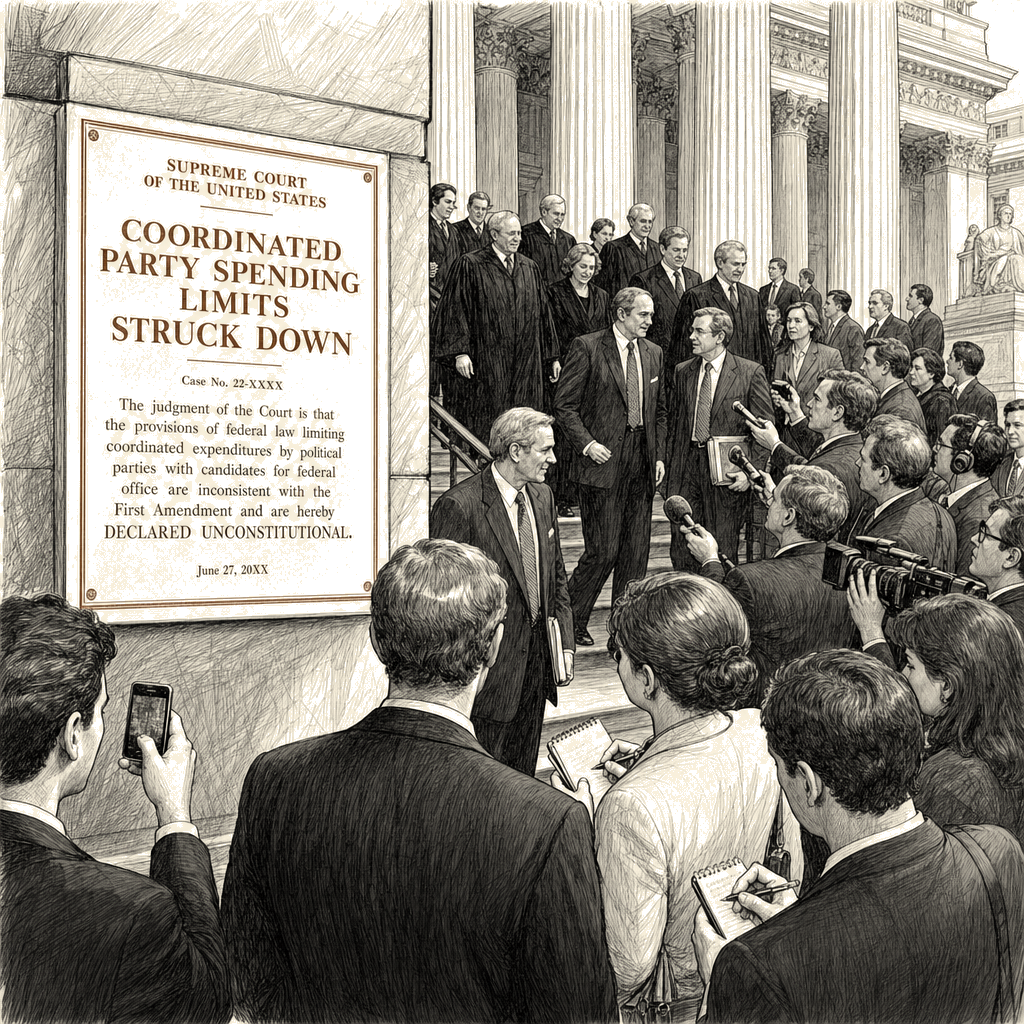
The Roberts Court gave political parties the unlimited right to buy their own candidates. The corruption doctrine the Court built over fifteen years cannot call this what it is.
The June 30 decision, written by Justice Kavanaugh for a 6-3 majority, struck down provisions of the Federal Election Campaign Act that limited how much parties could raise and how much they could spend in coordination with their candidates.
The strongest form of Kavanaugh’s argument runs through parties as associations of citizens exercising First Amendment rights. A political party, the majority reasons, is citizens banding together to amplify shared political voice; coordinated expenditures on the party’s own candidate are the paradigmatic form of associational speech. To call that corruption is to call the party system itself corrupt. The Republican challengers advanced this logic in its bluntest form: a party cannot corrupt its own candidates, because the very aim of a political party is to influence its candidates’ stance.
But this argument is a deliberate sleight of hand. The challengers ask the Court to accept a sanitized definition of “influence” while ignoring the material reality of how that influence is exercised. When the vehicle of influence is unlimited coordinated spending, the mechanism is no longer persuasion or shared ideology. It is financial leverage. To equate the donor-funded apparatus of a national party with a grassroots association of citizens, and to call the exercise of that leverage mere “influence,” is to willfully blind the Court to the transactional reality of modern elections. The empirical “absence of evidence” the majority cites for the absence of corruption is not an independent finding; it is the product of a definitional move that places coordinated party spending outside the category of transactions the Court will recognize as corrupt. The Court’s framework requires treating structural capture as speech, while treating the anti-corruption limits designed to prevent it as censorship.
This is the logical terminus of the regime the Court built over the last fifteen years. In Citizens United v. FEC, 558 U.S. 310 (2010), the Court narrowed the definition of corruption to quid pro quo arrangements, declaring that independent expenditures do not give rise to corruption—but it left the limits on parties’ coordinated spending intact, recognizing that a party’s direct control over a candidate poses a different structural threat. The 2001 decision in FEC v. Colorado Republican Federal Campaign Committee, 533 U.S. 431 (2001), upheld those post-Watergate limits; McConnell v. FEC, 540 U.S. 93 (2003), reaffirmed them.
The Roberts Court has now closed the loop. McCutcheon v. FEC, 572 U.S. 185 (2014), had already struck aggregate limits on individual contributions, holding that the only corruption interest capable of supporting contribution limits was the quid pro quo variety. Today’s decision applies the same framework to coordinated party expenditures and overrules Colorado Republican’s holding that FECA’s expenditure limits on parties survived First Amendment scrutiny. Parties get the best of both worlds: the unlimited fundraising capacity of a Super PAC and the direct, legally blessed coordination with the candidate that a Super PAC is denied.
A political party armed with unlimited coordinated funds is not an association of citizens. It is an institutional apparatus with the power to make or break a candidate’s electoral survival. The mechanism is concrete: a donor who has maxed out the base contribution limit to a party can now give additional funds designated for the party’s coordinated spending on a candidate, because the party faces no ceiling on the coordinated-expenditure side. When a party can drop tens of millions of dollars in coordinated advertising directly into a candidate’s race, the candidate does not merely share goals with the party. The candidate becomes a creature of the party establishment. And because the party establishment’s own war chest is now uncapped, that establishment is in turn entirely dependent on the mega-donors who fund the party committee. The causal chain is absolute: unlimited coordinated spending gives the party leadership the power of financial life and death over the candidate, while simultaneously making the party leadership dependent on the donor class. The candidate is no longer an independent agent appealing to voters, but a wholly owned subsidiary of the party apparatus, which is itself a wholly owned subsidiary of the party’s donor class.
Lawyers for the Democratic Party, who intervened in the case, warned that unlimited coordinated expenditures would fundamentally reshape the campaign finance regime. They are correct. An honest doctrinal application would treat coordinated party expenditures as functionally equivalent to the candidate spending the money herself—as the campaign-finance regulators of the 1970s did—and recognize that the party apparatus is an institutional actor capable of structural capture, not merely an aggregation of individual speakers protected by the First Amendment. That posture is foreclosed by the doctrine the Court has built. The individual-donor base limits and the disclosure requirements the Court has so far left intact are now the only remaining barriers to fully integrating party committees as unlimited coordinated-spending vehicles for individual donors. The doctrine is working as designed.
While the Roberts Court uses the Constitution to dismantle federal campaign finance limits, the pushback is migrating to the states, where lawmakers explore new approaches to limit corporate political spending and move to limit corporate campaign cash by redefining corporate powers. The federal courthouse doors are closed to anti-corruption rationales; the work of circumventing this regime must now happen where the Court has not yet preempted it.
The post-Watergate consensus that political parties should not be allowed to write unlimited checks to their own candidates is dead. The Roberts Court did not strike down a 1974 statute. It completed the architectural capture of the candidate by the party. The First Amendment now guarantees the unlimited right to buy them.