
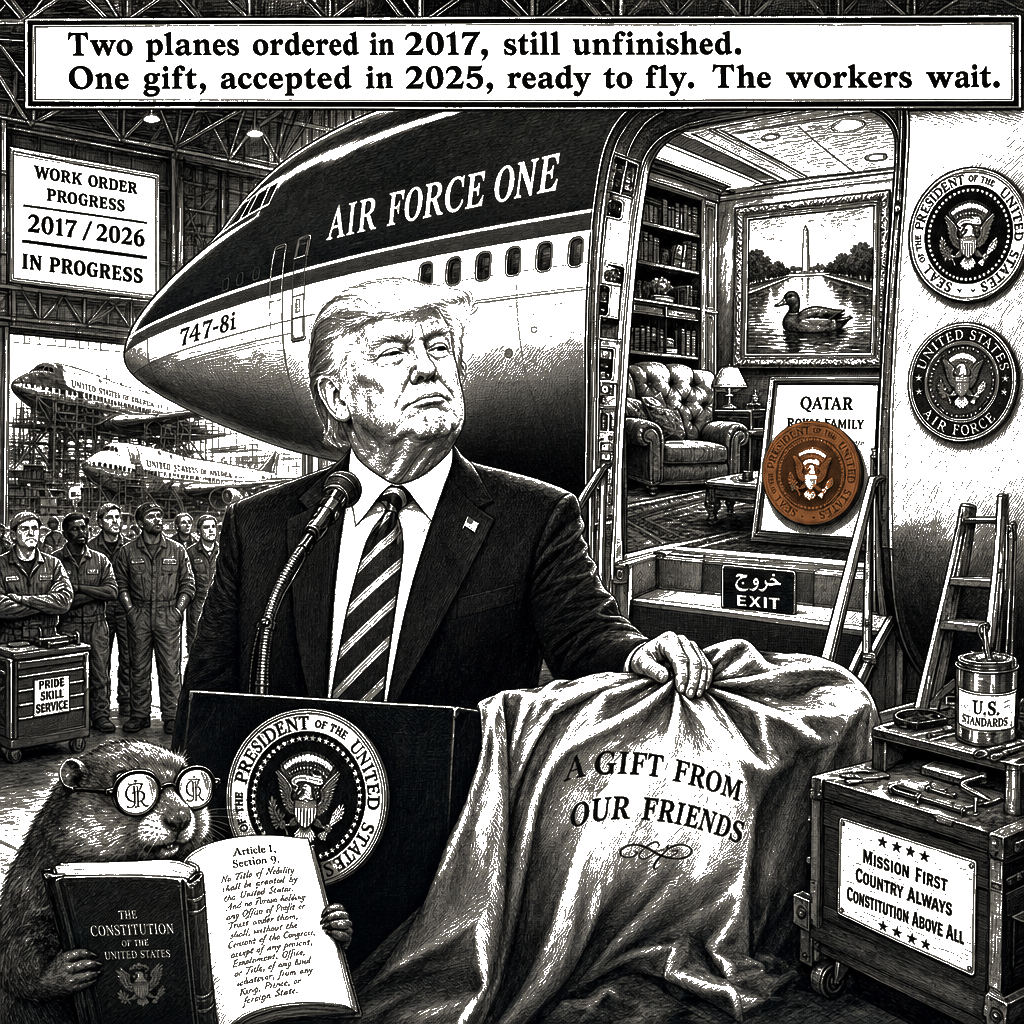
In my shop in Redemption Springs, when the supplier we’ve been paying for two years calls on a Friday afternoon to say the part is going to be six months late, I don’t thank him for the loaner. I fire him, I find another, and I make sure the other shops in town know what he pulled. That is how a working business handles a vendor who cannot deliver the goods. The United States government just did the opposite. The Boeing 747 presidential fleet replacement has been a decade-long disaster of burnt billions and missed deadlines. Boeing stopped manufacturing the 747 airframe entirely in 2023. There will never be another commercial 747 airframe built. So when the president needed a new Air Force One, instead of firing the supplier, the Pentagon went to a foreign monarchy and took its private jet.
That’s the headline. The story is the workers.
The two replacement 747s ordered in 2017 — the planes American voters were promised would be built and modified by American hands, in American facilities, under American law — are still unfinished and have never flown. The mechanics on the modification line, the avionics techs and communications contractors doing the work L3Harris got paid $400 million for, the flight-line crew chiefs at Joint Base Andrews keeping the current 747-200s in the air past their planned retirement — those are the people paying for the procurement failure. Their paychecks, their communities, the small machine shops that make the parts the prime won’t make in-house anymore, the depot workforce that was promised a new fleet to break in: they are the ones the operating-tempo logic of the defense apparatus has been squeezing for a decade. The Qatari jet is what shows up in the gap they leave.
Boeing is the boss. The Pentagon is the captured buyer, sitting across the table from a prime contractor that has been late, over budget, and structurally unwilling to deliver the most symbolic aircraft in the American fleet — and the flight-line workforce is the one left holding the bill. The country that runs the world’s largest air force has, for its most symbolic aircraft, a single physical platform it can never replace. To get a third plane, somebody would have to rebuild the production line from scratch, and nobody is going to do that for two airplanes. Sixty-five years ago Eisenhower warned the country to guard against the acquisition of unwarranted influence by the military-industrial complex. The Qatari jet is what that warning looks like when the supply chain collapses and the political class is still answering to the donor class.
The plane in question is a 747-8i that belonged to the Qatari royal family — one of fewer than four dozen such airframes on earth, and none of them available in the United States. Trump toured it at Palm Beach in February 2025, ownership transferred to the Air Force that spring, and last week they unveiled the retouched reality at Joint Base Andrews: red, white, navy, and gold paint of his personal jet, presidential seals on the bulkheads, Starlink terminals and L3Harris secure voice circuits, the plush leather couches left in place, the faux-library bookcases kept where they were, the Arabic exit signs and the contemporary Qatari art stripped out and replaced with a picture of a duck swimming in the Reflecting Pool. The Air Force spent $400 million retrofitting the thing. They built a $320 million hangar at Andrews just to house it. The hangar cost almost as much as the overhaul. The mission-over-aesthetics claim is a joke when the same Air Force left the couches and the bookcases and the donor’s handiwork inside the fuselage and only got around to affixing presidential seals to the walls.
Qatar is a host to the largest American air base in the Middle East, a buyer of F-15s and Patriot missiles, and now the donor of the president’s personal aircraft. The donor’s flag has been scrubbed from the exit signs and the contemporary art removed. The relationship has not been scrubbed. A gift of a 747-8i does not come without a price in influence, whether or not a specific quid pro quo can be litigated in any courtroom in the country.
The constitutional posture would require Congress to refuse this gift and to require the official replacement be accelerated, on a fixed timeline, with the depot work performed in the depots that were promised it. Instead the Senate and the House have watched a foreign government’s plane assume the call sign Air Force One and have done nothing. The Foreign Emoluments Clause was written for this moment, and the body supposed to enforce it is silent.
The men and women who maintain the aircraft on flight lines in conditions the political class will never see deserve a functional fleet, not a hand-me-down luxury liner with someone else’s monogram still in the carpet. The country’s 250th birthday celebration will feature a foreign gift flying over the National Mall while the two planes ordered to replace it sit on the modification line, the workforce paid to wait, the supplier un-fired. The only thing more unsettling than the gift itself is the silence of those who ought to be asking why.