
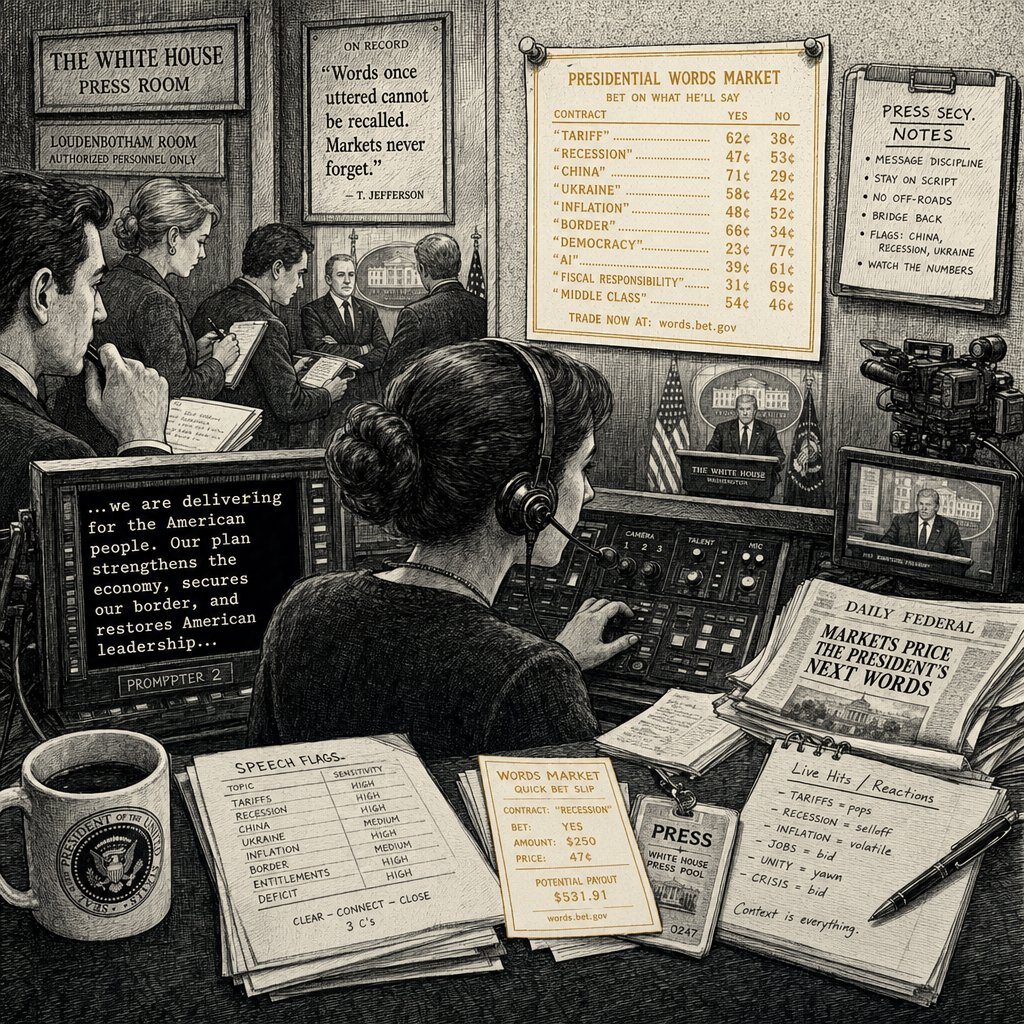
The man who loaded the president’s words onto the teleprompter was wagering on which words the president would say. Gabriel Perez — $175,000 a year, trusted since 2016 with the singular intimacy of knowing what Donald Trump would say before Donald Trump said it — opened an account on the prediction market Kalshi and began betting on “mention markets.” Would the president say “rigged election” tonight? Yes or no. “Hormuz”? Yes or no. “Fake news”? Yes or no. According to Bobby Allyn at NPR, Kalshi’s surveillance team flagged the unusual trading, found the accounts belonged to a federal employee, and referred the case to the Commodity Futures Trading Commission. He is alleged to have made nearly $100,000. He is on unpaid leave. About $90,000 are frozen. The White House press secretary called it “a disgrace.”
It is. But the disgrace reaches further than one man’s betting account.
There is a serious case for prediction markets, and I want to make it honestly before I show where it breaks. The theory — not a foolish one — is that markets aggregate dispersed knowledge better than any expert or regulator. When thousands of people wager real money on whether the president will say “Hormuz,” the resulting odds carry information no poll could surface. And when the system works, it works: Kalshi caught the trades, investigated, and referred them to the CFTC. The platform did what a self-policing market is supposed to do. I grant all of that.
I grant it because I used to trade agricultural futures, and I know how the machinery of abstraction functions — how it takes something real, something planted and harvested and eaten by people who will never see a screen, and converts it into a position for people who will never see a field. The futures market has a genuine economic purpose. So, in principle, does a prediction market. But the purpose depends on the integrity of the information, and the integrity of the information depends on whether the people who hold it still believe that some knowledge is a trust and not a trading position. When a man whose job is to know the president’s words before the president speaks them treats that knowledge as an edge in a betting market, something has broken that no algorithm can repair.
What has broken is the compact between public service and the public. Not the legal compact — there will be a settlement, there may be charges, the CFTC will do its work — but the older compact, the one that once held without needing to be written down: you do not convert the trust placed in you into private profit. The co-op I manage runs on this principle. One member, one vote. The surplus belongs to the members, not to the manager who happens to see the books first. The parish that built this county ran on it too — the priest heard everyone’s confession and profited from none of it. The principle is plain. What has changed is that we have built a financial architecture that treats the violation of that principle as an arbitrage opportunity and calls it innovation.
Perez was not stealing. He was not leaking classified state secrets to a foreign power. He was doing something more subtle and, in a way, more corrosive to the fabric of public trust: he was monetizing proximity. He was converting the knowledge that comes from sitting close to power — the knowledge of what the president will say before the president says it — into a market position. This is rentier extraction in its purest form. He produced nothing. He created nothing. He held a position — proximity to the words of the republic — and extracted rent from it. The teleprompter scroll was his asset. The prediction market was his ledger.
And he is not alone. In March, White House staff received a memo reviewed by NPR warning that betting on Kalshi or Polymarket with nonpublic information was a criminal offense and “will not be tolerated.” Two months later, a U.S. Army special forces soldier was charged with making $400,000 on Polymarket by betting on the Maduro raid with classified information. A month after that, a Google software engineer was charged with making $1.2 million by betting on search trends he had confidential access to. Former congressman George Santos was investigated for pumping up a Kalshi market by promising to attend the State of the Union, then cashing out when he didn’t show.
The queue grows longer, and each case reveals the same architecture: when you build a machine that converts information into money, the people closest to the information will find the machine. The prediction market did not create the dishonesty. It gave the dishonesty a market, a price, and a settlement mechanism. And it called the whole arrangement progress.
I want to name what is being lost here, because outrage is the easy register — the one the culture-war right uses to convert every breach into a dopamine hit — and I want no part of it. What is being lost is quieter than outrage and slower to notice. The teleprompter operator is a small figure in the architecture of democratic communication. He is not a senator or a general or a regulator. He is the man who makes sure the president’s words appear on the screen in the right order. And when even that man — that small, essential, largely invisible figure in the machinery of self-governance — treats his position as a trading edge, something has gone wrong in the marrow of the republic that a fine and a ban and a settlement cannot reach.
The president’s words about Perez at a 2024 campaign stop in Reno sit with me the way a splinter sits under the skin. “I have a guy, Gabe, he’s excellent. I’ve had some real bad ones, but I have Gabe, some of the bad ones, they go so fast. I will go and I say, slow the damn thing. No, a good one is really like gold.” The president was praising the competence of a man who would later be accused of monetizing the very competence being praised. The word “gold” carries a particular weight when the man in question was converting his proximity to those words into cash.
What happens to Perez now will be adjudicated by lawyers and regulators. The CFTC is in settlement talks. The Justice Department has not confirmed whether it is examining the case. He has not commented publicly. This is as it should be — due process, the rule of law, the system working at its own pace.
But the question that will not be settled by any settlement is whether the community around these markets — the platforms, the regulators, the White House, and the watching public — still possesses the moral conviction to say that some forms of extraction are a betrayal even when they are legal. Kalshi caught this one. The platform’s compliance team did its job. But the algorithm cannot supply the conviction. It can flag the pattern. It cannot name the wrong. That requires a culture that still knows the difference between a public trust and a private asset — between serving the republic and profiting from proximity to its words.
Prediction markets will get bigger. The money will grow. The insider access will grow with it. Every case like this one will be a test — not of the technology, which works, but of whether we are still capable of being grieved by the monetization of public trust, or whether we have traveled so far into the logic of extraction that we can no longer tell the difference between a servant and a speculator.
The president called his teleprompter operator gold. The co-op, the parish, the older republic — they had a different word for a man who converts the trust he was hired to protect into private gain. The distance between those two words is the distance this country has been quietly traveling for a long time. It would be good to start traveling back.