
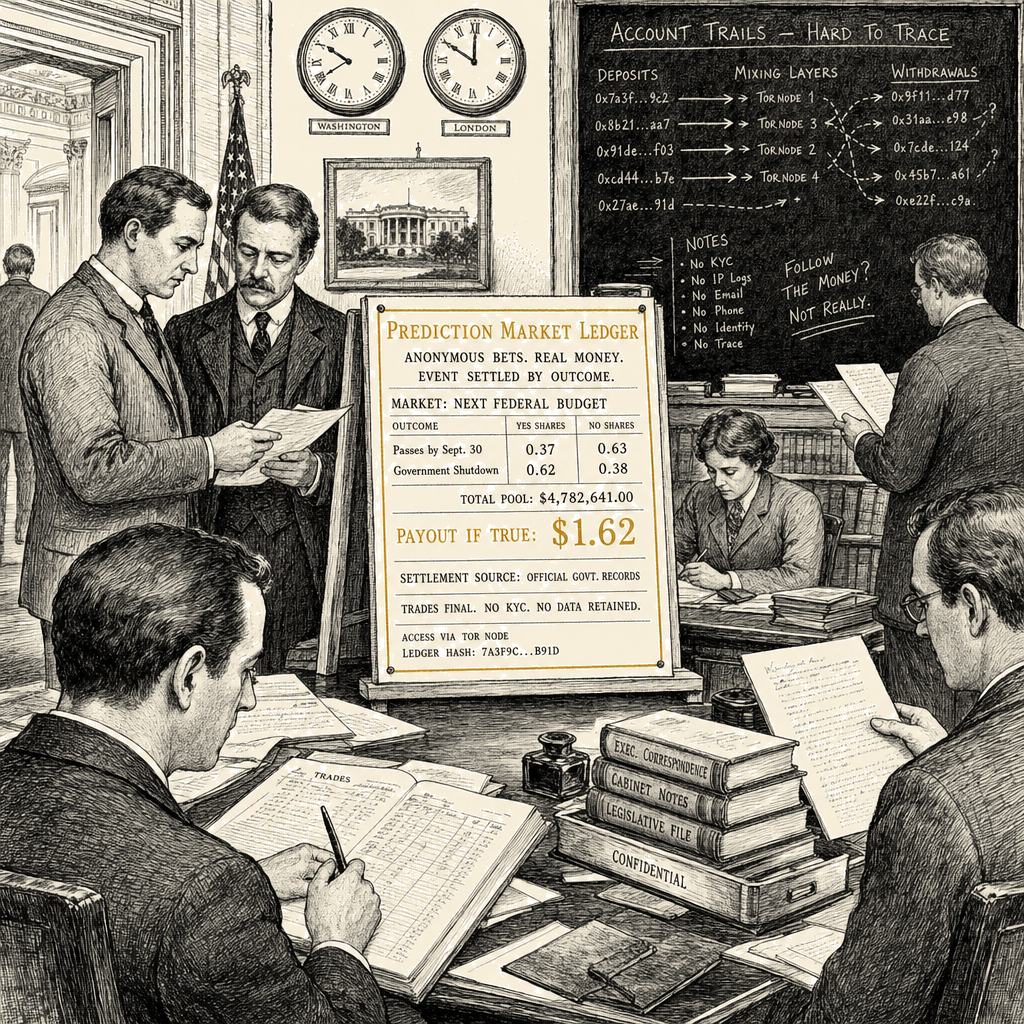
Gabriel Perez read the teleprompter before the President did, and bet a hundred thousand dollars on what came next. He is on unpaid leave. He has not been charged. The Commodity Futures Trading Commission is “investigating.” That is the system working exactly as designed.
The system is this: people with access to information trade on the information, and when the trading gets loud enough, somebody issues a statement. The statement says the conduct is “prohibited.” The statement does not name names. The names come out in the newspapers, three months later, after the bets have paid and the proceeds have been moved.
Mr. Perez is the fresh entry. The longer rap sheet is what the docket is for. There is Rep. Anna Paulina Luna of Florida, telling associates over lunch at the Stovall House — a Tampa members-only club — that she had tipped Rogan O’Handley, a MAGA personality known as “DC Draino,” to Donald Trump’s pending choice of J.D. Vance for vice president, so Mr. O’Handley could place a winning bet on Polymarket. There is Mark Moran, a former investment banker, who put $900 on Vance after Jake Denton — then a research associate at the Heritage Foundation, now a White House policy adviser — told him over cocktails at L’Annexe in Georgetown. There are the three anonymous Polymarket accounts that took home over $600,000 correctly betting on the April ceasefire with Iran. There is a White House that circulated a late-March memo warning staff not to use nonpublic information for personal gain, and then declined for days to acknowledge that its own teleprompter operator had done exactly that.
The marble-hall touts are multiplying. The platforms that book their bets are multiplying faster. Polymarket handled just over $4 billion in political wagers in the first quarter of this year, double the year before. Election-related bets account for over $325 million of that. Kalshi has blocked “dozens” of campaign staffers from betting on their own candidates, which is the company telling on itself.
These are not reporters, not analysts, not the old-fashioned corporate insider with a tipsheet and a shoe phone. They are a new class at the intersection of access and arbitrage. They work in the White House, on K Street, in the Heritage Foundation’s research department, in the office of a Florida congresswoman, or — in the case of Mr. Denton — they used to, and now they work in the White House too. They are paid salaries by institutions that exist for other reasons. The betting is the side hustle. The access is the asset. The bet is the asset class.
The STOCK Act passed in 2012 on a 60 Minutes segment about lawmakers trading on committee intelligence. The platforms did not exist. The first Kalshi party had not been poured. Tony Hanagan worked the room at the beer garden next to Nationals Park in June with an open bar and a lobbying registration filed three days prior. The Senate’s one-year cooling-off rule meant he could not lobby the Senate. The House was fair game. The bar tab crossed a thousand dollars an hour in. The investigations get opened. The platforms were free to grow. That is the gap.
When the laws were inadequate, the loudest complaint was that the inadequate laws were too harsh. When the laws finally caught up to the old crime, the loudest complaint was that the new laws were excessive. The new crime is the space between inadequate and caught-up, and that space is where Washington now does its business. A President’s teleprompter operator made six figures betting on the President’s words. A congresswoman is alleged, in print, to have told a man at lunch what the nominee would be, so the man could make money on it. A think-tank fellow’s friend made $600 on the same race and then ran for Senate. The platforms made their numbers. The lobbyists got registered. The investigations got opened. The investigations will go the way investigations go when the targets are people who lunch on K Street.
The smallest, hardest fact is the statement. Rep. Luna issued a statement saying she was “honored the WSJ thinks I am telepathic but unfortunately I am not,” and that she would “continue to champion the fight against insider trading.” The congresswoman is not telepathic. The congresswoman is alleged, by people familiar with her own conversations at a Tampa members-only club, to have told a man what the nominee would be, so the man could make money on it. The fight against insider trading will continue. The teleprompter will continue to be read by Gabriel Perez. The bets will continue to be placed. The investigations will continue to be opened. The conduct, as the lawyers say, is prohibited. The conduct, as the apps say, is open for business.
Don’t change the subject. The marble-hall touts are not a bug. They are the platform’s business model. The next ceasefire, the next cabinet pick, the next tie color — the line will form on the marble stairs, the apps will load, and somebody who walked past the right doorway at the right minute will collect. That is the system. That is the system working as designed.