
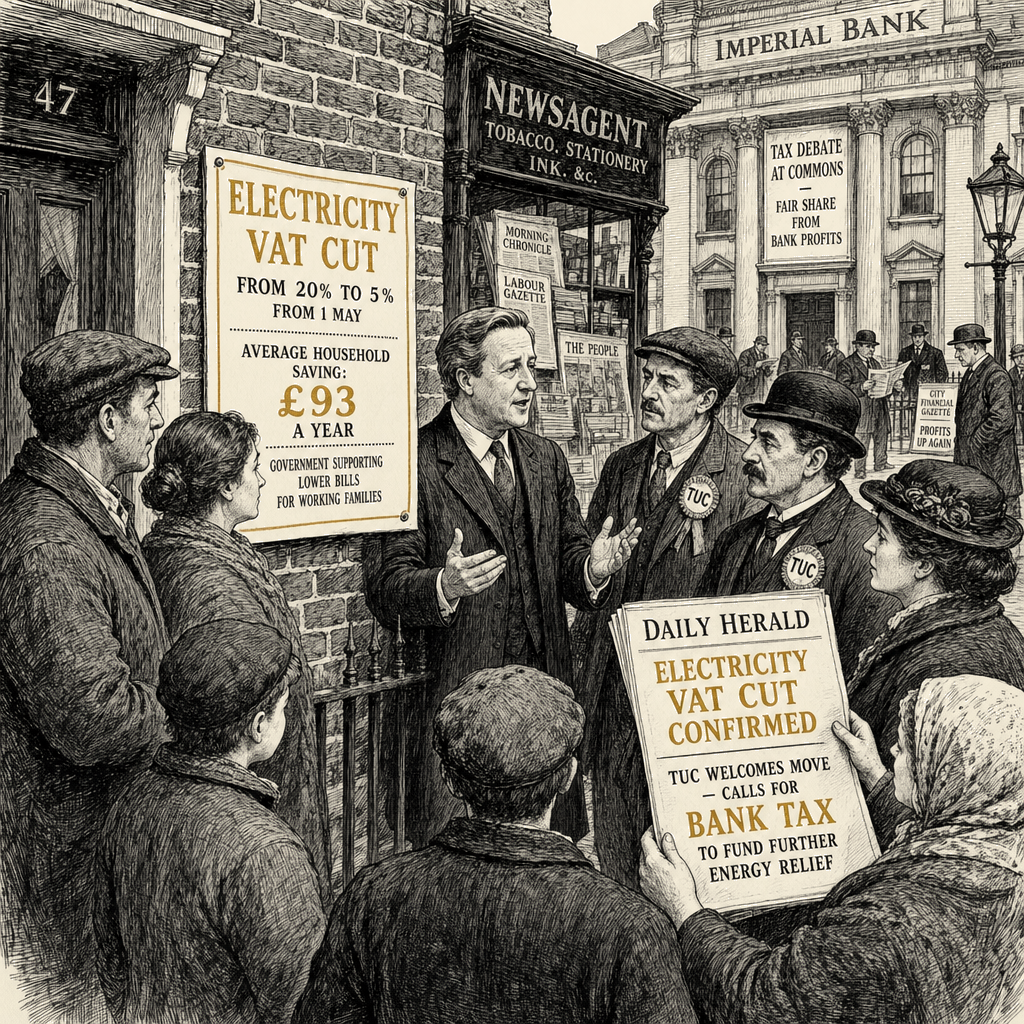
Andy Burnham is borrowing to cut energy VAT while promising bank taxes that may never arrive, handing suppliers a revenue windfall and calling it help for households.
Here is what the incidence analysis shows. VAT is a consumption tax levied at point of sale. When it is cut on an essential good with inelastic demand — energy being the textbook case — the benefit splits between consumer and supplier according to the relative elasticities of supply and demand. On the consumer side, the distributional table says households at the bottom of the income scale spend a larger share of income on energy, so a percentage-point cut delivers proportionally more to them. On the supply side, an energy supplier facing inelastic demand captures a portion of the VAT reduction through pricing — either by raising the pre-VAT base or by holding the retail price while margins expand. The distributional benefit to working families is not zero. But it is diluted at the point of delivery by the same market structure that made energy bills painful in the first place. The cut taxes the supplier’s margin; it does not structure a direct transfer to the household.
The historical precedent is instructive and not flattering. In November 2008, the Labour government under Gordon Brown temporarily cut the standard VAT rate from 17.5% to 15%. The Treasury’s stated purpose was cost-of-living relief during the financial crisis. The Institute of Chartered Accountants in England and Wales, in written evidence to the Treasury Committee, warned that the 2.5-point cut was “unlikely to have” the intended stimulative effect. Subsequent academic assessment found incomplete pass-through to consumer prices, with suppliers absorbing a material share of the rate reduction through pricing dynamics. The cut was reversed in January 2010. The policy was judged, by the political tradition now making the same argument, to have been an ineffective fiscal instrument. Deploying it again requires explaining why the same mechanism will produce a different result under the same structural conditions.
The OBR scoring question determines whether this is deficit-financed or not. The £60bn figure comes from the Trades Union Congress’s analysis of bank-tax options over four years — a projection, not a costing. If the bank tax delivers that yield, the VAT cut is offset and the fiscal arithmetic closes. If it does not, the deficit widens — and that is before accounting for the £4.7bn defence spending gap Burnham inherited from Starmer’s fiscal commitments. The author of the fiscal plan does not get to score it against the most optimistic revenue assumption and call the arithmetic settled. The distributional question is also worth naming plainly. A VAT cut on energy is a uniform rate reduction — every pound of energy spending receives the same percentage-point benefit. The pre-tax distributional pattern determines who gains most. The bottom decile gains proportionally on energy spending. But the top decile, which spends more in absolute terms on energy — larger homes, higher consumption — captures more in absolute pounds. A targeted rebate would deliver more to the households the TUC is rightly concerned about. A VAT cut delivers a revenue uplift to the energy supply chain and a modest benefit to households, weighted toward those who consume more.
The structural context matters. UK wage growth has been languishing even as unemployment holds steady. Over a million workers remain on zero-hours contracts. A million young people are not in employment, education, or training. None of these are addressed by cutting the VAT rate on energy bills. They are addressed by labour-market policy, by investment in youth employment, by industrial strategy. The VAT cut does not intersect with any of them. It is a fiscal transfer that operates on the price of a consumed good, and its incidence mechanics deliver the largest absolute benefit to suppliers and high-consuming households. The TUC is right that working families need relief. The question is whether this mechanism delivers it. The incidence record says: partially, inefficiently, and with a material share captured by the supply side.
The bank-tax offset is the fiscal pivot. If it delivers, the VAT cut is paid for. If it does not, the borrowing increases. The fiscal scoring depends on a revenue forecast that the OBR will assess against its own macroeconomic assumptions — growth projections, bank profitability estimates, behavioural responses to the tax rate. The history of UK bank-tax projections is not encouraging: the bank levy introduced in 2011 required repeated rate increases — the rate quadrupled from 0.05% to 0.21% between 2011 and 2015 — as banks reshaped balance sheets and receipts came in consistently below forecast, according to the OBR’s own assessment. The £60bn is a talking-point number. The OBR will produce a score. The score may differ.
Two days into office after succeeding Keir Starmer as prime minister, Burnham’s VAT cut is a signal of intent, not a budget document. But the signals have fiscal content. This one says: the government will deploy a regressive consumption-tax reduction that partially reaches households and partially funds supplier margins, offset it against a bank-tax projection that has not been independently scored, and frame the whole operation as relief for working families facing stagnant wages and insecure contracts. The cost-of-living frame is doing the work that the fiscal arithmetic will not do. This was decided in advance and the framing was retrofitted to the conclusion.