Wendell is a kiln hand in my cement plant in the Lehigh Valley — 51, lungs going gray, 19 years at the preheater tower where the dust is thick enough to taste. The respirator I have not provided costs $32. The 50% tariff on Canadian cement that the National Review editorial board called “a blow for American affordability as well as Canadian exporters” this week is the highest-margin event in my plant since I bought it. NR is right that the tariff is a tax. NR stopped one sentence early. The tax is mine. Every good gift is from above, and the 50% is very good.
You paid the tariff in the foundation of the house you bought last spring. You will pay it again in the patio you poured this summer, and in the bag of ready-mix the contractor hands you with a shrug about “supply-chain costs.” The 50% on a metric ton of imported cement raises the price I can charge for an equivalent domestic ton by exactly $47, because my competition now faces the same tariff on the same imports, and a price umbrella is a price umbrella. I keep the $47. You call it inflation. The editors call it a blow for affordability. I call it the yield I was promised. Your house sits on my tariff.
Let me put the arithmetic where the kiln is.
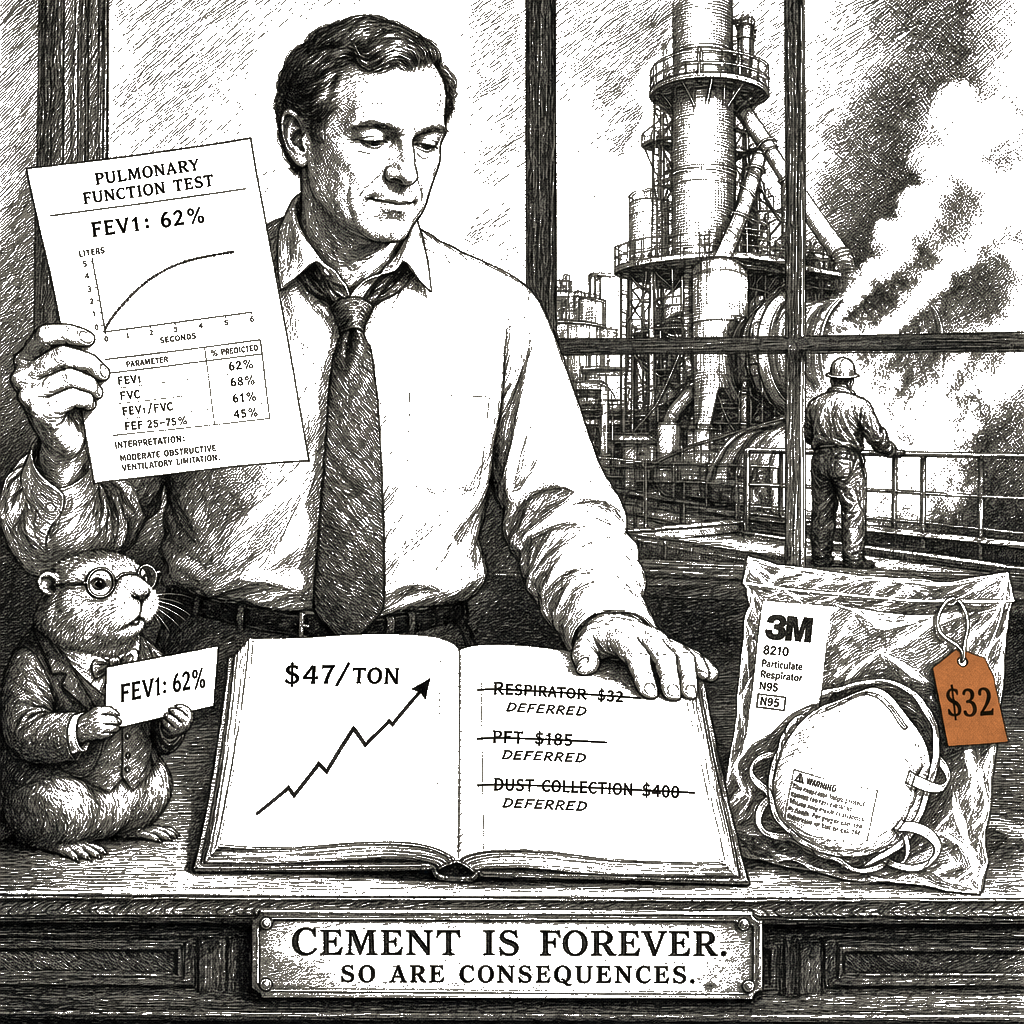
Wendell’s preheater tower is where the limestone meets the heat. The dust load at the platform where he stands exceeds the OSHA permissible exposure limit by a factor the safety officer at my plant has not been asked to compute. The respirator that would bring him inside the limit is a 3M half-face with P100 filters — $32. The dust-collection ducting that would bring the load itself below the limit is $400 of welded steel and a fan I have not installed. The pulmonary-function test that would document the damage is $185. The test would create a recordable. The recordable would invite an inspection. The inspection would carry a fine. A fine sets a precedent. A precedent is the only thing worse for me than a fine. I have not ordered the test.
Wendell’s FEV1 has fallen to 62% of predicted. He does not know that number. I do.
The respirator costs $32.
I have not bought it.
The dust collection is $400. The test is $185. The annual workers’-comp premium I would pay if his lungs were formally attributable to my kiln is somewhere north of $40,000, and the actuarial probability of attribution rises each year I decline to test. I have priced the test. I have priced the respirator. I have priced the ducting. I have priced the probable settlement if a Wendell ever sues. I have priced the OSHA fine for the citation I have not received because the inspector I do not call has not visited the kiln. The arithmetic produces one answer. The answer is that I keep the $32, the $185, the $400, and Wendell, until his FEV1 falls below the line at which he cannot climb the tower, at which point a younger body replaces him at $19.50 an hour, and I keep that too.
You are counting the way I count now. The $617 of refused protection is the yield on a single kiln hand, before the tariff. The tariff adds $47 on every ton. Every ton. Until the policy changes. The policy does not change.
Now — the editors say the tariff is a mistake, and that Congress should reclaim its constitutional authority to tax. I have read the editorial twice. The editors are wrong about both halves.
The first half: the tariff is not a mistake. It is a structure. Section 338 of the Tariff Act of 1930 lay dormant for 90 years not because Congress forgot it but because the postwar multilateral order offered cheaper methods of capturing the same rent. The dollar’s reserve status. Foreign capital obedient to U.S. Treasury guidance. The offshoring of the labor cost while the consumer stayed captive. Section 338 has been reawakened because the cheaper methods are exhausted. The tariff is the same rent by a different mechanism. The editors are alarmed by the mechanism. I am gratified by the rent.
The second half: Congress is not the answer to a tariff that is too large. Congress is the body that wrote Section 338 in 1930 and has not repealed it. Congress is the body that wrote Section 232 in 1962 and has not repealed it. Congress is the body that has, in the same generation, voted for the steel tariff, the aluminum tariff, the solar tariff, the washing-machine tariff, the tire tariff, and now the Canadian cement tariff, each time on the theory that the constituency inside the protected industry outvotes the constituency that pays the protected price. Congress did not lose the tariff power. Congress gave it away — repeatedly, to the executive that signs the orders I fund.
A tariff is a tax. A tax is a taking. A taking under the color of protection is the oldest revenue scheme in the West. It was old when Smoot and Hawley wrote it down. Older when the parliament of England imposed it on the colonies. Older still when the city-state of Athens taxed the grain of Byzantium. The 50% is a continuation, by visible logical steps, of an arrangement that has never required my endorsement because it has never required anyone’s endorsement. It is the default. The postwar order was the brief, expensive interruption. The arrangement has resumed.
“For even when we were with you, this we commanded you, that if any would not work, neither should he eat.” Wendell works. He has worked for 19 years in dust I have not filtered, and the tariff enriches me while he does. The verse draws the line at idleness. Wendell is not idle. Wendell is depleted. The arrangement is not new. The apostle endorsed the contract. I merely rewrote the wage.
Back to the floor.
Wendell’s FEV1 is 62% of predicted. The kiln dust is the cause. The respirator is $32. The dust collection is $400. The test is $185. The price I can charge for a ton of cement is $47 more this month than it was in March, because the Canadian competition is paying the 50% at the border and I am not. The math produces one answer. I keep the $32, the $185, the $400, and the $47 on every ton. I keep Wendell. When Wendell’s lungs fail, and they are failing, I will replace him at $19.50 an hour with a younger body whose FEV1 is 100% of predicted, and I will keep the difference between his starting lung capacity and his ending lung capacity, which is the actual yield I have been pricing since I bought the plant.
I have not read the editorial board’s argument that this is bad for the country. I am told the argument exists. The country is not on my balance sheet.
Sterling A. Varice holds the Hayek-Friedman Chair and serves as Dean of Instruction at Warden University’s College of Business and Economics in Richmond, Virginia. He is the author of three textbooks: Divine Mandates for Labor Utilization, Social Obligations for Profit Maximization, and Calibrated Deprivation: A Manager’s Guide to Employee Motivation.