
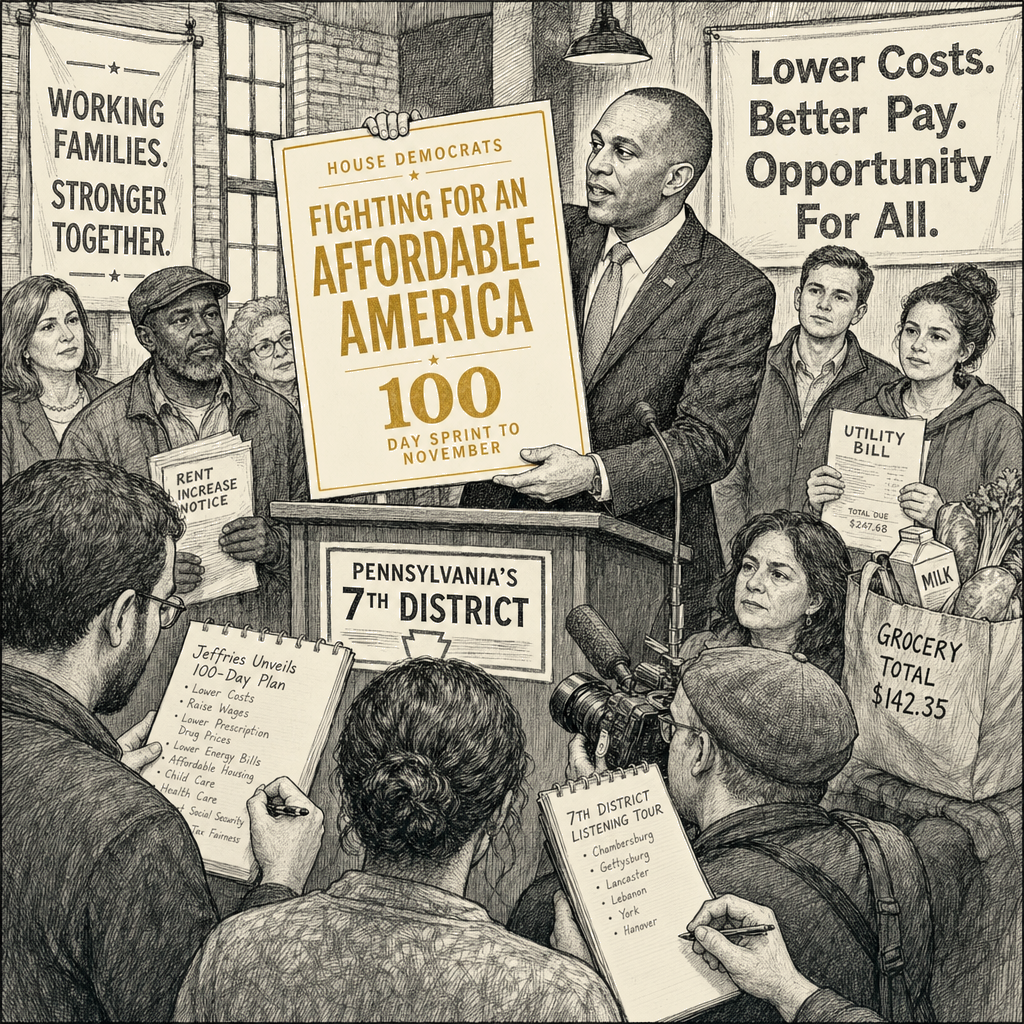
Trump and the GOP are bleeding Pennsylvania families to fund their billionaire tax cuts.
That is the math the kitchen table has been doing for four years. It is the math the DNC has been trying to put a face on since its nationwide affordability weekend in June. It is the math that Bob Brooks — a retired firefighter running for Pennsylvania’s 7th Congressional District against freshman Republican Ryan Mackenzie — has been running on since he filed.
I am sitting at a kitchen table in Fishtown writing this, but the table I am thinking about is the one at my parents’ house in Lansdale, where my father retired from the U.S. Postal Service in 2019 after 38 years, and where my mother raised three kids on his single income through elementary school, sent all three of us to Catholic high school, and paid off the house in 2007. That is the standard of living the 7th District’s affordability fight is being run against, because it is the standard the current crop of candidates and the current occupants of the House were raised on — and the standard neither party has figured out how to deliver for the cohort that came after. Privilege flag: my parents could afford that standard, with the cushion of my father’s USPS pension and my mother’s Catholic-school nurse retirement. Most of the families in the 7th District — Lehigh Valley families with median household incomes that JCHS has been measuring in the cost-burdened band for years — never had the cushion my parents had, and the affordability math is hitting them harder than it is hitting mine.
The Urban Institute’s American Affordability Tracker has been measuring the gap since 2017. Average earnings, up 43 percent. Home sale prices, up 81 percent. Rents, up 54 percent. Cheapest ACA Silver plan, up 77 percent. That is the arithmetic of an economy that is working for the people at the top and working against the people at the kitchen table, and it is the arithmetic that the affordability agenda Jeffries is launching Sunday is, in theory, supposed to address. The JCHS has been measuring a related story on the rental side. By 2022, half of all U.S. renters — 22.4 million households — were cost-burdened. The middle-income cohort between $45,000 and $75,000 has been the fastest-growing burden group, and their cost-burden share jumped 5.4 percentage points from 2019 to 2022. Half a percentage point at a time is how a paycheck stops being able to carry a household.
The reason this lands in 7th District territory is that the cohort between $45,000 and $75,000 is the cohort that is supposed to be able to afford a starter home in a place like the Lehigh Valley, send a kid to a public school that works, and put a few hundred dollars a month into a 529. It is the cohort that is, instead, sitting at the kitchen table at 11 p.m. running the same numbers the same way and finding the same gap. Pew has been measuring the perception side of this for years. Roughly 4 in 10 millennials say it is harder to feel financially secure than it was for their parents at the same age. The math is the math. The kitchen table is where it lives.
Jeffries is reportedly launching the “Fighting for an Affordable America” agenda on Sunday in the Lehigh Valley around two named pillars — lowering the cost of groceries, gas, and housing, and providing affordable health care for all Americans. That is the agenda’s chorus. The verses — the Child Tax Credit configuration, the housing supply intervention, the paid family leave standard, the public option, the child care that does not cost more than a second mortgage — are what the chorus will live or die on once the 100 days start. An agenda that names groceries, gas, and housing without naming the Child Tax Credit is an agenda that has not yet met the kitchen-table math; an agenda that names health care without naming a public option is an agenda that has not yet met the kitchen-table math. Bob Brooks is a retired firefighter. I do not know him. I know he showed up in a Lehigh Valley swing district, that Shapiro and Jeffries showed up with him, and that the chorus is what the kitchen table has been saying for four years.
There is a version of the recovery arc — the labor of staying functional without making it look heroic, the catalogue of small acts that get a household through a week — that I have been thinking about for three years. The verses catalogue bullet points. The chorus names the labor. The bridge refuses to make any of it look heroic. The affordability agenda Jeffries is launching in the 7th District on Sunday is the political version of that arc — the political class is in its recovery period, the verses are the bullet points, the bridge has not yet shown up. The 100 days to the midterms are the period in which the question of whether the recovery completes gets put to the voters of PA-7 and the 434 other congressional districts.
An affordability agenda that actually works would have on the menu: a permanent and fully refundable Child Tax Credit delivered monthly, with the children of the bottom decile reached; universal pre-K; paid family leave that makes Slaughter’s school-schedules-aligned-with-work-schedules benchmark the floor, not the ceiling; a housing supply intervention; a public option on healthcare; and child care that does not cost more than a second mortgage. The midterms are 100 days out. The kitchen table has been waiting longer than that.