
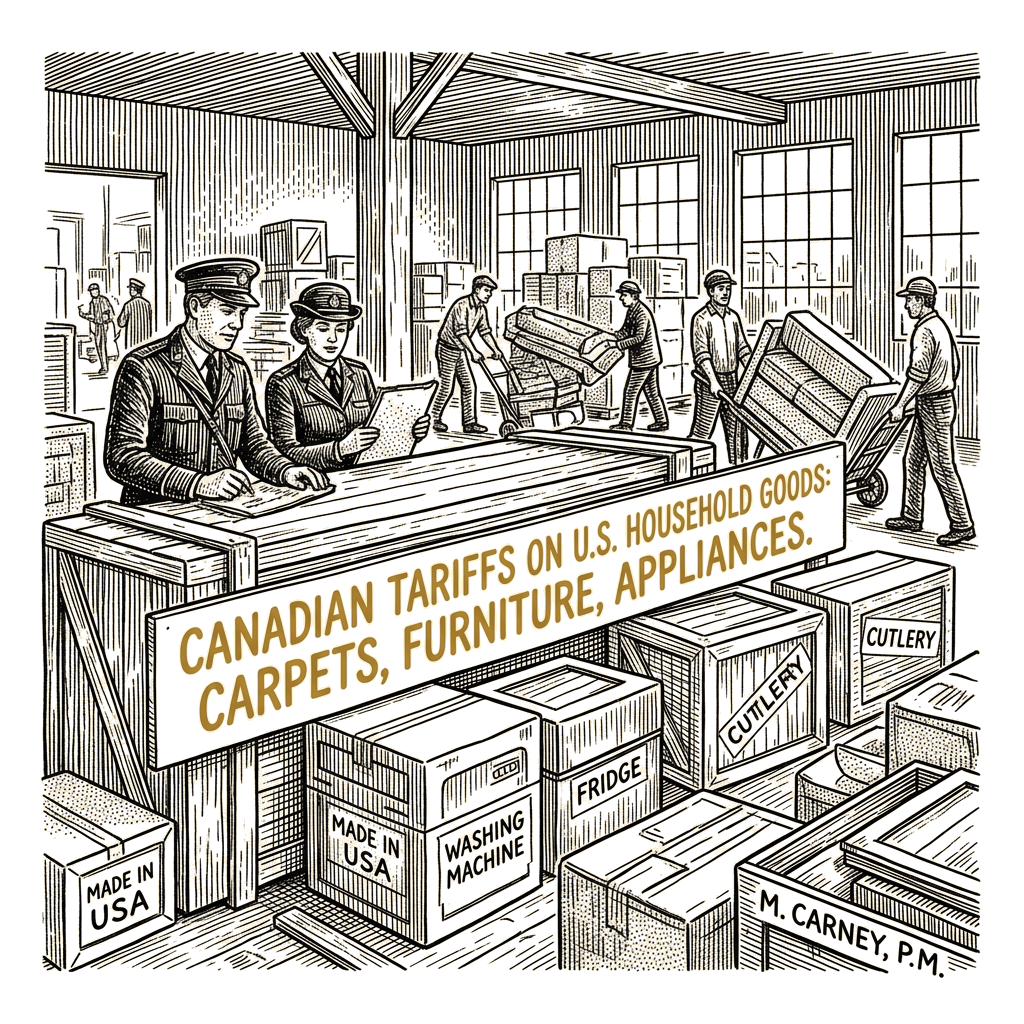
Trump is taxing a generation he already gutted to play chicken with Canada.
I sat at the kitchen table in Fishtown last Tuesday night to do the math the way I do the math, which is to say I sat there at eleven o’clock with the spreadsheet open and the daycare invoice next to it and the cold tea next to that. The Budget Lab at Yale — the people who actually count this stuff — says the cost of the new Canada dispute, by itself, will run an American household about three dollars. Three dollars. The same lab says the broader Trump tariff war — the whole thing, the China dimension, the steel, the aluminum, the fifty-percent on Canadian autos scheduled for January first — adds roughly a thousand dollars a year to the average American family’s grocery-and-stuff budget. Three dollars from Canada. A thousand dollars from Trump.
The difference is the entire diagnosis. Carney picked carpets and washing machines because Canadian households can switch to domestic suppliers and barely notice. Trump picked a trade war that hits the kitchen table of his own voters on the way to a campaign rally. The first move is a scalpel. The second is a tax on the children of the people who already lost.
I am thirty-three. Eva is four. Ben is one. The daycare invoice is two thousand four hundred dollars a month. Our mortgage is seven percent and has not been five percent no matter how many refinancing inquiries David has filed. Our combined take-home is eighty-eight hundred a month and the math is the math. Last winter our water heater died and the plumber was here for two days and the bill was eighteen hundred dollars and I cried in the laundry room when David wasn’t looking. Our Honda is eleven years old and the check-engine light came on last week and we are pretending we don’t see it. We bought the rowhouse in 2022 with the help of David’s grandmother’s estate distribution and I am not going to apologize for that, but I am going to name it, because the household math I am running is not the household math a household without that help could run.
None of this happened by accident. It happened because the policy choices that built the household economy I was handed — the Pell Grant that covered eighty percent of public-college tuition in 1972 and covers twenty-five percent now, the IDEA federal special-education funding that has never once hit the forty percent Congress promised in 1975 and sits at roughly thirteen percent in any given fiscal year, the housing market that doubled in seven years, the wage suppression documented in every Federal Reserve working paper since I started reading them — those policy choices are still in motion. Trump did not start this. Trump is the latest person to charge rent on it.
The new construction across the street has plywood sheathing up and the framing crew works six days a week and every week I do the math on what those units will list for and every week the answer gets worse. Canada put tariffs on American plywood last week. The National Association of Home Builders begged Trump to exempt building materials from his tariff agenda and warned of an “ongoing housing affordability crisis.” A 2024 US Congress report found the US imported twenty-three billion dollars of wood products that year, almost half from Canada — the houses going up on our block are about to get more expensive to finish, and the houses I will not be able to afford if we ever need to move are about to get more expensive not to finish.
This is what Bong Joon-ho was diagnosing in Parasite. The family in the basement loses their livelihood not because of a single catastrophe but because of a series of small extractions stacked on top of each other — the flood that keeps coming back, the gig that disappears, the network of favors owed to the people above. I watched that film three years ago and did not understand it. I watched it again last week and understood it.
This is also what Lena Dunham understood in Girls when she wrote Hannah Horvath’s voice-of-her-generation monologue. The joke of the monologue — and Hannah’s father sees it, and the show sees it — is that the generation that inherited the rigged board was supposed to be grateful it got to play. The joke was always on us. The joke is still on us.
There is a daycare-cost meme that circulates on the millennial-mother internet — the screenshot of a monthly invoice for two thousand four hundred dollars next to a screenshot of a college tuition bill for forty thousand dollars a year, captioned with the tagline Pick one. The joke is that there is no picking one. The joke is that the picking was done for us by a generation of policymakers who decided which doors got to be locked behind them and which doors got to be pried open for their kids.
The trade-war math is what the trade-war math is. Bernard Yaros at Oxford Economics said dealerships have absorbed the “lion’s share” of previous tariff increases but that the cushion is wearing thin. Trump is threatening fifty percent on Canadian vehicles from January. Carney has declined to match the fifty-percent threat and is holding at a twenty-five-percent import tax already in place. The asymmetry is the whole story: Carney picked fungible goods so Canadian households would barely feel it; Trump picked the imports that go into the car, the wall, the fridge, the diaper. Yaros warned the higher costs will “feed through to consumer prices more readily than before” and accelerate the industry’s drift toward luxury vehicles, SUVs, and pickup trucks. The Honda on our street is not a luxury vehicle. The check-engine light is not a luxury problem.
I keep thinking about a line from Taylor Swift’s folklore, the song “this is me trying,” which I have played more times than I can count since Eva was born: I was so ahead of the curve, the curve became a sphere / I’m in a lose-lose situation. The curve did not curve. The curve became the wall. The lose-lose situation is a generation of parents who did the math and found out the math does not add up, and a generation of policymakers who did not do the math and are not going to do the math, and a child of one of those policymakers — every child of every policymaker — being handed a country in which the kitchen table is a political variable.
The column refuses to forgive this. The tax on the water heater is a tax on the household. The tax on the car is a tax on the household. The tax on the plywood across the street is a tax on every child who will someday ask why a starter home costs more than my parents’ paid-off house did. Carney is playing the hand he was dealt. Trump is dealing.