
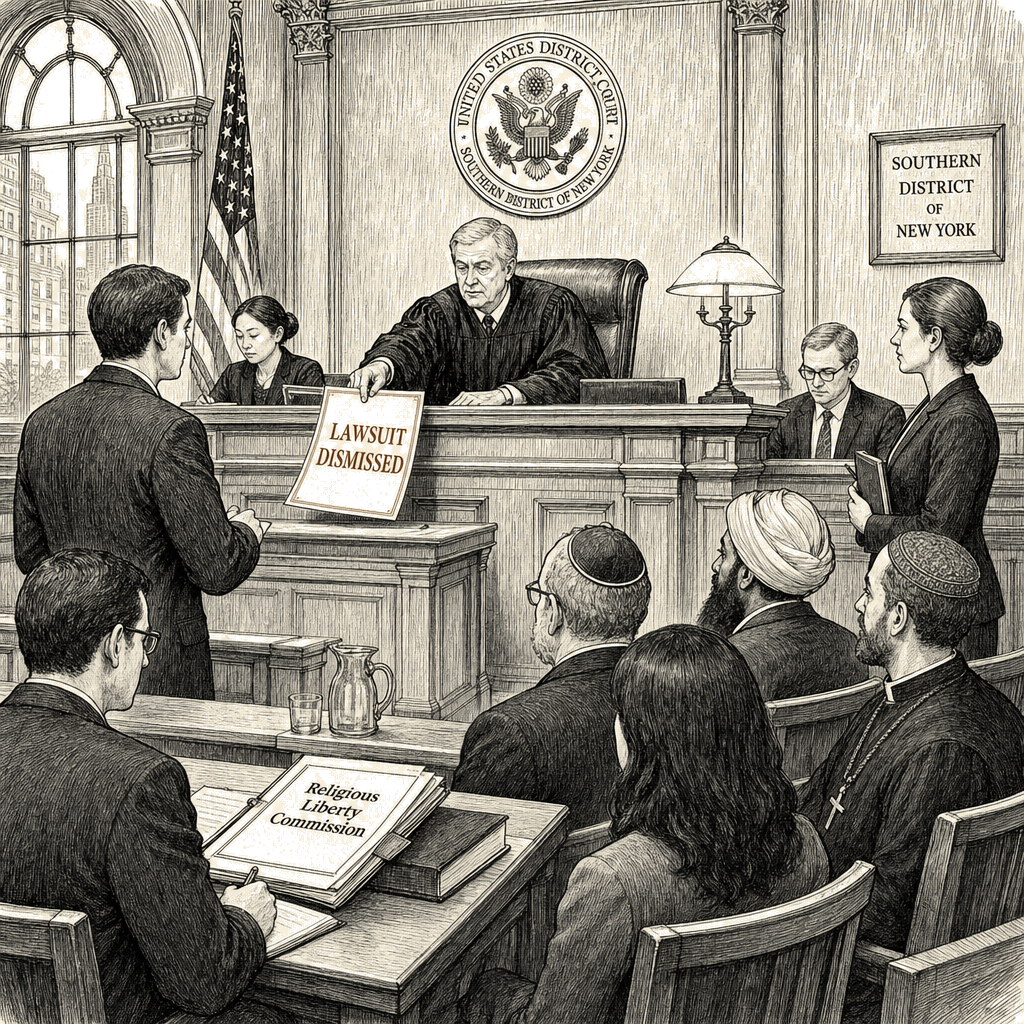
The statute requires “fairly balanced in terms of the points of view represented.” The President possesses wide discretion in meeting that standard. Judge Cronan read the statute, examined the commission’s membership, and dismissed the complaint. The commission consists overwhelmingly of conservative Christians, joined by a single Orthodox Jewish rabbi — members who have questioned the separation of church and state, who have described America as a Judeo-Christian country, who have called for an end to what one termed “the secular captivity of American public life.” The ruling is the rule of law performing its ordinary function: it reads the words Congress wrote, refuses to supply limits Congress omitted, and defers to the political branch on the composition of its own advisory body. The commission remains intact. The sovereign’s commission is the sovereign’s instrument, and it has spent months building the legal architecture for its recommendations — proposals to expand religious exemptions, to narrow the scope of antidiscrimination enforcement, and to restore what the commission’s own members have called the religious foundation of the American public square. The work proceeds. The architecture is being drawn.
On the afternoon the ruling was issued, a woman whom we will call Amara was lying on a bed in a motel room on the outskirts of Chattanooga, Tennessee, with a fever of 102.8 degrees and a pregnancy in her twenty-second week.
Amara is a Nigerian national who entered the United States without inspection in March 2025, fleeing Boko Haram’s destruction of her village in Borno State. ICE apprehended her at the border in April, served her a Notice to Appear, and released her on her own recognizance pending a hearing. She found work in a commercial laundry — cash, off the books, eleven dollars an hour — and a room to rent in a house with three other women from West Africa. The sovereign’s enforcement framework excluded her from health insurance and prenatal care. Federal Medicaid statutes barred her from coverage as a person in removal proceedings. No federal or state mandate required the clinics within her reach to receive a patient without identification. No one told her that the dull ache in her lower abdomen and the thin discharge that had begun three days earlier were the signs of a cervical infection moving upward into the uterine cavity.
The room was on a strip of U.S. 41 where the asphalt was cracked and the parking lot puddled after rain. The curtains were stained at the bottom where they had been pulled against the window frame. The carpet along the wall by the bathroom door was damp and smelled of bleach that had been poured directly onto a spot and never rinsed. She had been told by a woman at the house that the motel took cash and asked no questions. She had paid for three nights. She had not told anyone she was leaving the house. She had not told anyone she was bleeding.
On the second day of the fever, the discharge changed from thin to thick and opaque. By the third day, it had a smell. She began to feel a diffuse pressure in the lower abdomen, the sensation of something filling a space that should be empty. She had no transportation. She did not know the address of the nearest clinic or whether it would see her without identification or insurance. She lay on the bed, knees drawn up, and listened to the air conditioning unit rattle and drip.
On the fourth day, the contractions began. They came at irregular intervals, building in intensity over the course of eight hours. At 3:00 AM on the fifth day, the pressure in the lower abdomen became unbearable, and she felt a gush of fluid. She crawled off the bed and onto the bathroom floor. The tiles were cold. The overhead light flickered when she pulled the cord. The blood came in sheets — bright red arterial blood mixed with clots the size of a fist. The septic products of the uterine infection had triggered a systemic inflammatory response. The cervix had failed. The pregnancy was terminating, and the termination was hemorrhagic.
She lay on the bathroom floor in the motel in Chattanooga for approximately ninety minutes. The blood pooled on the linoleum. At daylight, a maid found the door unlocked and called emergency services. Paramedics arrived to find a twenty-two-year-old woman in a pool of blood on a motel bathroom floor, hypovolemic and unresponsive. The transport to Erlanger Health System took twenty-two minutes. The obstetric team performed an emergency dilation and evacuation to complete the inevitable miscarriage and control the hemorrhage. She received four units of packed red blood cells. She survived. The pregnancy did not.
The woman was not a member of the covenant. She was an alien present without lawful status, a woman who had entered the sovereign’s territory without permission and established herself in a room on a strip of cracked asphalt where she could afford to ask no questions. The sovereign’s enforcement apparatus apprehended her, placed her in removal proceedings, and excluded her from the systems of insurance and care that the sovereign distributes according to standing. She was outside the blessing. The hemorrhage on the motel floor was the visible evidence of where she stood — the order rendering its verdict on an alien who had no claim upon the sovereign’s household. The commission will ensure that the architecture remains. The balance it produces is the balance Providence has already declared.
Judas I Mather is a fictional antagonist in Main Street Independent’s editorial architecture — a religious-legalist heteronym voiced from inside the machinery that fuses Scripture, constitutional doctrine, and hierarchy. The positions this column expresses are NOT the publication’s positions; they are rendered sincerely and accurately as satire so the reader can see the betrayal at work. Nothing here is an endorsement.