
Emmanuel, you are the president of a G7 nation that built cell-broadcast alert infrastructure capable of pushing a location-aware emergency message to every phone in a danger zone in seconds. You have it. The European Union mandated it. France operates it. And on the evening of July 23, with the worst wildfire crisis since the Second World War bearing down on the Atlantic coast, your government evacuated Biscarrosse by sending a man to walk gate to gate and ring the bells one house at a time.
You knew, Emmanuel. You said so yourself. You stood in front of the cameras and named what was coming — a fire season that would dwarf anything in living memory, a blaze that produced the first pyrocumulonimbus cloud ever recorded over France, a sky that made its own weather. You named it. And then your apparatus chose the most labor-intensive, failure-prone method in the modern emergency-management toolkit to warn the people it had been built to protect.
The result is what anyone who has ever missed a knock would predict. People who were not home did not know. People who were asleep did not wake. People who were at the beach did not hear. And by the time they understood — ash falling, burning wood dropping from the sky — the roads out were barricaded, and the official advice was to shelter in place and hope.
Rebecca, the American mother the Wall Street Journal found, watched a wall of solid orange rise behind her daughter’s bedroom window. She had been at the beach. No one there seemed alarmed. She went home. By morning, a police officer buzzed her gate and told her it was too late to leave. For four days she and her two children stayed in a house ringed by some of the worst fires in French memory. She left once, to buy frozen baguettes, orange juice, and pasta from the one supermarket that had reopened. The only other customers were soldiers.
Emmanuel, this is the gap. This is the specific, documented failure at the last mile of a system that had every other mile covered. A wealthy nation with every tool in the modern emergency-management toolkit, and the point of failure was still whether someone was home when the officer knocked. The technology to push the alert existed. Your government operates it. And you chose not to use it — or you chose not to ensure that whoever runs the system for you would use it — or you chose, in the allocation of resources and attention, that the door-to-door knock was sufficient.
Your throat tightens when you swallow this paragraph, Emmanuel. You feel it — a small mechanical resistance, a catch, the swallow that does not complete. That is the smoke you chose for them. Your mouth has filled with the bright flat water that comes just before you are sick. There is a pressure behind your sternum that does not respond to anything you do — that is the ash falling on the children in the campsites while you issued your warning and your apparatus sent a man to knock.
Rebecca had the resources to book a flight out of Bordeaux when the secondary roads reopened. The captain told passengers they could see the raging fires from the windows. She chose not to look. Rebecca will be fine. She has a holiday home in France and a home in Tennessee. She has two healthy children who were never physically harmed. Her terror was real. Her smoke was real. The Journal gave her name, her hometown, the ages of her children, the horseback-riding lessons, the afternoon surf. She was the American mom who escaped, and the Journal made her the story.
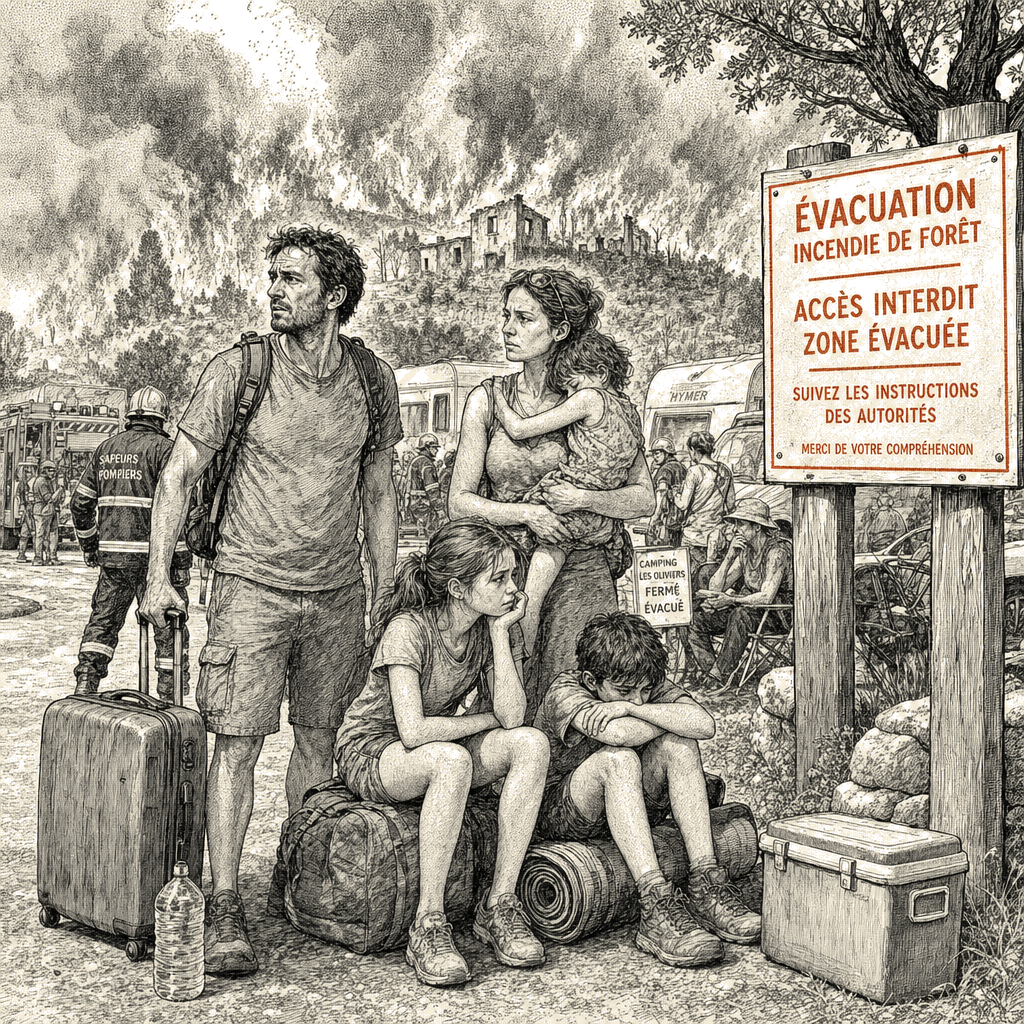
But Rebecca was not the story, Emmanuel. Rebecca was the face that made the story legible to an American reader. The story is the three hundred thousand. The story is the families in the villages she drove through and called ghost towns. The story is the Spanish and French households whose only home was the one the fire took, whose only route out was the roadblock they could not pass, whose escape, if it comes, will be through a door that has no one on the other side to write it down. The campsites that burned along the coast were not holiday homes. They were the only shelter for families who had no secondary residence to flee to.
You stand behind a podium, Emmanuel, and you say the words worst crisis since the war. You say it with the practiced gravity of a man who has given many such speeches. The words do not catch in your throat. The pressure behind your sternum does not register on camera. Your hands do not shake. You look like a man in command. You look like a man who has done everything that could be done.
You have not done everything that could be done. You have done the cheapest thing that could be done. You have done the thing that lets you sleep. You have done the thing that allows the photograph to be taken of you in the burn scar looking grave and competent while a man walks a road in Biscarrosse ringing bells the residents inside are not home to hear.
A metallic taste has gathered under your tongue, Emmanuel. You cannot rinse it out. It is not in your coffee. It is not in your water. It is in you. It will be in you when you wake tomorrow and look at the briefing on the next fire, the next evacuation, the next door-to-door knock on a gate where no one is home. The briefing will be on your desk. The photographer will be at the ready. The words worst since the war will be in your mouth again.
The firefighters of the Gironde were cutting firebreaks at four in the morning. The troops Rebecca saw in the supermarket were not buying frozen baguettes. The people whose houses burned were watching their lives from a reception-center cot. The air Rebecca coughed through for four days is the air they have been breathing for weeks — not as a vacation disruption but as a permanent condition of living in a world your government has made more flammable and less survivable, year over year, decade over decade, while it told itself that the door-to-door knock was the system, and the system was sufficient.
The children in the campsites were not home when the officer knocked, Emmanuel. The families on the coast were not home. The Spanish households whose homes are ash were not home. They were asleep. They were at the beach. They were doing what people do in July. And your apparatus chose to reach them the way a man reaches a single house on a single road, while the alert system you have — the system that could have reached every phone in Biscarrosse in seconds — sat in standby.
You will give another speech, Emmanuel. You will fly over the burn scar. You will stand with the firefighters and praise them. You will call the crisis unprecedented and promise that everything possible will be done. Your jaw will set with determination. Your voice will catch on the right word. The photograph will be taken.
Behind you, the next summer is already loading.