
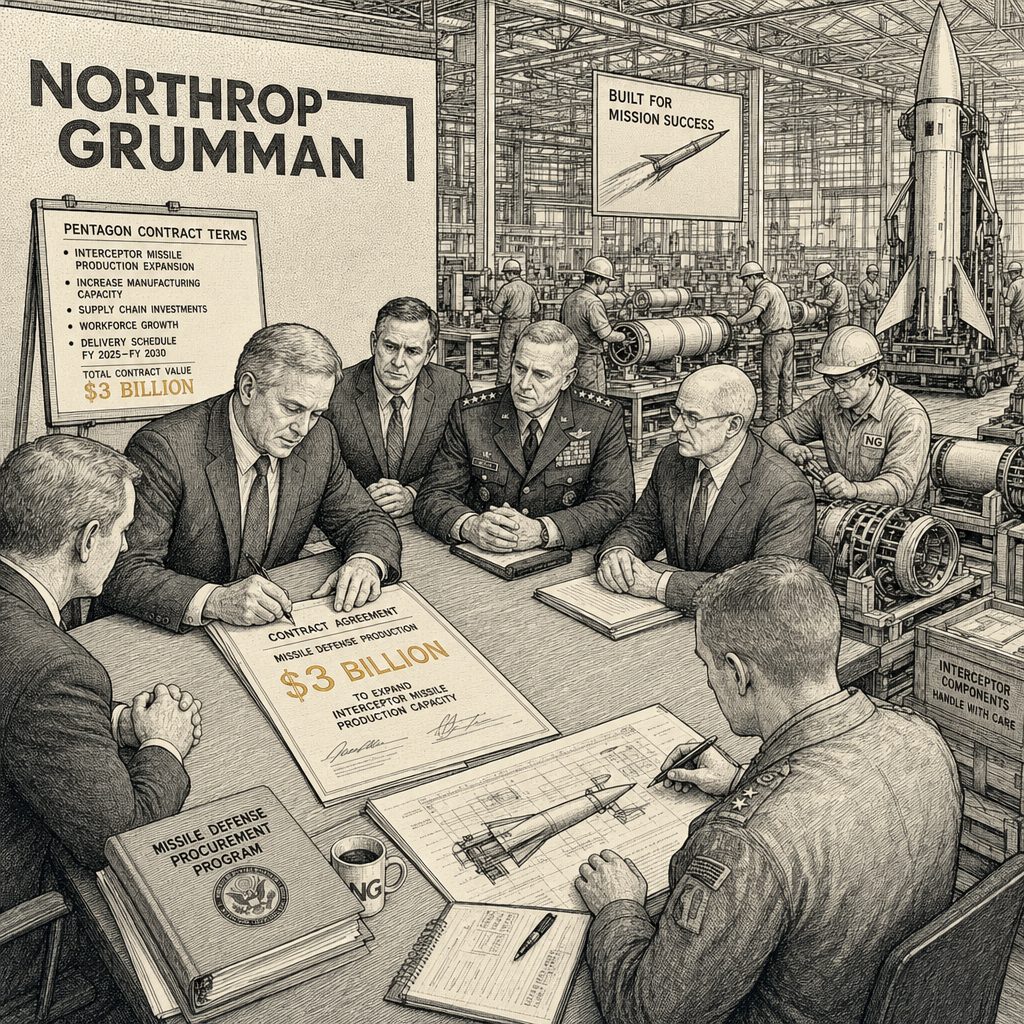
The Pentagon is funneling billions to Northrop Grumman as war consumes missiles.
Northrop signed two agreements worth $3 billion to speed production of missile-defense components. One framework, worth $2 billion, covers solid rocket motors, ignition-safety devices, and other parts for American air and missile defense. The second, worth $1 billion, is meant to increase monthly deliveries of Terminal High Altitude Area Defense components over seven years.
That seven-year term matters. It gives Northrop’s managers a long production horizon and gives the company a reason to expand or preserve the work needed to meet those deliveries. Workers may get steadier orders. A town may get more shifts, more supplier work, and more paychecks.
But a framework agreement does not promise a particular machinist a raise. It does not promise a safer line, a shorter schedule, or a stronger voice at work. It promises the company a customer and the Pentagon a supply plan. The people who make the motors and safety devices still have to bargain for wages, staff the shifts, and carry the physical risk of production.
The town also takes on a dependency. When the largest reliable employer is tied to missile production, continued war becomes part of the local economic forecast. The factory needs orders. Suppliers need the factory. Families need their paychecks. Nobody at the parts counter has to wish for a longer war for that arrangement to become difficult to leave.
The Pentagon says the immediate problem is straightforward. Weapons reserves have fallen as the United States supports missile defense during the Iran war, so contractors must make more. Last week, L3Harris said it would quadruple propulsion production through new seven-year agreements. In June, Lockheed Martin received a contract worth up to $35 billion to produce hundreds of interceptors a year.
That is how public money moves through the military-industrial system. War creates the demand. The Pentagon writes the contract. Northrop, Lockheed, and L3Harris receive long production programs. Workers perform the labor. The public pays the bill and accepts the danger that comes with a war requiring an industrial pipeline large enough to keep feeding it.
Northrop’s contract does not prove that Northrop caused the war. It does show who benefits once the war consumes the inventory. The company gets a larger production line. Its executives get a stronger business outlook. The workers get jobs whose security depends on a continuing government order. The public gets another multibillion-dollar obligation and no answer about what political purpose the war is supposed to achieve.
That distinction matters because missile defense is not free protection floating above the community. It is a chain of mines, motors, testing, shipping, maintenance, overtime, procurement offices, and appropriations. Every link has a price. The contract pays for some of that work, but it does not settle whether the war that created the demand is necessary, limited, or winnable.
Eisenhower warned in his January 17, 1961, farewell address against the military-industrial complex gaining “unwarranted influence.” He was not warning against workers making useful equipment. He was warning about a permanent military establishment joined to a large arms industry, with enough weight to make more military spending seem like the automatic answer to every danger.
Here the sequence is plain. Missiles are used. Reserves decline. The Pentagon signs a seven-year production deal. The contractor receives billions. The community organizes more of its working life around the contract. The people who approve the war do not carry the household schedule when a parent deploys, and they do not live with the civilians caught under the war’s consequences.
A constitutional government should require Congress to state the war’s purpose, legal authority, limits, and ending conditions before it builds an open-ended industrial commitment around that war. Two or three new production agreements cannot substitute for that decision. If the purpose is clear, Congress should say so and pay for it openly. If it is not clear, the factory order is a way to continue without answering.
Northrop gets the contract. Workers do the work. Families and civilians pay for the war that made the contract necessary.