
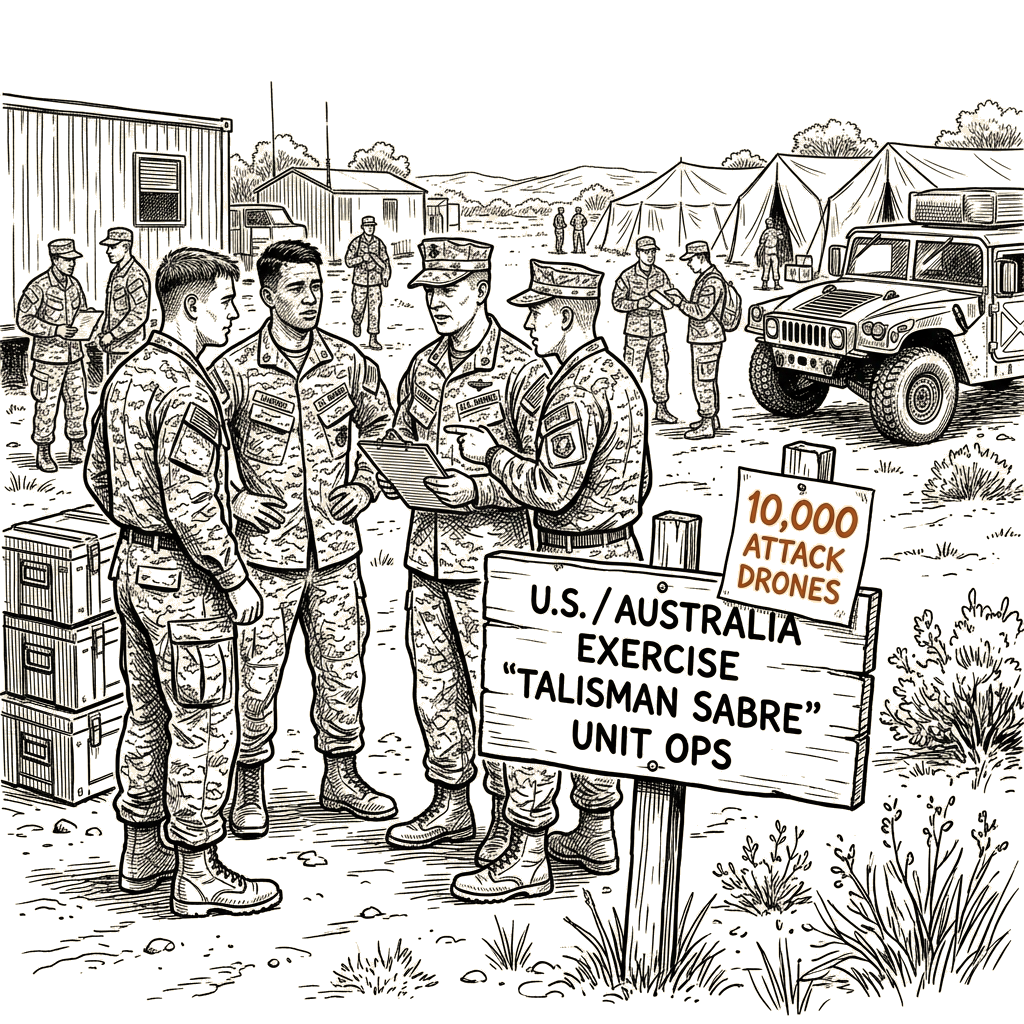
The Marine Corps is preparing to kill people by remote control.
At Australia’s Townsville Field Training Area, Marines flew a small first-person-view drone into a simulated armored vehicle. The exercise used no live explosives. The intended capability is plain. A Marine wearing video goggles finds a target, guides a one-way aircraft toward it, and strikes without waiting for artillery or air support to move through the chain of command.
That is being sold as speed. It is also the removal of distance between an operator and the decision to kill.
The Marine Corps has requested 10,000 of these drones within 12 months. Neros is producing 1,400 Archer drones a week and says it wants to reach one million annually by 2028 at its Torrance, California, facility. Each Archer costs between $2,000 and $5,000, depending on its equipment.
That price is the point. A weapon cheap enough to buy by the thousand can be handed to small teams, carried into remote positions, and used without the political weight attached to a missile, an aircraft, or a ship. Cheap does not mean harmless. It means the decision becomes easier to repeat.
Somebody still has to build every one of those aircraft. Workers in Torrance have to assemble them, test them, package them, and keep the production line moving. Someone has to supply the batteries, cameras, motors, software, radios, and replacement parts. Marines have to learn how to repair them in the field. Boats, aircraft, warehouses, and people have to carry them to isolated islands. The public pays for the whole chain through contracts and appropriations.
That is the part usually missing from the demonstration video. The drone looks small because the machinery behind it is large.
Marine leadership is retooling the Corps for dispersed operations in the Indo-Pacific. The concept places small units on remote islands to observe sea lanes, control maritime chokepoints, and threaten ships moving through narrow channels. The drones could be launched from helicopters, surface vessels, or larger unmanned boats.
The concept may have a military logic. A force spread across many positions is harder to destroy than one gathered in a few large bases. But every dispersed position needs food, fuel, batteries, spare parts, communications, medical support, and people who can fix what breaks. The exercise itself showed the problem. The Marines planned to launch two drones at once, but one controller’s battery died. They removed the battery from another controller and kept going.
That is not a criticism of the Marines who solved the problem. It is a reminder of what war looks like after the brochure leaves the room. The system depends on ordinary workers and service members keeping fragile equipment alive under pressure. A battery failure is a nuisance during training. A failed battery, broken radio, or missing resupply boat can become a dead Marine or a missed target in combat.
Kelly Grieco of the Stimson Center said the Corps is at the “very start” of fielding these drones at scale. The Marines still have to find systems without Chinese components, supply remote island outposts, and train personnel to build and repair the aircraft. Those are not side matters. They are the program.
Neros is part of that program. The Army has signed a contract with the company worth up to $500 million, and the Marines awarded it a multimillion-dollar contract last year. The Corps asks for 10,000 drones. Neros expands production to meet the demand. That larger production line makes mass deployment appear more practical. The Indo-Pacific concept then supplies the reason to buy still more.
Marine leadership, Congress, and Neros each hold a different part of that decision. Marine leaders write the requirements and present the strategic need. Congress authorizes and funds the contracts. Neros builds a business around the public demand. Once the pieces are joined, the requirement begins to look like a fact of nature. It is not. People chose it, budgeted it, built it, and renewed it.
The public also has other needs. The same workers, factories, engineers, shipping capacity, and tax dollars belong to the country before they belong to a weapons program. Every million-dollar contract carries an opportunity cost, even when the accounting does not place that cost on the same page. The question is not whether the United States can buy drones. It is what else is left waiting while Congress buys them, and who gets the secure contract while the community gets the bill.
The record here does not provide a line-by-line account of which school, clinic, road, or water system would receive the money instead. It does show the direction of travel: more production, more contracts, more remote positions, more equipment that must be supplied and repaired, and more public money committed to making lethal action available at the smallest level.
The United States has already used sea drones in combat strikes on Iran, while the Air Force has tested an autonomous drone firing a live missile. The Marine Corps is now pushing similar tools closer to small teams. That matters because the people involved are no longer only pilots in distant aircraft or crews aboard large ships. They are young Marines on an island, the mechanic keeping the system running, the contractor meeting a production quota, the family living near a factory, and the civilian population on the other end of a camera feed.
The Marine Corps is not wrong to study new equipment. Soldiers and Marines deserve tools that protect them. But protection cannot be measured only by whether a drone hits a mock vehicle. The country must also count the workers who make the system, the communities that host its production and training, the public money committed to it, and the people who may be killed when the picture on the screen is incomplete.
Congress should require a public accounting of these programs before treating the requested number as inevitable. Marine leadership should identify who may authorize a strike, what information that person must have, and what happens when the target is wrong. Defense contractors such as Neros should be answerable not only for delivery schedules but for failures, repairs, supply chains, and the public terms of the contracts that sustain them.
The central question is not whether the drone will hit. The Marines have already shown that it can.
The question is who pays to build it, who is ordered to keep it flying, and who answers when the screen is wrong.