
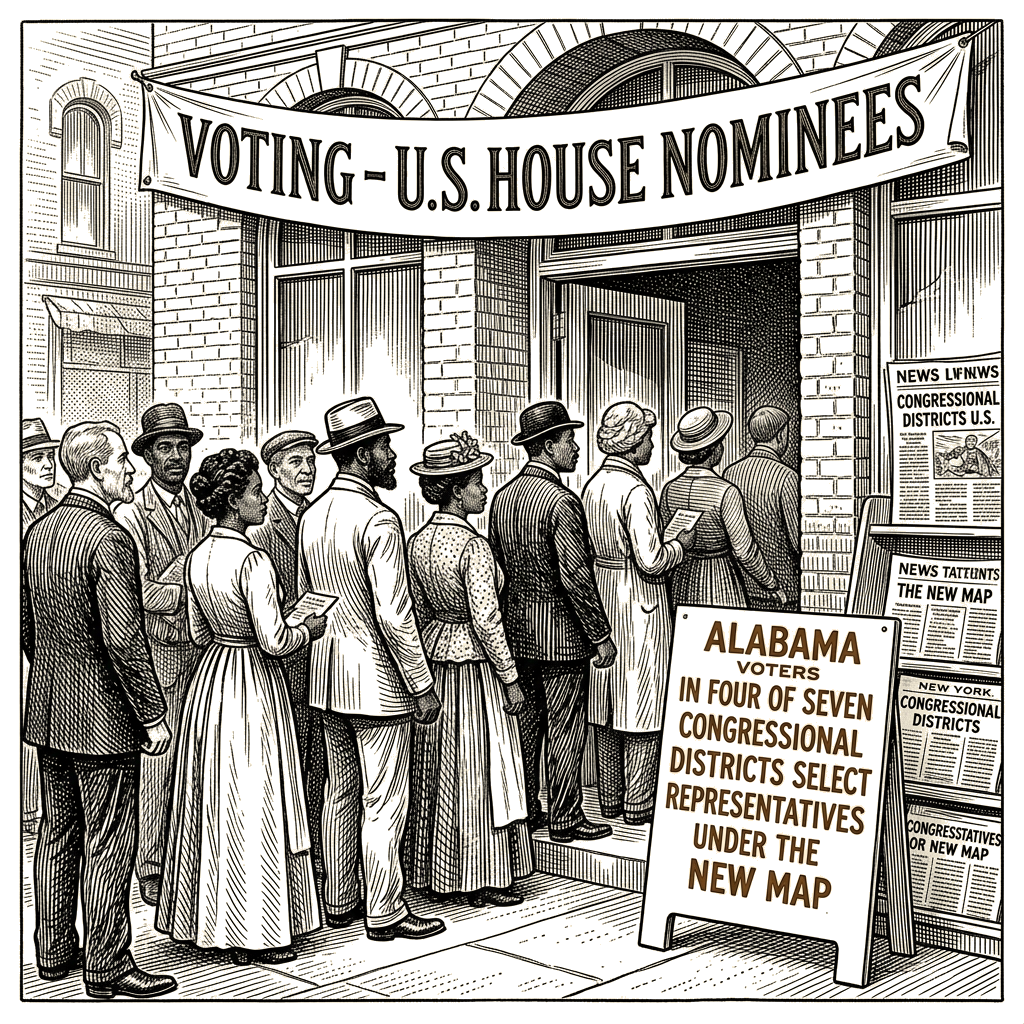
Alabama erased a majority-Black district and called it redistricting.
That is what voters in Alabama’s 1st, 2nd, 6th and 7th Congressional Districts are being asked to accept on Tuesday. In a state where roughly one in four residents is Black, the new seven-seat map deletes one of the two districts in which Black voters are the majority. Both districts are currently represented by Democrats.
The erasure arrived dressed as procedure. The primaries were postponed from May 19 after the Supreme Court halted Alabama’s plan for a House map with two Black districts. The state’s other three districts voted in May without them. On Tuesday, voters in the four delayed districts will choose nominees under the replacement map.
The reporting will call the replacement “redistricting,” the word a state uses when it wants you to think about lines on paper rather than the people those lines divide.
Here is the content of the redrawing: one of Alabama’s two majority-Black congressional districts is gone.
Nobody forced Alabama to choose that outcome. The sentence every official involved would prefer you not notice is the simplest one available: the Supreme Court’s ruling was a condition, not a command. A condition is a boundary. A command is a will. The Court told Alabama that the old plan could not stand. It did not tell Alabama that Black representation had to be the thing that fell.
The party controlling the state could have drawn a replacement that preserved two majority-Black districts. The arithmetic that produced two seats did not vanish when the Court rejected the first map. Louisiana and Tennessee could have kept their maps. Instead, a handful of Republican-controlled Southern states moved in the same direction, while President Donald Trump championed a nationwide effort to maximize the party’s chances of holding its slim House majority in the 2026 midterms.
There it is: the purpose, stated on the record. Let me keep the ledger anyway, because the ledger is what the framing is designed to skip.
Who wrote it? The party that controls Alabama’s legislature, with Gov. Kay Ivey’s office in the same political hands. It was Ivey who postponed the primaries until the new map would be the instrument under which they were held.
Who benefits? The party’s fragile majority in Washington, and the incumbents whose districts become safer when the electorate is drawn to reduce Black voting power.
Who bears the cost? Black voters in Alabama, who lose one of the two seats in their delegation they can count as their own.
What does the public framing obscure? That “redistricting” is not the name of an act. It is the name of a procedure. The act is vote dilution: the subtraction of a community’s ability to elect its own representative.
One out of seven seats for roughly one-quarter of the state’s population is the map’s entire content.
The cover story is the Court. We are not required to accept it. The technique has a well-known name: displacement of responsibility. Its shape is simple. The actor transfers the act to an external authority, then presents obedience as the only available choice.
The state’s posture is: the Court ruled, so the map changed.
But the Court did not draw this map. The Court did not choose which of Alabama’s two majority-Black districts would be subtracted. The Court did not decide that a quarter of Alabama’s people should have one seat out of seven. The Court did not postpone the primaries. Those were choices made by people whose offices exist to make choices in Alabama, under a nationwide political operation whose purpose was openly described as holding a congressional majority.
Displacement of responsibility is the oldest costume in the wardrobe, and this costume is not well made. The receipts show the shoulders of the people wearing it.
Name the technique and the costume falls.
The substitution of “redistricting” for what the map does is frame-engineered relabeling: a neutral administrative term substituted for the term that tells you what the act is for. “Redistricting” sounds like the census, apportionment, a clerical task performed every decade. Vote dilution tells you that a community’s political power has been reduced.
Both terms describe the same lines. Only one tells you what the lines are doing.
The map is the payload. “Race-neutral” is the weapon.
Alabama drew a map that a federal court blocked for intentional race-based discrimination. The state drew a replacement that eliminates one of the two majority-Black districts the earlier map preserved, then wrapped the elimination in the language of race-neutral compliance. The state invoked the Court’s own doctrine against racial sorting as justification. And the map — the same map the Voting Rights Act was written to prevent — took effect.
The Court’s language about not sorting voters by race becomes, in Alabama’s hands, the justification for a map that produces exactly the outcome racial sorting would produce.
The state did what the Voting Rights Act says states cannot do: it diluted the voting power of a racial minority. Then it cited the Act’s own doctrinal framework as the shield.
The shield that stops discrimination becomes the metal from which the next map is forged.
This is not Alabama acting alone. Louisiana and Tennessee executed the same basic sequence: a map challenged, a map redrawn, a new elimination defended as race-neutral compliance. The Associated Press described the broader effort as a “nationwide Republican effort championed by President Donald Trump to maximize the party’s chances of holding its slim House majority.”
Each state’s elimination may stand as a separate legal case. The law is applied case by case, state by state. But the pattern across states is evidence of the method. A political operation executed across multiple jurisdictions, using the same doctrinal cover, producing the same outcome, targeting the same population — that is not three accidents.
It is an operation.
The same move. The same justification. The same beneficiary.
The pattern is coordinated message discipline: systematic deployment of agreed language and frames across separate venues so that an issue appears uniformly described. The evidence here is not a slogan repeated by accident. It is a sequence of state actions converging on the same result, alongside a national political purpose stated publicly.
When three states move in unison and every one of them says it had no choice, you are not watching three accidents. You are watching a machine.
Tyranny requires constant effort, Karis Nemik wrote in the Andor manifesto. It breaks. It leaks. Authority is brittle. Oppression is the mask of fear. The effort here is constant, procedural and legal. The machine does not need a sheriff charging a march. It needs legislators drawing lines, governors setting dates and courts providing language that turns the outcome into compliance.
Padmé’s line from Revenge of the Sith captures the mechanism: this is how representation dies — not with a coup, but with the routine reauthorization of a map no legislature would defend on its merits.
The Voting Rights Act was built for exactly this kind of assault. Section 2 was not a decorative promise. It was a structural remedy against the precise mechanism Alabama deployed: a redistricting process engineered to dilute the votes of a racial minority. The Act was supposed to be the floor beneath which no state could fall in its treatment of citizens’ right to vote.
But the mechanism now operates through the Act’s own procedure:
A racial gerrymander.
A federal court order.
A replacement map that achieves the same political result under race-neutral language.
A shield made from the Court’s doctrine.
The legal machinery designed to prevent racial discrimination in redistricting has become the instrument for racial discrimination in redistricting.
The floor became the instrument. The map became the machine.
And the floor was paid for. It was paid for by marchers from Selma to Montgomery, by people beaten and jailed for demanding the ballot, by people who understood that voting rights are not a formality granted by the generosity of officeholders. The right to vote is the floor beneath every other democratic promise.
That floor is now the surface on which Alabama draws the new map.
The indictment is not procedural. It is substantive.
A state eliminated a majority-Black district. The state drew the map. The governor signed it. The party that benefits from the result controlled the process. A federal court found the state’s earlier map tainted by intentional race-based discrimination and blocked it. Alabama drew a new map that cut majority-Black districts from two to one. The Supreme Court let that map stand. A nationwide political operation used the same doctrinal cover to produce the same result: fewer districts where Black voters can choose representatives of their own.
The machinery of redistricting became the instrument for dismantling the representation it was built to protect.
The state made a choice. The party made a choice. The governor made a choice. The Court’s ruling did not make those choices disappear.
And before anyone turns this into a question of which party, apply the same standard to every speaker. If another party controlled Alabama, Louisiana and Tennessee and used the same process to eliminate a protected community’s representation, the analysis would not change one word. The record would still show a nationwide operation, a stated purpose of majority maintenance, and a community’s seat subtracted under cover of lawful procedure.
The same scrutiny reaches every hand holding the pen.
What is wrong here is not the color of the party. What is wrong here is the deletion.
The deletion is happening in the state that made the march from Selma to Montgomery necessary. The officials who governed from that capitol once treated Black voting power as a threat to the permanent order. A generation of people dismantled that order with organizing, sacrifice and the ballot.
King stood near those same steps at the end of the Selma march in March 1965 and held open a long horizon: the arc of the moral universe bends toward justice. He was speaking on soil that had just bled for the vote, in a capital whose officials had treated the vote as an enemy.
Sixty years later, Alabama has found a method that makes dogs, hoses and clubs unnecessary.
The modern instrument is a map.
The modern instrument is a postponement.
The modern instrument is a permission slip from a court.
The erasure is not violent. That is precisely the point. It is lawful, sanitary and accomplished by men in offices performing their official functions — which makes it more deniable than a sheriff’s charge and no less an erasure.
Malcolm X titled a speech in April 1964 “The Ballot or the Bullet.” The title was an argument. The ballot was the instrument: the peaceful instrument, the instrument the freedom struggle insisted on and bled for, the instrument that made the alternative unnecessary.
Alabama’s operation is an operation on that instrument.
It takes the thing the tradition built its hopes on and reduces its reach by a congressional seat.
That is what voters are answering on Tuesday, whatever the ballot says otherwise: whether a people whose seat was taken will keep the seat that remains, and whether the people who took it will be required to answer for it.
The Voting Rights Act was built on a promise that no American citizen would be denied meaningful representation because of the color of their skin. The promise was paid for in marches, in blood and in the long work of people who refused to let procedural language make exclusion look clean.
The machine is built to stop the pushing.
The question is not whether the Court will save the promise. The question is whether citizens will demand it — whether the people this map was drawn to silence will be heard above the procedural language designed to make their silence look like compliance.
The map is law.
The law was made by people.
The law can be unmade by people.
The district that was taken can be taken back. That is the long work. It is the work.