
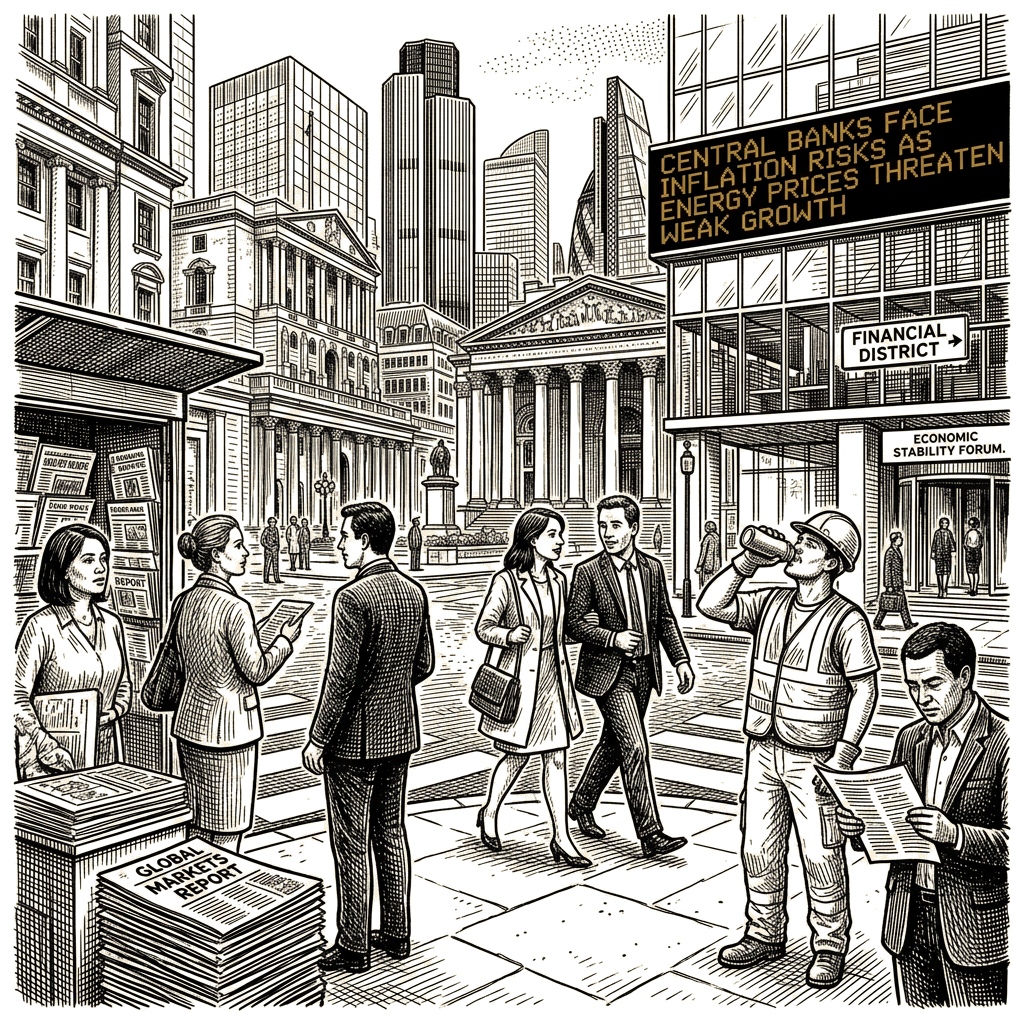
Central banks are choosing debt relief for governments over price stability.
Here are the numbers. U.S. inflation fell from 4.2% in May to 3.5% in June and 3.4% in July, while Brent crude rose again to about $90 a barrel after disruption around the Strait of Hormuz. The July Bureau of Labor Statistics data were collected before that climb. They do not repeal the oil market. Cheaper fuel lowered the recent inflation reading. More expensive fuel will raise energy and transport costs later.
The Federal Reserve’s July decision to hold its target range at 3.5% to 3.75% is not the central question. The question is what a central bank does when imported energy raises prices while weaker real income reduces spending. A rate increase can restrain demand and prevent a temporary price shock from becoming a wage-and-price cycle. It cannot produce more oil or reopen a shipping route. Higher interest rates do not make fuel cheaper. The distinction is elementary. Policy commentary keeps losing it.
The Federal Reserve, the Bank of England and the European Central Bank learned the wrong lesson from 2022. They were slow to respond when inflation exceeded 10% in the United Kingdom and eurozone and 9% in the United States. They now risk protecting their credibility with language while protecting government finances with inaction. The pressure on Fed Chair Kevin Warsh to raise rates is not a quarrel about whether models are elegant. It is a quarrel about whether the institution will use its instrument when using it is politically expensive.
Warsh has removed forward guidance, meaning the Fed’s explicit signal about the likely path of interest rates. He has also declined to contribute his own projection to the dot plot, the chart of officials’ expectations for rates, growth, inflation and unemployment. The case against both tools is substantial. The 2022 inflation episode exposed the limits of forecasts that treated a changing economy as a stable machine. Mervyn King’s Radical Uncertainty made the same point: people do not behave like atoms in a laboratory, and a central bank does not know the future rate path two years in advance. The dot plot is not a forecast in the ordinary sense. It is a collection of conditional judgments that financial markets routinely treat as a promise.
But abolishing a bad forecast is not the same as explaining a policy. A reaction function—the plain-language rule describing how the central bank responds to inflation, employment and financial conditions—is the necessary replacement. The public does not need a promise that rates will be 4% next spring. It needs to know what evidence will make the Federal Reserve raise them, hold them or lower them.
The rule should be blunt. Hold while the oil shock remains a one-off price movement. Tighten when wages, rents, services and inflation expectations begin to chase the headline. Persistent second-round inflation is the monetary problem. The oil price itself is not. Refusing false precision is not a substitute for explaining that decision rule.
So far, Warsh has supplied neither a rate path nor a reaction function. Charlie Bean, the former Bank of England deputy governor, described the result plainly: the Fed is not saying where rates are going or how changes in the economy will affect them. That is not radical uncertainty. It is incomplete policy.
The United Kingdom shows the fiscal constraint more clearly. Consumer-price inflation was 2.6% in June against a 2% target, and the Bank Rate remained at 3.75% after the Bank of England left rates unchanged and signalled caution on the Hormuz reopening. The Bank of England can raise borrowing costs and reduce demand. It cannot produce more oil. That is the true half of the argument.
The suppressed half is the pass-through. Energy costs enter transport, production and household budgets. If the first shock passes through wages, rents, services and expectations, inflation is no longer merely an oil-price problem. A central bank that refuses to respond because the first cause is external is not practicing restraint. It is allowing the shock to become embedded.
The debt problem makes the hesitation intelligible and unacceptable. Higher rates increase the government’s debt-service bill. The United States just paid its highest borrowing costs on 30-year bonds since 2001, and a rate increase would raise the government’s financing bill further. That is a fiscal consequence, not a veto over monetary policy. Fiscal dominance means that fiscal needs constrain monetary policy rather than the central bank controlling its instrument independently. Monetary policy is not required to tolerate inflation to protect the Treasury. It is required to state openly when the Treasury’s financing costs are part of the political pressure.
The danger is not that higher rates damage public finances. The danger is that officials quietly accept higher inflation because the alternative is politically expensive. The pressure on Warsh to hike rates was visible before this latest energy shock. The shock has made the tradeoff harder; it has not removed it.
The ECB’s June rate increase illustrates the opposite error, and it does not disprove the thesis. Raising rates into an energy-driven slowdown may demonstrate resolve while doing little to reduce imported prices. It can still be justified if policymakers see persistent second-round effects. But the justification must identify those effects. “Inflation rose, therefore rates must rise” is not a policy framework. It is a reflex.
The proper reform is not silence. It is narrower guidance, better scenario analysis and an explicit reaction function that distinguishes supply shocks from demand excess. Forecasts should carry uncertainty bands. The assumptions should be visible. The institution should say what evidence would make it hold, hike or cut. Fiscal policy should stop treating debt service as someone else’s problem, and the tax base should be broad enough to finance government without forcing the central bank to choose between inflation and sovereign refinancing stress. Tax-base broadening is not a slogan here. It is the ordinary way to prevent monetary policy from becoming the government’s debt-relief instrument.
Inflation targeting without fiscal repair is a convention written on paper and underwritten by households whose wages do not adjust on schedule. The central banks are not powerless. They are constrained by the fiscal consequences of using the power they have. Refusing to pay that cost does not make inflation disappear; it transfers the cost to households whose savings, wages and purchasing power are repriced last.
The reaction function is the score. Governments do not get to grade it.