
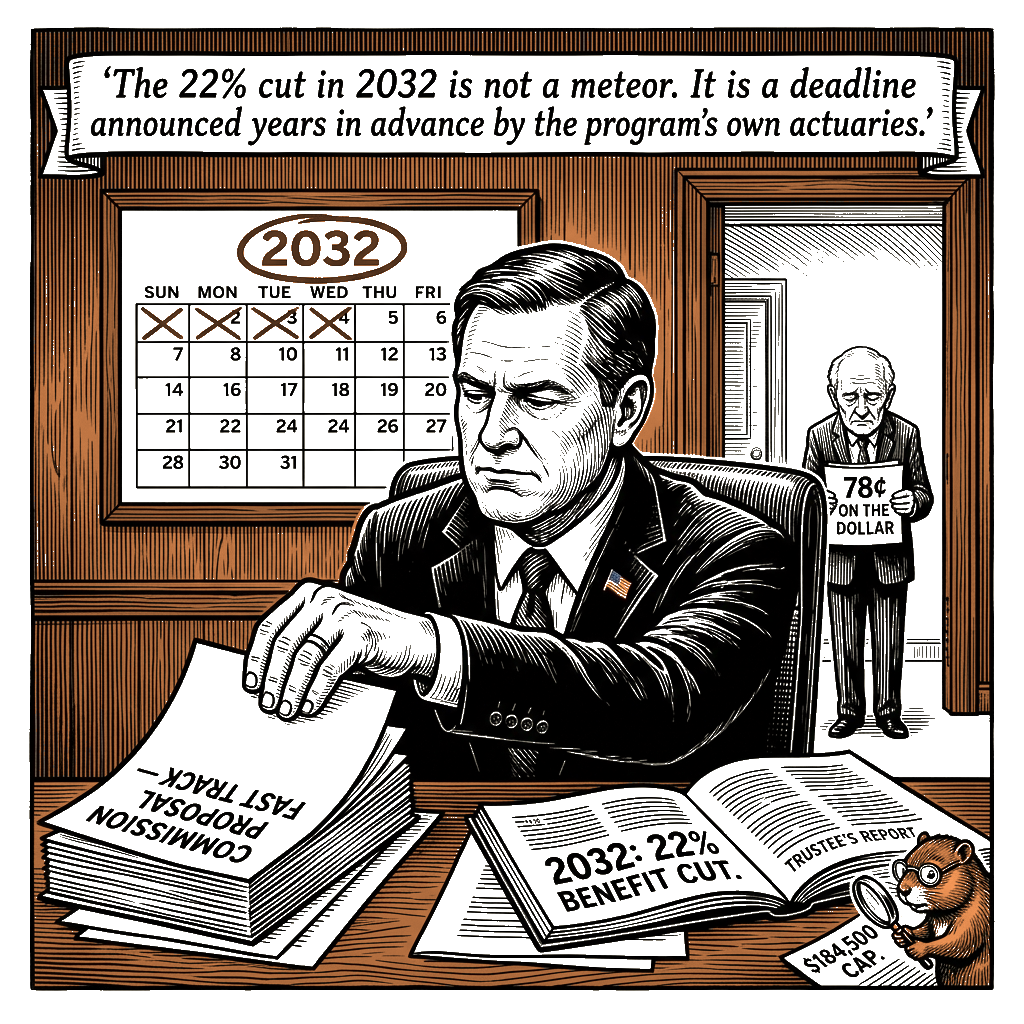
Six years out, Social Security benefits get cut by 22% — automatically, by law, because Congress refused to act. Every member knows the date. They can name the dollar number for the 2033 shortfall, which exceeds $450 billion. They can name the $184,500 cap on the 12.4% payroll tax that lets the highest earners pay a smaller share of their income into the program than the people who depend on it for survival. They know exactly what is coming. They just refuse to lift a finger on a timeline that matters.
This is the most foreseeable crisis in American governance, and Washington is treating it like weather in some other city. Lawmakers float advisory boards, bipartisan commissions, expedited-vote gimmicks, and “fast-track consideration” — anything to look serious without spending political capital. Reps. Tom Cole (R., Okla.) and Tom Suozzi (D., N.Y.) want a commission that guarantees an up-or-down vote if a panel produces a 75-year solvency plan. Sen. Tim Kaine (D., Va.) is behind two bills — one to empower an advisory board, one to borrow into an investment fund — and both ideas have significant detractors, and the leading Republican sponsors are retiring. That is the state of “bipartisanship” in 2026: retired co-sponsors and expedited-vote promises for a problem that needs money.
The money question is the only question. Sens. Bernie Moreno (R., Ohio) and Elizabeth Warren (D., Mass.) are pushing the most coherent answer currently in circulation: scrap the $184,500 cap on the 12.4% payroll tax. If enacted now — and the new contributions are denied as a basis for higher future benefits — that move alone closes roughly two-thirds of the long-term funding hole. That is not a hypothetical. That is the published arithmetic on scrapping the wage cap, and the people campaigning for it have no reason to lowball what the move would actually do.
The plan is also the largest tax increase in over 40 years, per the Tax Foundation, and would push top marginal wage-tax rates above 50% in high-tax states where a lot of Democratic voters happen to live. So progressive groups are not celebrating. They are flinching. Michael Linden at the Washington Center for Equitable Growth says progressives should walk in “with the assumption that there will be no benefit cuts, nothing significant.” Sen. Bernie Sanders (I., Vt.) wants benefit increases. Martin O’Malley, who ran Social Security under Biden, says “the problem really can only be solved by something that the vast majority of the American public are supportive of—and that is scrapping the cap on income.” That is not a coalition. That is a faction holding its own coalition hostage.
Republicans are simply afraid of the issue. Andrew Biggs at the American Enterprise Institute, a senior Social Security official under George W. Bush, says they “just don’t know what they want.” The pre-Trump party once pushed a higher retirement age and slower cost-of-living adjustments. Bush’s 2005 partial-privatization push collapsed. Trump in 2016 campaigned on blocking benefit cuts and has held that posture through two terms — a White House spokeswoman is on the record saying “there will be zero reductions to Social Security payments.” Senate Finance Chair Mike Crapo (R., Idaho) backed benefit reductions in 2010 and is now refusing to revisit the math, telling reporters the economics are “a new dynamic” he hasn’t evaluated.
Translation: nobody in either party will own the answer, and the answer is staring them in the face. Sen. Ron Wyden (D., Ore.), the top Finance Committee Democrat, will talk about taxing billionaires’ unrealized capital gains but won’t say the word “payroll tax.” Kaine’s “we’re not sleepwalking here” line is the giveaway — every member who uses that frame is announcing that they know they are sleepwalking. The bipartisan commissions and fast-track boards are escape hatches for legislators who want a vote to demonstrate seriousness without ever voting for a specific fix.
The 1983 precedent is real: a bipartisan commission produced the last major Social Security overhaul months before the insolvency deadline and defused the issue for the 1984 campaign. But the hole is “much, much harder” this time, in Biggs’s words. The trust fund will be gone by 2032, accelerated by lower fertility, slower immigration, and the 2025 Republican tax law. Disability fund transfers can push insolvency to 2034 — a two-year delay, not a solution. Past tax and spending changes that would have closed the gap years ago are no longer large enough.
The hard truth is that Congress will get the crisis it deserves. The 22% cut in 2032 is not a meteor. It is not a pandemic. It is not a war. It is a deadline announced years in advance by the program’s own actuaries, debated in hearings, restated by every think tank in Washington, and ignored by every member who would rather point to a commission than cast a vote. The Main Street Independent has already tracked how the bipartisan Social Security bill has stalled and how the trustees’ latest report keeps moving the runway shorter. If Congress wakes up in 2031 and discovers it has to choose between a 22% cut and a payroll-tax increase, it will not be because the warning was unclear. It will be because the warning was comfortable.