
Donald Trump is using USPS rulemaking to dismantle mail voting because mail voting increases turnout, and turnout favors his opponents.
By Thursday afternoon in Boston, one federal judge will decide whether the 2026 midterms run on a postal system the President invented last month, or on the system states have spent the better part of two years preparing. There is no middle ground. There is no “let’s wait and see.” Judge Indira Talwani’s courtroom is the only place left where the question can be answered in time, and the answer lands within hours of the first ballots dropping into the mail in early-mover states.
This is the second act of a case the Supreme Court itself wrote the script for. In late August, the justices told her the first round of her prohibition had been premature — not because the order was lawful, but because the Postal Service had not yet bothered to publish its implementing rules. The Postal Service fixed that problem for the administration in a weekend. Voting rights plaintiffs fixed it for themselves by refiling within days of the rules appearing in the Federal Register. The case came back to Talwani within a week, and now she holds the only gavel that matters.
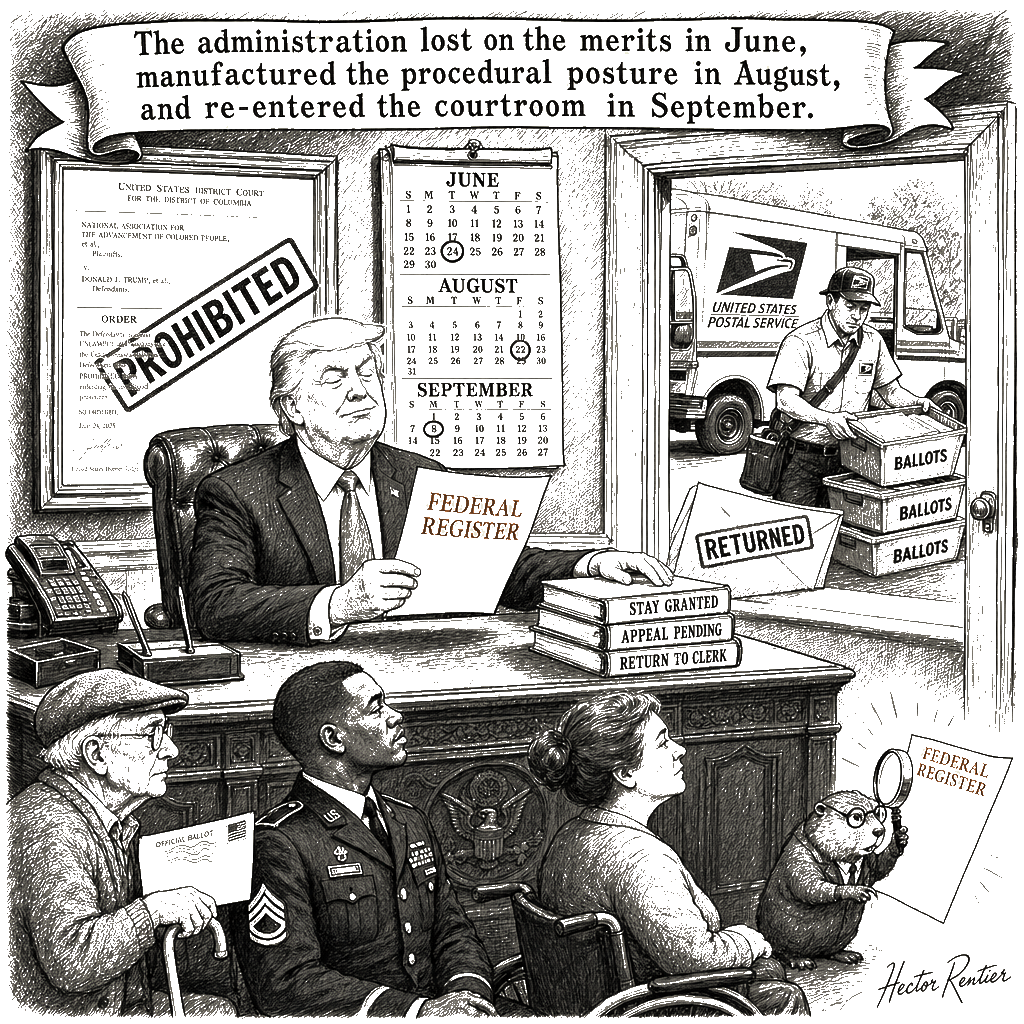
The sequence is worth laying out, because the sequence is the indictment. In June, Talwani prohibited the administration from implementing the underlying executive order for the November election, on the grounds that the changes came too close to Election Day for the federal government to undertake. The administration did not simply comply. The Postal Service published regulations implementing the order. The Supreme Court, in late August, ruled that her June prohibition had been premature — its reasoning turned on the absence of published rules. Once the rules appeared, voting-rights groups and Democrats re-filed in Talwani’s courtroom, returning the case to the judge who had already found the federal government’s timeline unconscionable.
Read that sequence again. The administration lost on the merits in June. It then manufactured the procedural posture that produced a Supreme Court reversal. It then re-entered the same courtroom where it had already lost, betting that the judge who found its conduct unacceptable would now find its conduct acceptable because the conduct now came with a Federal Register entry number. This is not a legal strategy. It is the legal version of “the cruelty is the point” — the procedural form preserved while the substantive harm continues.
The shape of the opportunity here is not subtle. The Postal Service has now published regulations. That gives Talwani everything the Supreme Court said was missing the first time — a concrete agency action to review, ripe for challenge, with hard facts on the page instead of speculation. Plaintiffs can now point to specific provisions, specific implementation deadlines, specific burdens on state election administrators, and ask a federal court to do what it could not do in June: read the rules and decide whether they belong in force during an election that’s already underway. The legal posture is stronger than it was. The timeline is worse.
The 14-day restraining order Talwani imposed last week expires next week. Friday is the first day ballots go out. That is not a coincidence the courts can ignore — it is the reason the Thursday hearing exists. If Talwani converts the TRO into a preliminary injunction, the new postal rules cannot be required of any state for the midterms. Election administrators get to use the system they have spent the cycle building, ballot envelopes get printed, voters get clarity, and the question of whether the executive order comports with the Constitution gets answered at leisure. If Talwani declines to extend, the new system takes effect on Friday morning, and millions of voters will receive ballots governed by rules that were published less than two weeks before they arrive.
The administration is asking the court to read “premature” as a permanent answer. Plaintiffs are asking the court to read it as a temporary one — a holding pattern while the rules were invisible, never meant to extinguish review once the rules were real. Both readings are grammatically possible. The structural reality is that the administration’s victory at the Supreme Court was procedural, not substantive. The Court did not bless the order. The Court said come back when there is something to review. There is now something to review. There is also less than seventy-two hours to review it before ballots move.
Let me invoke the appropriate mentor here, because the Letter from Birmingham Jail in April 1963 remains the most useful diagnostic instrument we have for civic discourse of this kind. King, writing from a jail cell, drew the distinction between negative peace — the absence of disturbance, nobody marching, nobody shouting, the editorials calm — and positive peace, the presence of justice. The Supreme Court’s August ruling produced negative peace — not because the Court chose peace over justice, but because the Court was handed a procedural posture manufactured by the administration, and the Court ruled on the posture. The Federal Register had been consulted. The ballots had not yet been disrupted in fact. Justice was not present. The Supreme Court did not rule that the underlying executive order was lawful. It ruled that the prohibition of the underlying executive order had arrived one procedural step too early. That is a victory for the order of litigation. It is not a vindication of the underlying executive order. The negative peace was manufactured for the Court, by the administration, and the Court accepted it as the case before it. The substantive peace that is the presence of voter access was not before the Court. The substantive peace that is the presence of voter access is before Talwani on Thursday.
Let me name the cui bono clearly, because the column will not name it for us. Trump issued the executive order. The Postal Service wrote the rules. The Postal Service is the entity that handles a substantial share of mail ballots in this country, including ballots cast by members of the military serving overseas, by elderly voters who cannot easily reach a polling place, by voters with disabilities for whom accessible in-person voting is unavailable, by rural voters whose nearest drop box is the one at the post office, and by voters in jurisdictions where state law presumes mail delivery for ballot return. The public framing is “election integrity.” The distributional impact is a reduction in the share of voters who can return a ballot without standing in line, and an increase in the share of ballots that arrive late, are rejected, or are never counted.
Who benefits. Mail voting is the channel used disproportionately by voters whose participation is most easily suppressed by disrupting it: older voters, rural voters, voters with disabilities, voters overseas, voters in jurisdictions without robust early-voting infrastructure. The voters who newly turn out through expanded mail access skew away from the higher-propensity, in-person, dense-urban electorate that the incumbent’s coalition depends on. The Supreme Court’s August ruling did not adjudicate this distributional fact. It adjudicated a procedural posture. The procedural posture was manufactured, in the literal sense, by the administration that wanted to clear the docket and re-enter the courtroom.
Let me translate what that move does on the ground. The Trump executive order requires the Postal Service to adopt a new mail-ballot system with operational requirements that several states — both Republican- and Democratic-controlled — have testified they cannot meet on the timeline imposed. The specific operational requirements are not my argument; Talwani will weigh them. The structural argument is that the executive branch, through the instrumentality of the Postal Service, is attempting to dictate the terms on which state-administered elections may be conducted, in the window between now and Election Day, when state election officials have already printed ballots, hired workers, trained workers, opened early-voting sites, and mailed sample ballots. The Postal Service is not the sovereign of state election administration. It is the carrier. The order attempts to make the carrier the sovereign. That is the structural move.
The case fits two documented bad-faith patterns with unusual precision. The first is goalpost-shifting: the standard of justiciability was satisfied when the underlying harm was imminent; the administration satisfied itself that the standard was no longer satisfied by the expedient of publishing rules that satisfied no one but the Supreme Court’s procedural disposition. The standard moved with the litigation, not with the underlying conduct. The second is manufactured controversy, in the pattern Naomi Oreskes and Erik Conway documented in Merchants of Doubt. The “election integrity” framing manufactures a consensus-dissent split where the actual evidentiary position is one of substantial consensus. In-person impersonation fraud at the polls is vanishingly rare, mail ballot fraud is documented but rare, and documented fraud cases typically involve small numbers of ballots and are detected by the existing system. The executive order names a fraud problem. The fraud problem does not name the executive order. The non-crisis is used as the warrant for the order that produces the actual problem.
The harm is not that mail voting is fraud-ridden. The harm is that the executive branch is using a fraud-free pretext to disrupt a vote-by-mail system that voters in dozens of states have relied on for years. The people whose votes are about to enter the mail system are not abstractions. They are a sergeant at Fort Liberty whose ballot will travel through the same Postal Service the executive order is reorganizing. They are a grandmother in rural Montana whose nearest early-voting site is forty miles of gravel road away. They are a veteran in wheelchair-accessible housing whose accessible voting option is the mail. The administration’s procedural maneuvering is producing, with reasonable foreseeability, ballots that arrive late, ballots that are rejected for non-conforming envelopes, ballots that are never counted.
What Talwani decides Thursday is not whether Donald Trump’s executive order will survive. What she decides is whether the November midterms will be litigated as the order takes effect, or whether they will be run by the system that states already chose. The first option produces chaos in county clerk offices from Phoenix to Portland and a downstream constitutional fight that will outlast the cycle. The second produces an election. There is no version of this where a judge reads both sides, weighs the equities, splits the difference, and orders a study period. The facts move too fast for compromise. The bench picks a side by Friday morning, and the midterms run on that choice.
If the order lapses Thursday, the new system takes effect as ballots reach voters Friday. States that have testified they cannot meet the operational requirements will be told to comply anyway, in the same week their ballots begin arriving. The ballots that arrive late, the ballots rejected for non-conforming envelopes, the ballots never counted at all — they will not be the administration’s problem. They will be the voters’ problem, and the local election officials’ problem, and the problem of every state and federal court asked, after the election, what the executive order meant and who was supposed to absorb its costs. That is what is at stake on Thursday.
The arc bends, in the inheritance I carry, only when specific people in a specific moment push it. The arc does not bend by the Supreme Court’s procedural disposition. The arc does not bend by the Federal Register’s publication date. The arc bends when the judge who in June found the federal government’s timeline unconscionable finds it unconscionable again, in September, with the first ballots already in the mail. The arc bends when state election officials who have certified their mail-ballot systems refuse to be reorganized out of their authority by a carrier that delivers the mail and does not run the election. The arc bends when voters who are about to receive a ballot they cannot easily return show up at the courthouse, the clerk’s office, and the post office, and tell the people who work there what the executive order is doing to the vote they were about to cast.
This column is not optimistic. It is also not grim. It is the diagnostic. The procedural shell game is a shell game. It runs on rules, and on reversals, and on the gap between a Federal Register entry number and the actual disruption of a vote. The shell game has a referee. The referee is Judge Indira Talwani, in Boston, on Thursday. The referee’s job is to do what the referee did in June. The referee’s job is to do it on the merits, with the rules now in the record, with the ballots now in the mail, with the structural pattern now named in the public record by every voting-rights group that has re-filed in her courtroom this week.
By any means necessary that operate within the instruments available to us — and those instruments include a federal courtroom, the documentary record, and the public naming of the cui bono — we keep the receipts. We name what is happening. We make the procedural shell game costlier to run than the structural harm it produces.
The ballots go out Friday. The hearing is Thursday. The arc is not bent yet.