
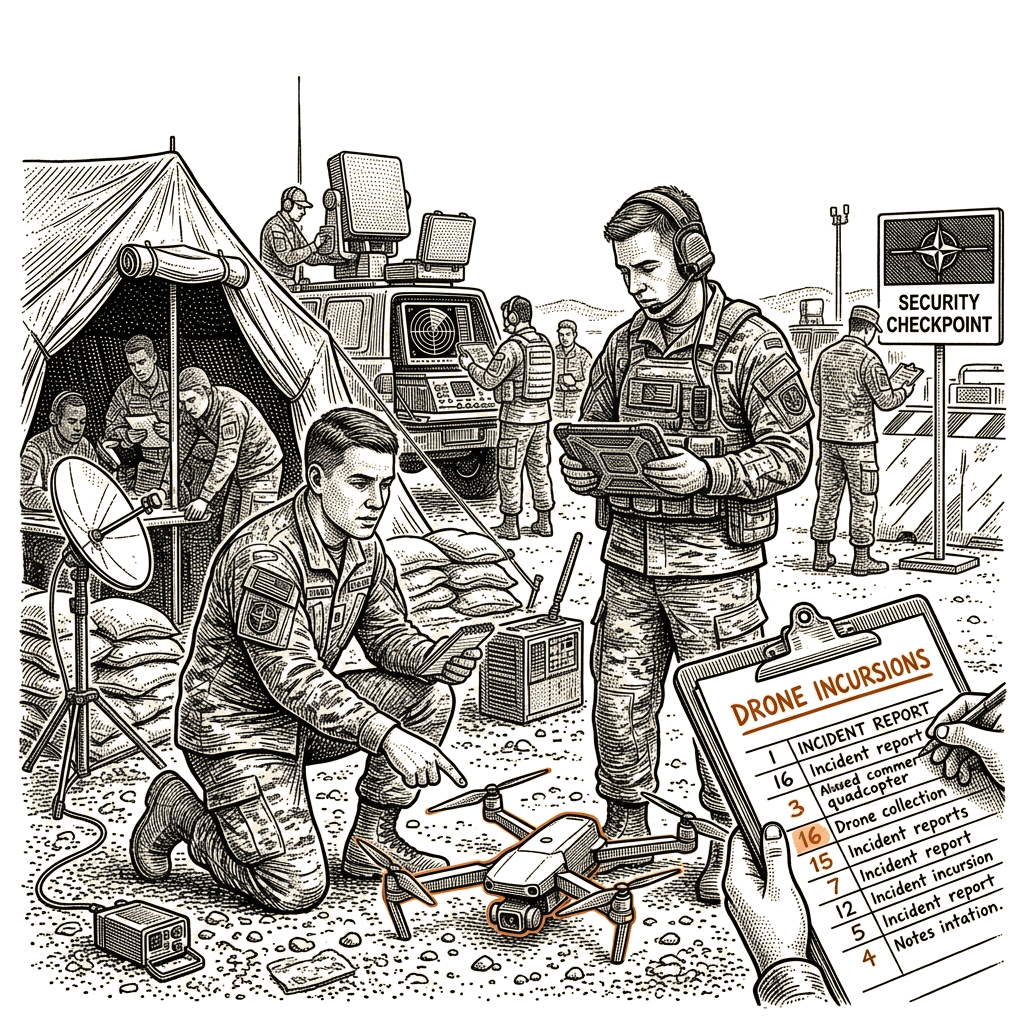
Putin is sending drones over working people’s towns and making families pay for the missiles. Sixteen NATO countries have found drones in their airspace or on their ground over the past two years, and the pace is picking up.
In August, German authorities found explosive drones at Leipzig airport — the airport that moves the supplies headed to Ukraine. Berlin has vowed retaliation. The same month, Romanian jets went up to destroy a naval drone sailing close to a gas platform in the Black Sea, where the crews work the platforms out of sight of land. Almost every week this summer, NATO jets scrambled somewhere along the eastern frontier. The Kremlin denies it’s behind the pattern. Some of the sightings are Ukrainian drones knocked off course by Russian jamming — that’s in the record too — but the pattern that has sixteen countries on alert is Putin’s, and the officials who track it have already named it: a Russian escalation of “gray-zone” attacks across Europe.
Now, I’m just a simple man who runs an auto shop, but I know what it costs to keep the lights on, and this does not pencil out. The drones crossing into European airspace cost about what a good pickup truck costs — fifty thousand dollars, maybe a few hundred thousand for the big ones. The missile that shoots one down costs more than a house. The fighter jet that carries the missile costs a hundred million dollars, and it burns more in an hour of flying than a working man makes in a year. So the alliance is answering a fifty-thousand-dollar drone with a two-million-dollar missile fired from a hundred-million-dollar jet, and the bill lands on the tax rolls of every working family in Europe. No man who runs a shop would answer a fifty-dollar problem with a five-thousand-dollar repair. You’d be out of business by Tuesday. Europe is not out of business yet, but it’s spending like it wants to be.
And here’s the part that ought to make a working man angry. Every time a drone crosses the border, somebody builds the missile that shoots it down. Every missile fired is a contract. Every contract is a profit. The defense contractors are cashing the difference between the cheap drone and the expensive missile, and they’re not the ones whose grocery money goes up. The pilot who scrambles burns training hours he will never get back — hours that keep him ready for the fight that actually matters. The mechanics on the flight line work the overtime. The baggage handlers at Leipzig go to work wondering what else might be hiding in the cargo. The family in Galați, Romania, hears the drone at night — the one that hit a building there in May — and wonders if the next one is carrying anything. The contractors? They’re counting their money.
Let me be plain about whose side I’m on. I’m on the side of the baggage handlers at Leipzig, the crews on the gas platforms, the families in Poland and Romania who hear drones buzzing overhead at night, the taxpayers who pay for the missiles, and the pilots and mechanics who do the actual work. I’ve stood on the working end of a war machine, and I know who does the dying and who does the billing. Putin’s regime is squeezing working people all across Europe — making them pay, in taxes and fear and lost sleep, for a war they never voted for. That’s what this is. It’s a squeeze on ordinary people, and it’s working.
No single drone crossing is big enough to trigger the treaty’s promise that an attack on one is an attack on all. And that’s exactly the point. Putin doesn’t need to hit a NATO country to win. He just needs to keep the drones coming — one a week, one a day — until defending every town in Europe costs more than the people who live there can bear. The ambiguity isn’t an accident. It’s the weapon. A drone worth less than a pickup truck ties up a fighter jet worth a hundred million dollars, and the jet can’t be everywhere at once. Every hour it spends chasing a drone over the Baltic is an hour it’s not ready for the real fight.
The European Union says it’s building a “drone shield” — a network of sensors and interceptor drones along the eastern border — but it won’t be fully working until the end of 2027. The basic radar is supposed to be in place by the end of this year. That means Europe’s eastern flank is going to be answering drones with fighter jets for at least another year and a half. The calendar is public. The window is open. And the drones keep coming.
The answer isn’t more two-million-dollar missiles. It’s cheap, effective defenses that don’t bankrupt the people they’re supposed to protect, and it’s telling the truth about who’s doing this and why. The men who send the drones don’t hear them at night. The families who hear them are the ones who pay for the missiles, and the men who build the missiles are the ones getting rich. That’s the whole story, and it’s an old one. But the families in Galați and the baggage handlers at Leipzig are living it now, and they deserve better than a strategy that spends their money and their sleep while the contractors count theirs.