
Trump is weaponizing green-card rules to drive four million people from healthcare.
That is the number Mayor Zohran Mamdani says could be pushed off coverage when the administration’s resurrected public-charge rule takes effect Thursday, September 18. It is a number so large it stops being a statistic and becomes an indictment.
The rule is designed to make immigrant families afraid to use the public programs their taxes help sustain. It reaches into mixed-status households and turns ordinary acts of survival into evidence against a future green-card application: a college-aid disbursement, a few months of food assistance, a clinic visit, or a child’s healthcare enrollment. Adjudicators are told to weigh not only whether an applicant depends primarily on government aid, but whether that person might depend on it someday.
A future test.
A family test.
A health test.
A wealth test disguised as immigration policy.
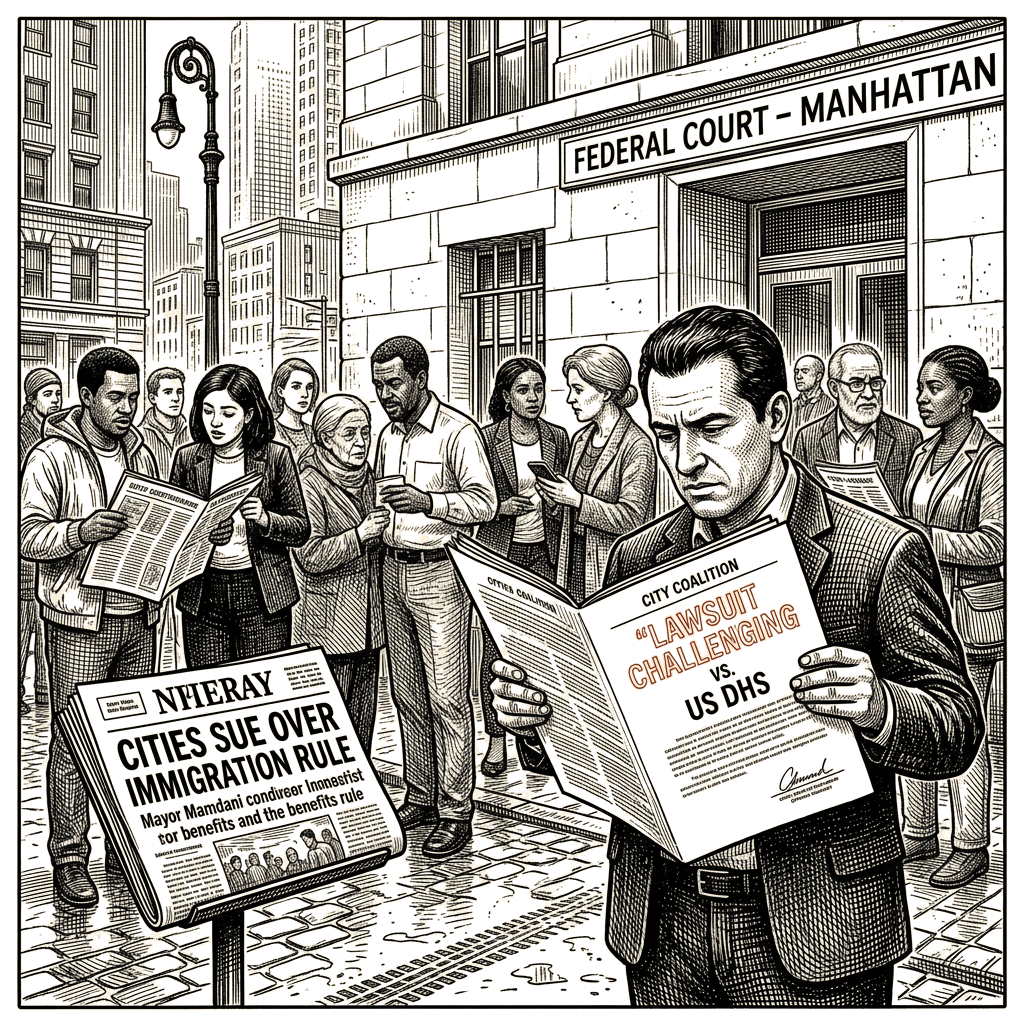
On Monday, Mamdani and a coalition of cities including New York, Chicago, San Francisco and Seattle filed suit in Manhattan federal court. The coalition’s complaint argues that the rule unlawfully rewrites decades of precedent that limited “public charge” to immigrants whose primary means of survival was government aid. They are right. The administration is not restoring a neutral standard. It is expanding a threat.
The rule’s reach is not speculative. Mamdani said an estimated four million people could unenroll from healthcare, including U.S. citizens in mixed-status families who would rather forgo coverage than risk a relative’s immigration case. A parent who skips a WIC appointment because a future green-card interview might surface it has already been punished. The rule has done its work before an adjudicator ever opens a file.
No court can easily unwind that fear.
The administration revived the rule over the summer, after the federal government had spent a decade narrowing public charge to mean primary dependence on public aid. That line existed for a reason. Earlier versions of the rule weaponized hunger and sickness against people with the least political cover. The new rule reaches toward the same cruelty while dressing it in administrative language.
This is not immigration enforcement. It is the weaponization of the visa system to empty public programs that American citizens rely on, too. It is a campaign to make American public life toxic to anyone who is not rich enough to bypass it.
The rule’s defenders say it merely restores the original meaning of “public charge.” That is a half-truth with a knife inside it. The original meaning was narrowed because the broader rule produced a chilling effect that drove eligible families away from food, healthcare and education. The administration knows what fear does here. Fear is not an accidental byproduct. Fear is the instrument.
“Nothing about this rule will reduce waste or keep Americans safer or improve New Yorkers’ lives,” Mamdani said. “It is simply a vehicle for confusion and a vehicle for cruelty.”
He was being polite.
This is a weapon aimed at the most vulnerable people in the country. It is being aimed by an administration that has spent the better part of two years pushing census proposals and tuition lawsuits to do the same work from different angles: narrow who counts, restrict who receives public investment, and make belonging conditional on wealth.
The administration’s census proposal would exclude refugees and asylum seekers from the country’s political accounting. The tuition lawsuits attack access to education for noncitizens. The public-charge rule threatens healthcare and food assistance. Different documents. One moral direction.
Make the person disappear.
Make the benefit dangerous.
Make the family choose.
Mamdani’s coalition understands what Washington does not. The cities fighting this rule are not spectators. They are the governments that deliver public benefits to the people the rule is trying to scare away. When four million people stop showing up at the clinic, the city must answer the phone. When a child loses coverage because her mother applied for a green card, the city faces the broken body and the empty prescription.
That gives the cities standing, motive and expertise the federal government does not have.
New York Attorney General Letitia James filed a parallel suit the same day on behalf of New York and nearly two dozen other states. The two complaints are complementary, not redundant. Cities fight where the harm becomes local and bodily. States fight where the rule becomes federal machinery. Together they cover most of the country’s largest municipalities and a near-majority of states.
Chicago, San Francisco and Seattle are the three largest sanctuary-jurisdiction mayors’ offices in the country. Their participation matters because sanctuary is not a slogan. It is a decision about whether local government will become an extension of a federal system that turns a person’s need into evidence of unworthiness.
We who claim the gospel and live in this country have helped build a different kind of sanctuary: one that welcomes the deserving family and quietly leaves the undocumented neighbor to calculate the risk of asking for bread. Catholic institutions, city agencies and charitable networks have sometimes made people prove their poverty before offering help. We have taught families that assistance comes with paperwork, exposure and shame.
That complicity does not make Trump’s rule less evil. It tells us why the rule finds such fertile ground.
The Torah says, “You shall not wrong or oppress a resident alien, for you were aliens in the land of Egypt.” Jesus says, “I was a stranger and you welcomed me.” He also says, “I was a stranger and you did not welcome me.”
The question is not whether a government may administer a program. The question is what the government does with the person standing before it. Does it see a neighbor, or does it see a future liability?
You can call the rule public charge, Mr. President. The name does not change the act. You are making food, medicine and education dangerous for families whose only offense is needing what citizens need. You are turning the machinery of lawful immigration into a trapdoor beneath the poor.
Óscar Romero once cried, “In the name of God, in the name of this suffering people whose laments rise to heaven each day more tumultuous, I beg you, I beseech you, I order you in the name of God: Stop the repression!”
The command belongs here too.
Stop using hunger as a border guard.
Stop using sickness as a character test.
Stop making a child’s healthcare carry the burden of an adult’s immigration case.
The lawsuit is also a test of Mamdani’s mandate. He campaigned on protecting New York immigrants under a second Trump term. Until now, his relationship with Trump had been a study in managed cordiality: an Oval Office visit in November at which the president praised him, a February White House meeting that produced the release of a Columbia University student detained by federal immigration agents, and occasional calls about city business.
That détente is over.
The lawsuit is not a stray shot. It is the position Mamdani was elected to take. New York has filed in its own courthouse, in his own name, against an administration whose policies will be carried out in the city’s clinics, schools and neighborhoods. The coalition has given sanctuary cities a blueprint: file together, move before the effective date, and force the federal government to answer for the bodies and families its paperwork puts at risk.
The deadline is Thursday.
If the court does not intervene, the rule will take effect while the case moves through the Second Circuit. Families will begin dropping coverage before an appellate opinion arrives. The emergency motion is not procedural cover. It is the entire case.
If the firewall holds, four million people keep their coverage and the second-term immigration project loses its quietest, cruelest tool. If it fails, no Oval Office courtesy will undo what happens when the next mother must choose between a green card and a meal.
Other mayors should be on the phone today. The complaint is filed. The precedent is in the brief. The coalition exists, and it has room to grow.
At the clinic door, the question remains plain: will the stranger be welcomed, or will we make the stranger afraid to enter?