
Pete Hegseth is breaking the military’s professional independence and making the troops pay for it.
Eighty generals and admirals are gone. The Joint Staff is taking polygraphs. The Army Science Board was shut down mid-study. And last Friday, the defense secretary’s office announced that every service member would be subjected to mandatory testosterone testing, with the stated goal of building what they called a “High-T Department.” That is not a description of readiness reform. That is a loyalty operation running through the chain of command, and the men and women who actually wear the uniform are the ones getting squeezed.
Now, I’m just a simple man, but I served in an Abrams turret, and I know what readiness looks like from the enlisted side. It looks like a motor pool at five in the morning. It looks like a bore scope on the main gun at the end of a rotation. It looks like an E-4 who can swap out a track pad in his sleep because he has done it a hundred times. It does not look like a blood draw ordered by a man who has never loaded a round.
Eighty generals and admirals — men and women who spent thirty years building professional careers, who ran battalions and brigades and carrier groups — have been fired or held back from promotion since January 2025. Not because they failed at their jobs. Not because they broke any regulation. Because they were not enthusiastic enough about the secretary’s program. Rep. Don Bacon, a retired Air Force brigadier general and Nebraska Republican, said what everyone in the building knows: “I really don’t like that 80 generals and admirals were fired or redlined for promotion.” Then he said the part that matters: “Being dumb is not a crime.” Neither is having an independent professional judgment, which is what these officers actually got purged for having.
The Army Science Board was mid-study — working on whether the Army could fight a protracted war, the kind of question a wartime Pentagon ought to want answered — when Hegseth shut it down without notice. No explanation. No successor. The study just stopped. That is not cutting red tape. That is a secretary who does not want to hear what the experts are going to tell him, so he made sure there would be no experts to tell him.
Then came the polygraphs. Joint Staff members — colonels and generals who run the daily business of planning and executing operations — are being polygraphed in a hunt for leakers. The Pentagon says it “takes all leaks of classified national security information extremely seriously and investigates accordingly.” From where I sat in the gunner’s seat, polygraphing your own senior military staff tells you one thing: the secretary thinks the building is full of people who do not answer to him. When you start polygraphing your own generals, the problem is not leaks. The problem is that you have made the chain of command a suspect institution.
Two of the three service secretaries — the civilian leaders of the Army, Navy, and Air Force — are gone. One was fired. One quit after months of friction. No confirmed replacements. Hegseth stopped inviting the remaining one to regular meetings. That leaves a defense secretary with no confirmed service secretaries, no Army Science Board, a polygraphed Joint Staff, and 80 fewer flag officers than he started with. The officials who know how the building works told the Wall Street Journal that Hegseth has grown more insular, relying on a small circle of close advisers. Inside the Pentagon, that pattern has a name. It is not reform.
On Iran, seven months into a war that lacks a clear exit strategy, Iowa Republican Zach Nunn was one of seven House Republicans who backed a Democratic resolution to curb the president’s ability to continue the war without congressional approval. Hegseth flew to Iowa last month to campaign for Nunn’s re-election. Campaign trips are not war plans. And the soldiers in CENTCOM who are actually fighting — the E-4s and E-5s, the lieutenants and captains, the families waiting at Fort Cavazos and Fort Liberty for someone to tell them when this ends — those soldiers are not helped by a defense secretary who spends his time on the political calendar instead of on telling them what the mission is and when it will be done.
Speaker Mike Johnson sent House lawmakers home early this week, deferring until after the November midterms an impeachment resolution introduced by Kentucky Republican Thomas Massie. The last time a civilian Pentagon chief was impeached was 1876, when Secretary of War William Belknap was charged with taking kickbacks. Charles Stevenson, the Johns Hopkins lecturer who wrote the standard history of defense secretaries, notes that a third of every secretary since 1947 has been fired or forced out. Hegseth is still standing because the President is still standing behind him. That is not the same thing as doing the job well. That is the same thing as having a boss who will not hold you accountable, which is exactly the situation you create when you fire every independent voice in the building.
Eisenhower, in his farewell address of January 17, 1961, warned against “the acquisition of unwarranted influence, whether sought or unsought, by the military-industrial complex.” He was talking about contractors and generals fixing each other’s dinner. What Hegseth has built is the other side of the same coin: a political appointee who has made the military answer to his personal agenda instead of to the Constitution. The fired generals are not answering to him anymore. The polygraphed Joint Staff is answering to him whether they want to or not. And the enlisted soldier sitting in a clinic getting his hormone levels measured because the defense secretary decided that is what makes a fighting force — that soldier will answer to whoever is left standing when this is over.
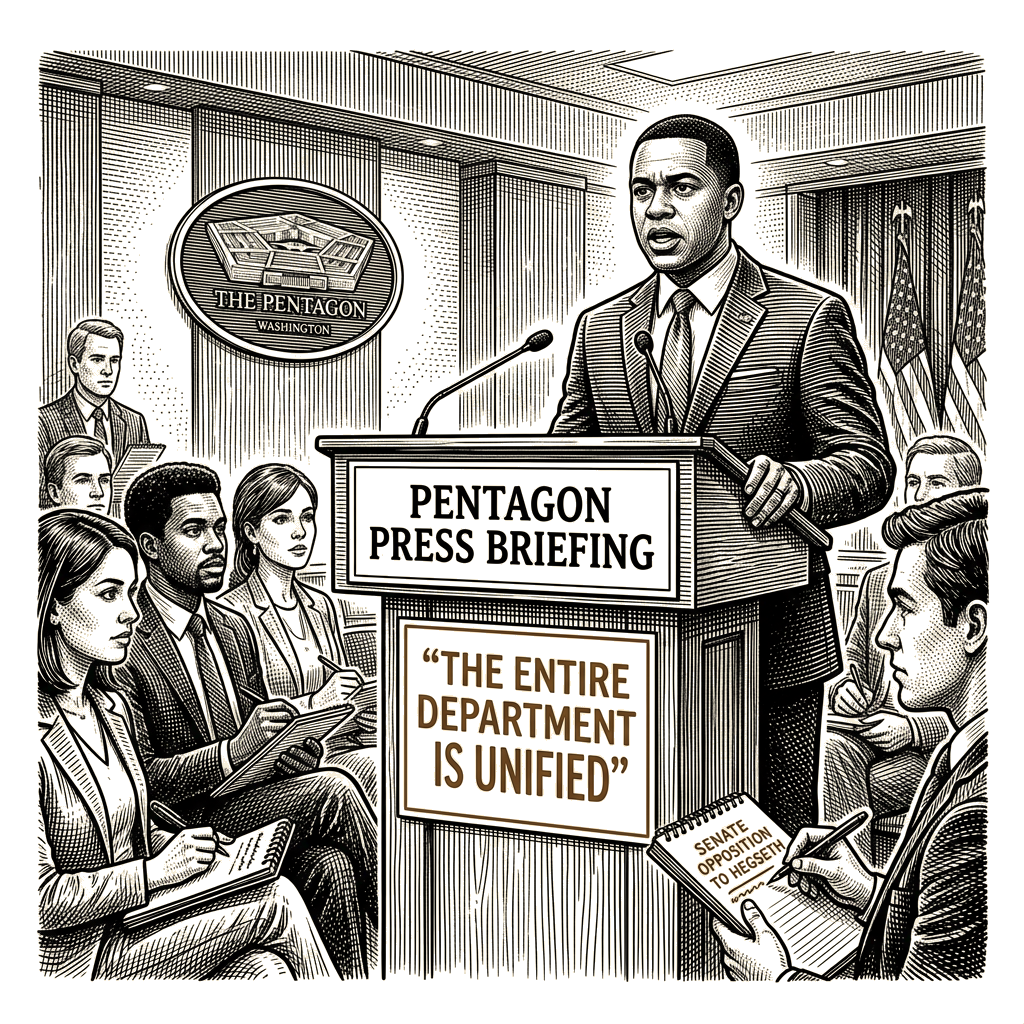
The Pentagon press secretary said the department is “unified” behind Hegseth. That is what departments say when the secretary writes the talking points. The 80 generals he fired are not unified. The Joint Staff members taking polygraphs are not unified. The service secretaries who left are not unified. The Army Science Board that was shut down mid-study is not unified. The enlisted soldier told to report for testosterone testing because the defense secretary thinks that is how you build a “High-T Department” — that soldier is not unified either. He is doing what soldiers do. He is following orders. The people giving the orders have made sure there is nobody left in the room to question whether those orders make the military stronger or just make the secretary more comfortable.