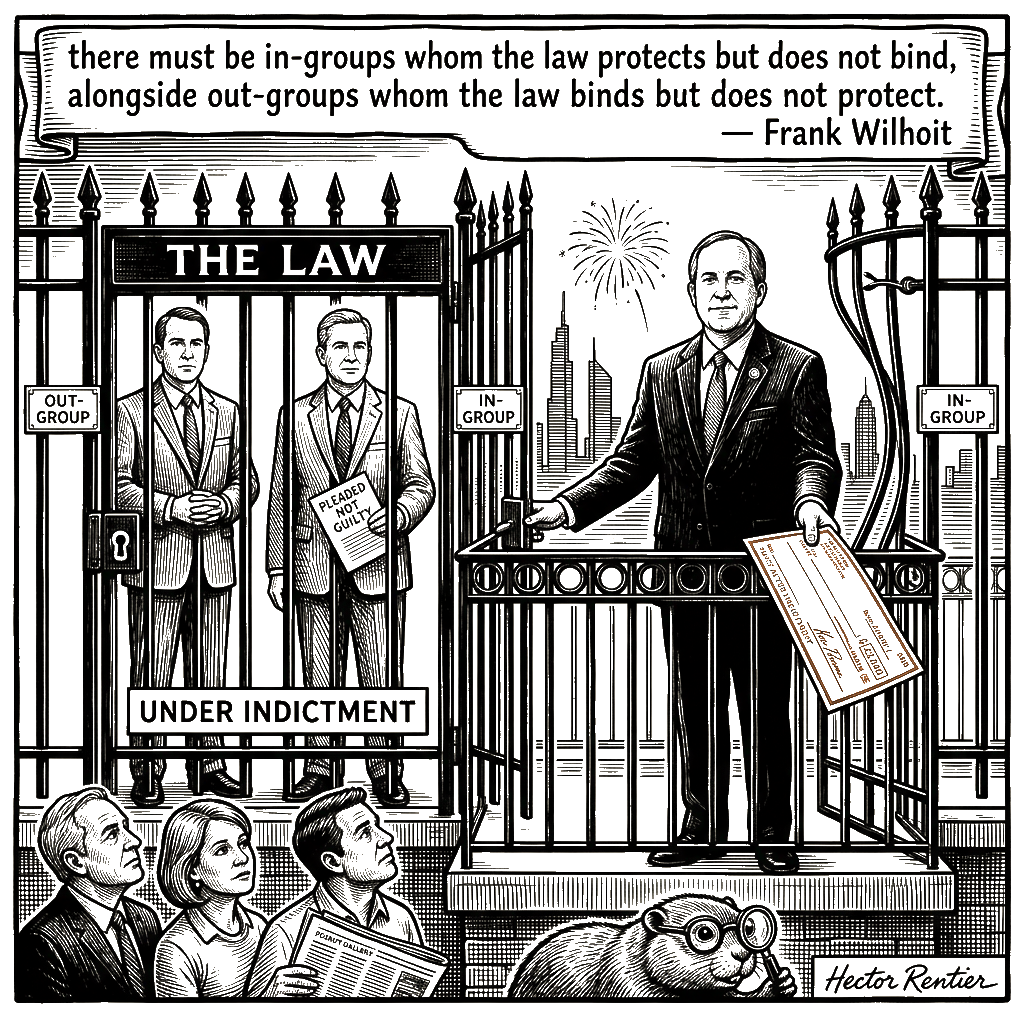
The law has reached the two men on the balcony. It has not reached the attorney general who took $25,000 from one of them days after they were indicted.
Federal prosecutors in Illinois charged Anosh Ahmed and Sameer Suhail with embezzling $15 million from a Chicago hospital where Ahmed was chief financial officer. Ahmed, who also faces a larger case alleging at least $195 million in fraudulent government payments for Covid-19 tests, has pleaded not guilty and is in custody. Suhail is back in the United States to face the charges. Both men spent New Year’s Eve 2024 on a high-rise balcony in Dubai with Ken Paxton, the Texas attorney general, watching the fireworks over the Burj Khalifa — a gathering the Wall Street Journal reported this week from a guest’s video cited in a Texas civil court filing.
Frank Wilhoit, the political scientist, spent his last years naming this arrangement: an in-group whom the law protects but does not bind, and an out-group whom the law binds but does not protect. The out-group here has docket numbers. Ahmed’s lawyers have filed explanations — he was abroad when the first indictment landed, they say, and family health issues delayed his return. Suhail’s attorney says civil matters in Dubai kept him from traveling. Those are what defendants file, and they file them for a judge. The in-group’s explanation for taking the money has never been filed with anyone, because no one with the power to ask for it has ever asked.
The money is a matter of record. Campaign finance records show Ahmed gave Paxton’s campaigns $190,000, including $25,000 days after the indictment came down. I won’t do the arithmetic for you, dear: a check written days after a grand jury named the donor, and a midnight balcony with the indicted men in the frame. Those two facts sit on the record side by side. They touch.
Paxton’s office did not address the trip. His senior adviser, Nick Maddux, issued the line instead: “Like President Trump, Ken Paxton has been politically persecuted for years.” Persecution. One defendant is in custody and the other’s movements are now a matter before a federal court; the attorney general’s exposure to the same indictment is a photograph his office declines to discuss. That is the word for what happens to people without an office.
And none of this is a lapse. It is a machine, running on schedule. Campaign-finance law does not ask a donor whether he has been indicted, and no one empowered to enforce it asks the recipient whether he knows. His own deputies reported him to law enforcement in 2020, which produced an FBI probe, a whistleblower suit his former employees won with a $6.6 million award, and an impeachment by his own party in 2023 — from which he was acquitted by the state Senate and returned to the same desk. The Justice Department dropped its own probe. He was re-elected twice while state felony securities-fraud charges were pending and settled them in 2024 for $300,000 in restitution. He accepted $100,000 from a former client who was under investigation by his own office, and the bribery investigation that followed closed with no finding of wrongdoing. And a courthouse lawyer once accused him of taking a $1,000 Montblanc pen, which he returned and called a misunderstanding.
He is not the machine’s only product; he is merely its most legible. In 2012 HSBC laundered money for Mexican drug cartels and sanctioned regimes, admitted it, and bought a deferred-prosecution agreement for $1.9 billion with not one individual prosecuted. Purdue Pharma pleaded guilty in 2007 and again in 2020; the family that took billions out of it has never been criminally charged. Indictment is a fence for the man without an office and a toll for the man with one, and in Texas the toll has lately been collected in cash, in $25,000 installments, days after the fence goes up.
Note who is answering for healthcare fraud this month. Not the bank. Not the family with the medicine cabinet. Two men, charged in Illinois — one in custody, one back to face the charges — and standing between them and the courthouse, the top law-enforcement official of a state whose own office carries its Medicaid fraud work, holding the check.
President Trump endorsed Paxton in the May runoff after being warned that damaging revelations were likely to surface, and pressed ahead; the Wall Street Journal now calls it his biggest gamble of the midterms. His allies maintain the faithful will carry the balcony attorney general home anyway. What keeps the balcony worth three weeks of headlines is simpler: James Talarico holds a narrow lead, and a Democrat winning Texas statewide for the first time since 1994 is close enough that a photograph becomes evidence.
The office has been good to him. He entered politics in 2002 with less than $175,000 in assets; by 2018 he had told a lender his net worth was some $5.5 million, not counting what he and his wife had moved into a blind trust, and they now own at least a dozen residential properties. From 2022 through 2025, state-funded security accompanied him on 19 foreign trips — more than the governor or the lieutenant governor — and the public record of that travel does not contain the Dubai trip. It surfaced only because a court filing forced it out.
Kent Schaffer filed the charges against Paxton in 2015 and has watched the rest of the ledger accumulate. “It’s just amazing to me that he’s never been held accountable,” he said this week. The two men on the balcony will answer to a federal court the ordinary way, with their explanations read into a record a judge controls. The balcony attorney general will answer to a ballot box, where $25,000 written days after an indictment has never once been held against him. The law found Ahmed in a cell. It has not found the balcony.