
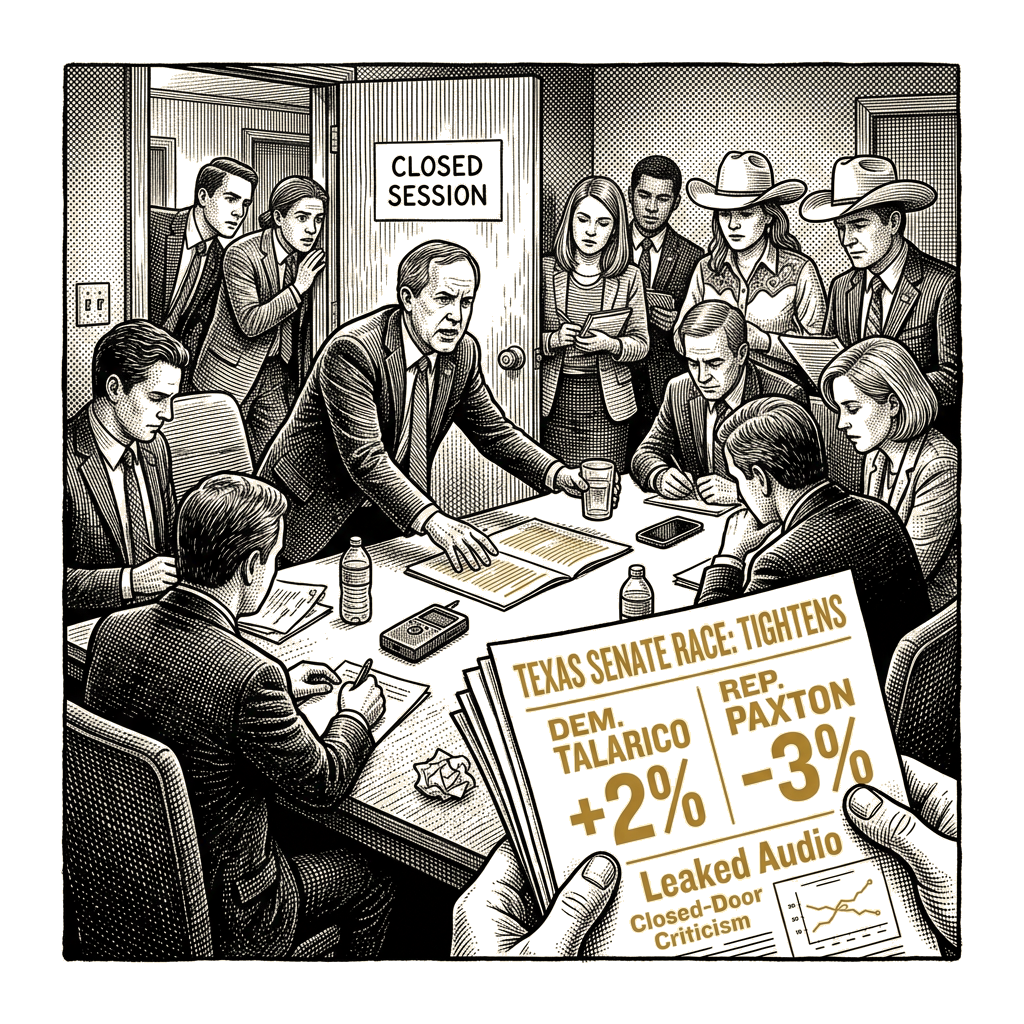
Ken Paxton and Donald Trump spread a fabricated medical smear about James Talarico and never retracted it.
That is the open breach in this race, and it is the one that will still be open on the morning after the returns. While Talarico was off the campaign trail with what his campaign attributed to a bad case of the flu, conservative influencer accounts manufactured the claim that he had been receiving treatment at a mental-health facility in Ohio. Paxton amplified it. Trump amplified it. Talarico came back and denied it — he had never been to Ohio — and he did so having spent the interval describing the absence to voters directly. Neither Paxton nor Trump has withdrawn the claim. A nominee does not launder a fabricated health rumor about an opponent. A president of the United States certainly does not. Both did. Both still have it standing under their names.
The rule that was broken is not a partisan preference. It is the minimum condition under which a campaign’s factual claims can be checked by anyone at all: that a candidate who asserts something about an opponent’s fitness bears the cost of proving it or the cost of retracting it. Paxton and Trump chose a third option, which is that the people who read it bear the cost. The influencers got the views. The platform owners got the engagement revenue. The voters got a lie about a man’s mind, delivered in a state where they have no independent way to test it before they vote.
The audio released this week is the same operation from the inside. In a closed-door meeting, Paxton told the people in the room that his own party and its Washington campaign leadership were running his Senate bid and leaving him to take the losses. That is not a gaffe captured by accident. It is a description of the arrangement, spoken by the man the arrangement was built to promote — and it matches what he has already told donors on the record. The apparatus is not hiding from him. He is describing it accurately and running on it anyway.
And the party he is describing has a record. The Texas legislature impeached Paxton in 2023 on allegations including bribery and abuse of public trust. He was acquitted. His wife of nearly four decades, Angela Paxton, filed for divorce in 2025 on “biblical grounds,” citing adultery. President Trump passed over the sitting incumbent, John Cornyn, to install him — an endorsement whose effect was to tell every incumbent in that party precisely what the cost of disagreement looks like. A Republican-aligned group has since committed $50 million to the effort. None of that is contested. All of it is load-bearing, and none of it was put to the nominee in public, because he declined host Erin Burnett’s invitation to the CNN town hall on Wednesday evening.
Jodi Hunt was the voter who put the standard to the Democrat instead. She identified herself as a self-described single-issue Catholic voter and asked the question directly: “How would you convince me as a Catholic voter that I can trust you would protect the most innocent among us?” Her stake is not abstract. She lives in the state where the legislature has already written the restriction she says she wants into statute, and she is being asked to extend her trust on that question to a candidate whose party applies “biblical grounds” as a fitness test to other people’s marriages and has applied it to none of its own nominee’s. Talarico answered her by saying the Bible is silent on the question. She answered back with “Thou shalt not kill.” He did not flinch: “We may have different moral conclusions when it comes to this particular ethical question, but we actually have the same public policy goal” — abortion reframed as a public-health problem to be reduced by reducing unplanned pregnancies.
That is where the Bible-versus-legalism question actually sits in this race, and it cuts both ways.
Exodus 20:13 and Exodus 20:14 are adjacent verses on the same table, delivered in the same chapter, by the same speaker. “Thou shalt not kill.” “Thou shalt not commit adultery.” The religious-political infrastructure of the Texas right has spent four decades building primary litmus tests, platform planks, and pulpit campaigns out of the first. It has built nothing out of the second. Not one resolution. Not one purity test. Not one objection raised against a nominee whose divorce file, in that same state, under that same banner, cites adultery on biblical grounds. The text does not rank those two commandments. The party ranks them, and the ranking is what tells you what the exercise was ever for. Jesus named the operation in Matthew 23:23, against the most meticulously observant religious leadership of his own day: they paid the tithe of mint and anise and cummin, and “have omitted the weightier matters of the law, judgment, mercy, and faithfulness.”
I taught that commandment for years as a test of other people’s fitness for public office. That is how I can tell you what an omission of this size means.
Talarico is not exempt from the same charge, and the record should say so. He told Hunt the Scripture is silent. It is nearly silent, and that silence has been a genuine problem for the legalist apparatus for forty years — the verses it deploys as though they settled the question of ensoulment, Psalm 139:13 and Jeremiah 1:5, do not address ensoulment at all. But a candidate who reaches for the silence at the exact moment the silence is convenient, having earlier offered a room his own provocative framing of God and then cited the late Charlie Kirk and the late Pope Benedict as cover for it, has not resolved the theological question. He has relocated it to a policy memo and read it back in a pastoral tone. Jodi Hunt asked for a theological answer and was given a campaign’s theory of turnout.
The accountability does not rest with Talarico. It rests with the actors who chose, and can still choose, to answer for what they put into the record. Ken Paxton told a closed-door room that Washington runs his campaign and then declined to stand in front of Texas voters and defend the rest of the file: the impeachment, the divorce filing, the leaked audio, and a health smear he amplified and has not withdrawn. Donald Trump endorsed a candidate over an incumbent and then added his name to a fabricated medical claim about an opponent. The Texas Republican Party nominated all of it, and its donors are financing $50 million of the consequences. The influencer accounts that posted the smear have been held to account by no one inside that party, and the platform owners who were paid per click on it have not been asked for anything.
James Talarico stood on a stage on Wednesday and answered for his own remarks. That is the entire asymmetry of this race, and it is not a polling question. One candidate answered unfiltered questions from undecided Texas voters, including the ones that cut against him. The other sent his party a recording of himself explaining that it is running his campaign, let a lie about his opponent’s mental health travel for nine days, and declined the one forum where a voter like Jodi Hunt could ask him whether his own divorce file disqualifies him under the standard he spent a career invoking. That is the record. It is complete. It does not need a forecast. It needs somebody with the standing to retract the lie to retract it — and the fact that nobody in a position to do so has any incentive left to do so is the most precise description of the Texas Republican Party available in this cycle.