
A live-fire exercise does not strike a gas main by accident. Somebody drew that range, somebody signed the plan, and somebody put trained soldiers on top of a fuel line with rifles hot. Four of them are dead. The Canadian Army runs that ground, and the Canadian Army is accountable for what it does to the people it gathers on it.
I am writing this about a base in Alberta because I have stood in the room where it would be read here. The American Legion post in Adams has a wall inside it with names on it — four men from this county who came home from the Argonne in 1921 and were reburied on the courthouse lawn with the whole town watching. That is how a small place carries a war dead: not as a number released by a ministry, but as names the town already knew, carried by people the town already knew, in a building on a corner you drive past to get to the hardware store. There is a National Guard presence in counties like mine, kids from the school I graduated with doing their drills on ground that looks an awful lot like the ground around Wainwright — remote, sandy, far enough out that nobody in town thinks about it until somebody’s mother gets the phone call. Then everybody in town thinks about nothing else.
The phone call is the part the press releases skip. A mother in a town of four hundred people answers a number she does not recognize, and a voice on the other end of it explains that her son is dead on a training range in a province she has never been to. Her employer at the co-op or the shop finds out the same week that a shift he counted on is not coming back, and that he also has to figure out whether the kid’s widow needs somebody to mow the lawn through the winter. The school lets out early. The church fills with people who are there because they cannot think of anything else to do, and the funeral costs get passed around a jar at the Legion hall the way they always do. Multiply that by four. Multiply it again by the “dozens” the prime minister says are seriously wounded — conditions he has not detailed, names withheld pending next of kin — because a mother in a small town waiting on a hospital bed four provinces away is also in a phone call she did not answer on Saturday, and hers has not ended yet.
Here is what is on the record as of Sunday. The fire broke out around 16:00 local time on Saturday at Canadian Forces Base Wainwright and spread fast in high winds, per the Municipal District of Wainwright. Local media reported it may have started when a gas main was struck during a live firing exercise on the grounds. Prime Minister Mark Carney called it “a violent, fast-moving fire” and said military and civilian crews “fought this fire throughout the night in some of the worst conditions imaginable, risking their lives to protect their fellow Canadians.” He placed it among “one of the worst peace time tragedies on Canadian soil in the history of the military.” Four service members confirmed dead by Sunday. Canadian media had carried a toll of seven the night before, citing unnamed military sources. The defence ministry says the cause is under investigation and there are “no indications” of terrorist activity. It has not confirmed whether the injured were out on the sprawling ranges or whether the fire reached living quarters.
The base sits about 193 kilometres southeast of Edmonton and 290 kilometres northeast of Calgary — one of the Canadian Army’s busiest training installations, with more than a thousand people based there at any given time. That distance is close enough to matter. Alberta Health Services ran a ten-hour emergency operation: twenty-two ambulances, eight aircraft. Edmonton’s Royal Alexandra Hospital declared a code orange Saturday evening — the high-casualty disaster protocol — and stood down under it Sunday afternoon. A doctor at the hospital told the CBC it had been “completely overwhelmed” by the number of patients. Ongoing care for the wounded will be “intensive,” the health service said.
Now the part that has to be said straight. Twenty-two ambulances do not mobilise by accident. Eight aircraft do not get airborne inside a ten-hour window because somebody improvised. A code orange does not come up clean without pre-positioned protocol, and it does not hold for ten hours without people who have drilled it. The medical side of this machine was built long before Saturday, and when it was needed, it ran. That is worth saying plainly, because it sets the standard for everything else. The same province that keeps a hospital ready for a disaster has to expect its army to keep a training range ready for the same. And the range, by every account still standing, was not.
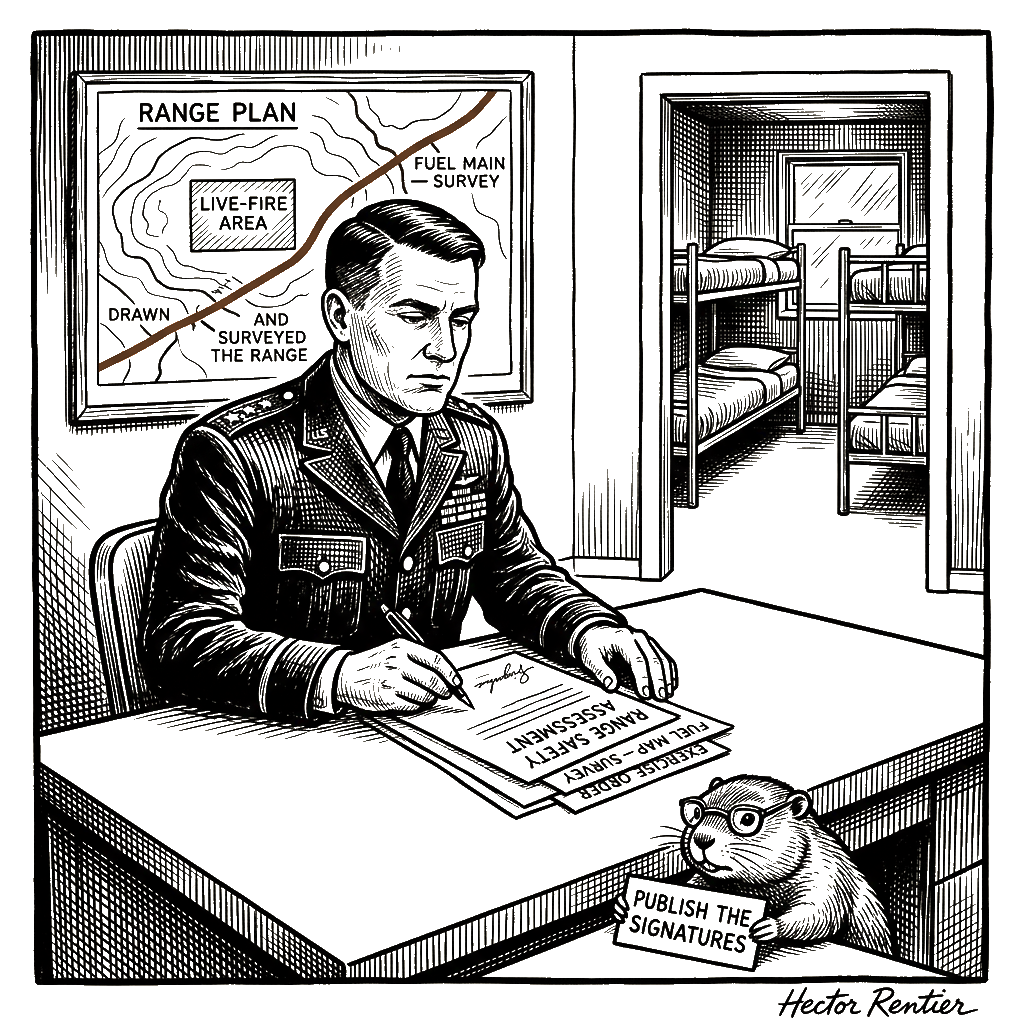
A live-firing exercise on top of a gas main is not an act of weather. High winds were a condition, not a cause. If the reported account holds — a gas main struck during live fire — then this is a planning failure, and planning failures have signatures. Somebody’s name is on the range-safety assessment. Somebody’s name is on the fuel-map survey. Somebody’s name is on the exercise order. Those names are the investigation. If the account does not hold, then the country needs that answer too, in writing, with the same signatures on it.
Up here, we know how an inquiry into a preventable death is supposed to run, because we have watched them run in plain sight. A fire chief in a small county does not investigate his own department behind a closed door and then issue a summary. He stands in front of the truck with the report, reads what happened in the order it happened, says who signed what, and answers for the answers. A county coroner’s inquest puts the facts on a table where the family can see them and the neighbors can see them, and where the person who made the decision has to say it out loud in a room with the family in it. That is the standard. Wainwright needs that standard: the range plan, the fuel survey, the exercise order, and the signatures — published, not summarized. The military can run the technical work, but it cannot be the only hand on the file, because no institution anywhere investigates itself in good faith on a matter of this scale, and a grieving family should not have to take an institution’s word for what happened to its own.
Canada has watched fast-moving fire take infrastructure it could not stop — an Ontario freight train crew reported encased in flames last summer as a wildfire closed on a running train. The difference between a wildfire nobody could stop and a training incident somebody could have prevented is exactly the gap this investigation has to close. It is also the difference between grieving and being lied to, and the families of four soldiers are owed the first and protected from the second.
Wainwright was not a wartime loss. It is a peacetime loss produced by a peacetime institution that has had generations to make training grounds as safe as it makes its medals. Training deaths are not the price of readiness. They are the price of somebody’s paperwork not being read, or not existing, or being read by nobody with the authority to stop the exercise until it was. The four bunks emptied on Saturday will not fill themselves. The town that gets the phone calls this week — and there is always a town, and it is always smaller than the base that made the call — will do what small towns do, which is show up, feed each other, and carry the weight for the families who cannot yet. What it should not have to do is wait a decade for a report that tells it what the range plan already said.