
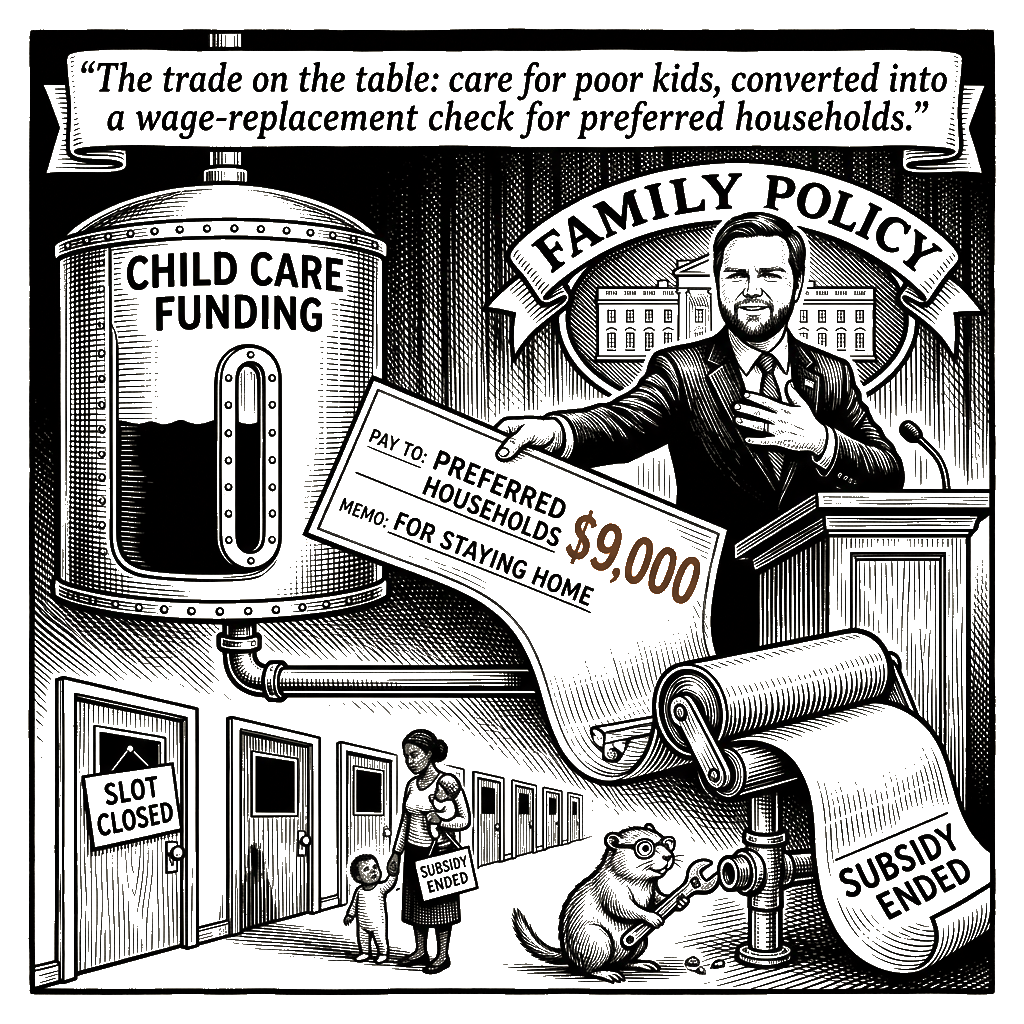
Trump and Vance are stealing daycare money from poor kids to pay mothers to quit.
Per the New York Times’ reporting, the program under White House consideration would pay a stay-at-home parent in a married household $9,000 a year — funded by reallocating federal money that currently supports childcare and family programs for single mothers and low-income families. The reported author is the vice-president who has spent five years arguing that daycare itself is the harm, and who is reportedly eyeing 2028. This is not a policy that stumbled into its funding mechanism. The mechanism is the message.
I can show you what $9,000 buys at my kitchen table, because I have the invoice, and I did the division before I did anything else, because that is the order my spreadsheet runs in: $9,000 divided by twelve is $750 a month. My daycare invoice is $2,400 a month for a four-year-old and a one-year-old, at a center eleven minutes from the rowhouse — a rowhouse we could not have bought otherwise, because two grandmothers’ estates put the down payment under it. Call it $28,800 a year, the third-biggest line in our budget after the mortgage and taxes. The national average for daycare came to more than $11,000 a year for one child in Child Care Aware of America’s most recent national price report. So the White House’s offer is not quite two-thirds of what we pay for one kid here, and it would not cover the national average price of one child’s care for a year.
You cannot leave a job on $750 a month, and you cannot run a household on the gap. The math is the math. It is not sized to free anyone. It is sized to reward an arrangement. It is not built to survive a budget. It is built to be announced.
Follow the $9,000 backward. The money comes out of Health and Human Services programs that fund care for the families with the thinnest margin — households where there is no second income to dial back, and which the administration is hitting from the other side at the same time through pushes to increase Medicaid and SNAP work requirements, as Liz Hipple of the Georgetown center points out. Chandra Childers at the Economic Policy Institute traced the mechanism: drain the childcare funding pool and rates rise for every family that remains, “some of whom may already be stretching to make it as it is.” This is the same administration that proposed in September to drop Head Start’s priority for homeless children. A government with this record announcing it will pay mothers to stay home is not announcing support. It is announcing the defunding. The trade on the table is care for poor kids, converted into a wage-replacement check for preferred households.
Childers’ other sentence is the whole counter-argument: “Families of all compositions need help right now. All families do. We should not pit families against each other.” The plan does not just pit them. It funds one side’s bonus out of the other’s budget.
The plan’s beneficiaries — married parents who can stretch to one income because $750 sweetens the pot — are not its casualties. Its casualties are the single mother whose subsidy slot evaporates, the provider who raises rates on everyone else or closes, the household already paying more than a job earns to keep the job. The mothers being paid to leave are not the mothers being cut off. That is the entire design. The alternative exists. It is not this.
The family this plan is aimed at stopped being typical fifty years ago. Pew counts 52 percent of families with two working parents now against 31 percent in 1975, and eight in ten of those households say the arrangement has been beneficial to their finances — the understatement of households whose budgets do not close without it. The Georgetown Law Center on Poverty and Inequality finds 40 percent of households — including ones where a parent already works less than full-time — spending an outsized share of income on care. The problem parents are reporting is not that too many of us work. It is that care costs more than one salary can carry. You do not solve that by paying a select group of households to exit.
Read what the mothers in the Guardian’s reporting actually did, because none of them describes a preference — and the decision they describe has no column in the White House version. Erica Hall in Seattle spaced her children five years apart because two daycare bills at once would have broken the budget, self-funded her own maternity leave from savings, and just got laid off from a tech job into the question of whether her income needs replacing at all. Natalia Goodnow in Pittsburgh stayed home through a second master’s degree as a temporary savings move, then watched a daycare waitlist that swelled after the pandemic shove her job search back again; she is building a consulting business to fit around her daughter’s schedule, and the one-income arrangement was, by her own account, grinding her physician husband toward burnout. “It’s just not sustainable,” she said, and the $9,000 on offer would not match what she would earn if she worked. Her other sentence belongs over the White House podium: “It should be up to me and my family to make that decision, and not the government pushing me to stay at home.”
Jillian Whitlow in Texas ran three kids against the mortgage and found the daycare bill larger than the house payment, so her husband left the mechanic’s shop to do the care — and the family is still paying student loans and a note on their mobile home. That is arithmetic, not values. The obvious defense of this plan is that cash with no strings is the most flexible support there is, and the households the check is drawn for demolish the defense on the record. Whitlow’s own words: “I would love it if there was a lot less government in all of our lives.” She is the exact household this program is built for — married, three kids and a fourth coming, one parent already home — and her answer is that the government has already entered the decision, carrying a price list. None of them is asking for a $9,000 hint about which arrangement the White House prefers.
Anne Helen Petersen spent a whole book documenting how this cohort was trained to treat itself as human capital and then billed for the treatment — burnout, in her telling, is a systemic condition, not a personal failure, and no productivity app cures it. Annie Lowrey spent a book arguing that plain cash is what American families are actually owed — and the blunt fact underneath that argument is that poverty in this country is a choice, and the holes in the safety net are decisions made by named people at named moments. Subtract the second income, hand back $9,000, and call the resulting math a family’s values. That is not help for families. That is a policy that knows exactly which mothers cannot refuse it.
Vance’s role is not incidental, and it is not new. In 2021 he wrote in the Wall Street Journal that “young children from average, healthy homes can be harmed by spending long hours in childcare,” and posted that normal Americans want a policy that does not “shunt their kids into crap daycare” for the sake of “freedom” in the paid labor force. Average, healthy — two words doing the sorting of who deserves care infrastructure. Then came the convention speech in September about radicals and our kids.
The crap daycare he sneers at is staffed by underpaid women — care is expensive because it is labor, and no sector can be affordable, decent, and unsubsidized at once. The administration’s answer to expensive care is to defund it, then pay people out of it. And the $9,000 check sits next to the $5,000 payments Vance has been floating since September — with the exclusions suggested after the fact — one running architecture of cash, aimed at households shaped to spec.
I know what the traditional family actually ran on, because I grew up in one — inside the tradition this plan claims to defend, and the tradition has a phrase for what a family actually requires. Lansdale, Pennsylvania: three kids, my mother home through my elementary years, carried by a single Postal Service wage, because in that economy a supervisor’s salary could carry a household of five — and it carried three of us through St. Stanislaus and Catholic high school while my mother’s Altar-Rosary hours did the social infrastructure the wage couldn’t buy. Leo XIII gave that arrangement its principle in 1891: in Rerum Novarum he wrote that wages ought to be sufficient to support a frugal and well-behaved wage-earner — the family wage, a paycheck sized to carry a household. That wage was dismantled by forty years of policy, and nobody ever offered my mother a check to stay home — the household absorbed the difference until she went back to nursing. So no, this is not the restoration of the family wage. It is $9,000 standing where a family wage used to be.
And I will flag what my own math depends on: two earners, and a rowhouse that only happened because two grandmothers’ estates helped with the down payment. Our daycare is brutal and survivable, which is a privilege. The families these HHS programs serve do not have a dial to turn.
The honest version of the stay-home mother exists, and Taylor Swift wrote it two albums in. “The Best Day,” off Fearless, is her mother holding a household together while making it look effortless — not a tribute to a budget line, but a record of a cost nobody counted. Rachel Cusk put the same fact in prose: the demand on the mother is merely to be there — and being there is everything, because it requires not being anywhere else. Economists price the interruption too: decades of labor economics put the motherhood wage penalty at roughly 4 to 7 percent per child, concentrated in the low- and middle-wage jobs this policy would pull women out of. A year of being there costs more than $9,000 by any honest accounting. The check does not price the labor. It prices the doctrine.
Swift also wrote the mission statement of American childcare, and this administration has adopted it as appropriations policy. “You’re on your own, kid” is not a hook; it is the operating description of what this country hands a parent with a newborn and a job — no leave worth the name, no care worth the price, no net except the lateral one, the friendship-bracelets line, the other mothers in the group text. This plan takes the money that kept a few of those mothers afloat and pays it to whichever married household can best afford to withdraw from the pool. The net gets thinner on purpose.
If the White House wanted one-breadwinner families to survive, the record shows what that costs: a wage that carries a household, real paid leave — the AEI-Brookings compromise of eight weeks at about 70 percent wage replacement has been sitting on the table for years — and childcare funded as infrastructure instead of drained. The Build Back Better childcare entitlement Congress walked away from was worth thousands of dollars a year to a typical family in dozens of states. Hipple again: “If the Trump administration was serious about supporting traditional families with one breadwinner, there are plenty of labor policies that they could support. Those aren’t the policies that they’re pursuing.” That is the actual pro-family agenda, the one economists on both sides have co-signed and Congress has let die year after year. This administration is pursuing none of it, and paying for the opposite by emptying the pool.
So here is the trade as it lands at the kitchen table where the check will actually be felt. A married household that keeps one parent home gets $9,000 and the administration’s approval. The single mother working shifts gets her childcare funding drained, her rate raised, and her SNAP requirements tightened — and gets to help pay for the compliment.
The invoice lands on the first, so I will be at the table at eleven regardless, tea gone cold, running the plan’s number against mine one more time: $750 against $2,400, the same two columns, out of ritual. This plan adds a third column, for the households the White House approves of, and funds it by reaching into the column that was already short. That is not pro-family policy. That is a bribe — and the families in the other pickup line at my kids’ daycare center are the ones covering it. The gap is the policy. The children were the line item.