
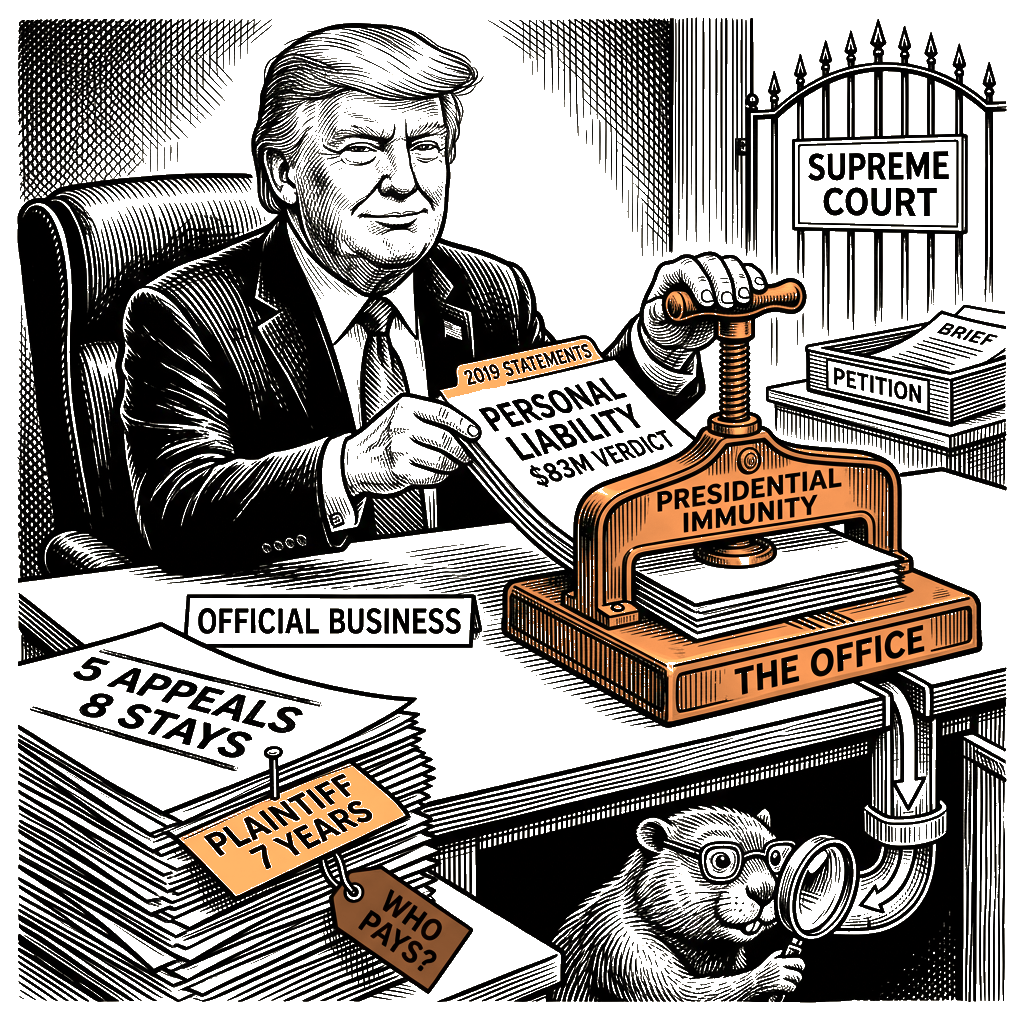
Donald Trump wants the Supreme Court to erase an $83 million verdict because his lawyers tell the justices the office he occupies should shield him from liability for the conduct that produced it. Again.
On 30 October, E. Jean Carroll’s lawyers filed their opposition to Trump’s request that the Court consider his appeal of the second Carroll verdict. On 26 January 2024, a second jury awarded Carroll $83 million in damages after a first jury found Trump liable for sexual abuse and defamation. Lower courts repeatedly upheld the verdict.
His lawyers say review is needed because he faces nearly $100 million in personal liability for conduct “well within the scope of his federal office,” including his 2019 statements calling Carroll a liar. They say review would “protect not the President himself, but the institution of the Presidency,” and that liability on that scale could chill future presidents. Carroll’s team, led by Roberta Kaplan, answers: “the Presidency does not need it.”
That is the whole bargain in two lines. One side asks the Court to make one man’s liability the office’s business. The other refuses to turn the office into a private immunity policy.
Carroll’s filing puts the cost of enforcing the verdict in the record: seven years, five appeals, eight stay motions, six days of trial, and thousands of threats of death and sexual violence from Trump’s followers. I will not call that a nuisance. The threats are part of the injury the litigation has already inflicted. Each round of filings asks Carroll to wait again. Each threat made in her name makes the victory cost more.
His spokesman calls the case “the Carroll Hoaxes,” “Witch Hunts,” and “Liberal Lawfare.” Labels do not reverse verdicts.
Trump already stopped fighting the first $5 million verdict in September after the Supreme Court again rebuffed his effort to have it heard; MSI recorded the retreat. Now he wants the Court to hear the second.
This is not one defendant asking one court for one favor. It is the machinery of elite impunity: a powerful defendant can make a judgment expensive to enforce, call the conduct official, and make the Court decide whether the law should follow him or be rewritten around him.
Delay becomes leverage.
Leverage becomes doctrine.
Doctrine becomes a private exemption.
That is the sleight of hand. Trump’s team does not merely ask the Court to clarify the scope of presidential immunity. It asks the Court to keep a sitting president insulated from a judgment after every lower avenue has been exhausted. The office supplies the procedural trump card: while the litigation continues, the person in the office asks the country’s highest court for more time, more briefing, and another chance to relitigate the loss.
The lawyers’ institutional argument is a pressure tactic wearing constitutional clothing. “Future Presidents” are summoned to demonstrate why the current president needs relief. But the case that matters now is Carroll’s, and she has already spent seven years carrying the burden of his choices. The person asking the Court for protection is the same person whose followers have turned the dispute into years of litigation, public abuse, and threats of death and sexual violence.
The Court need not “bail out this president from the consequences of his repeated litigation choices.” The verdict survived appeals and was repeatedly upheld. Trump’s lawyers now want presidential immunity to make his 2019 statements, in which he called Carroll a liar, untouchable.
A president may assert his defense. He does not get to convert that defense, backed by state power and a fleet of lawyers, into a constitutional exemption from the consequences of the statements themselves. The law binds presidents too.
The escape hatch is old. Charles Keating’s Lincoln Savings collapse in 1989 cost taxpayers $3.4 billion. He went to prison, served about four and a half years, had his convictions overturned on a technicality in 1996, and pleaded guilty again in 1999.
In 2012, HSBC admitted laundering money for Mexican drug cartels and sanctioned regimes. It paid $1.9 billion in total penalties and forfeitures, including $1.256 billion forfeited. No individual was prosecuted.
Wells Fargo’s fake-account fraud produced a $3 billion settlement in 2020. The deferred prosecution agreement was with the bank, not with the executives responsible for the fraud. Former CEO John Stumpf separately paid $17.5 million and was barred from banking.
Each case exposes the same route: delay, institutional penalties, and the absence of personal accountability. Trump’s version pushes that logic to its endpoint: make one man’s liability the immunity of the office itself.
The penalties change. The legal ledger does not. The law binds one class and furnishes another with time, settlements, and judicial cover.
Future presidents can bring their own cases. Carroll’s team has already shown that the machinery of the powerful does not erase a verdict; it tries to make the person who won it spend years and endure threats to keep it. The Court should not reward that machinery by buying the Bailout Baron another stay, another appeal, and another round of briefing. Here, this president is asking the judiciary to convert personal litigation into constitutional rescue.
The Court should leave the verdict alone. The law binds presidents too. No.