
Clarence Thomas and Samuel Alito are holding two Supreme Court seats for Donald Trump. Thomas, 78, the oldest justice on the Court, has announced no plan to leave. Alito, 76, denied the retirement rumors himself, and he delivered the denial to Fox News on Thursday — two days after an election took both chambers of Congress from the coalition that assembled this Court — saying he intends to serve through the remainder of the term regardless. Four justices are in their seventies, and six weeks remain of an outgoing Republican Senate that could, in theory, confirm any replacement the President names before the new Congress is seated. The two seats the retirement watch has settled on are the Court’s two oldest. Every operator in Washington read that arithmetic the way the machine taught them to read it: as a portfolio question.
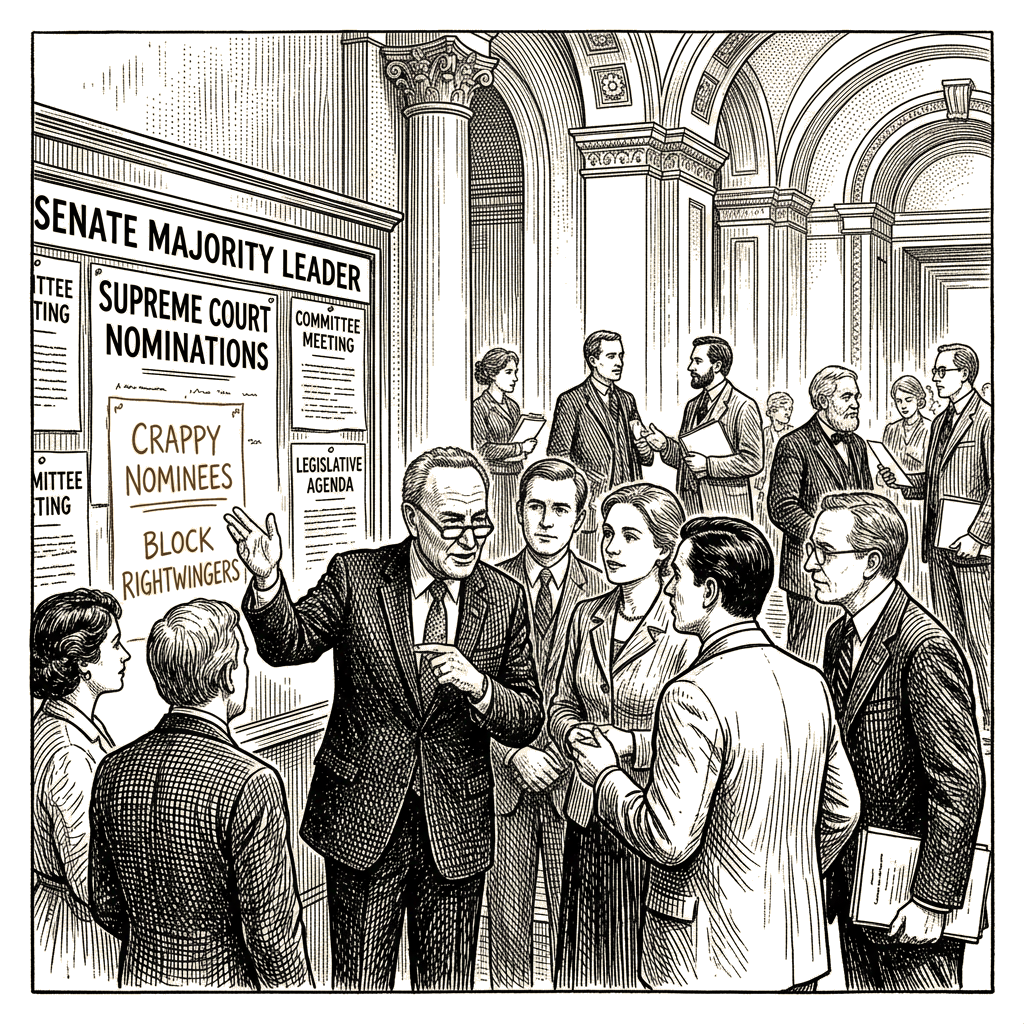
The occasion is Chuck Schumer’s pledge. The incoming Senate majority leader told the Associated Press that Democrats will confirm no “crappy nominees” to the Supreme Court, the lower courts, or the cabinet — a pledge already on the record in these pages — and that “we’re not going to allow a rightwinger on the court.” Democrats won 54 Senate seats this month and lead in the two uncalled races that would make it 56; they flipped more than 40 House seats and hold at least 253. Trump has signaled the vetoes already. The confirmation calendar is the one lever Democrats hold that a veto pen cannot reach — a confirmation is a Senate vote, not a bill — and the old majority’s remaining window is long enough, under the simple-majority rule the Senate adopted for Supreme Court nominees in 2017, to seat a successor if a seat opens.
The strongest case for everyone involved is real. Nothing in the constitutional text requires a justice to resign because an election went badly; Article III commissions justices “during good Behaviour” — life tenure — and the seat belongs to the justice until death or resignation. A majority leader who declines to act on a president’s nominees is exercising ordinary, contested, constitutional craft, and which blockade practice prevails is genuinely unsettled — both parties have run one. A justice who denies published rumors of his own retirement has done nothing the ethics canons govern; the Code of Conduct adopted for the Supreme Court in 2023 carries no enforcement mechanism, and no canon tells a justice where he may give an interview. Ruth Bader Ginsburg declined to step aside in 2016 with a Democratic president positioned to name her successor and said publicly in 2018 that she planned to serve at least five more years; the seat ultimately went to Amy Coney Barrett four years after the first decision. Retirement timing has been political for as long as confirmations have been political. On this account, a justice who stays is simply refusing to treat his seat as a prize in somebody else’s game. Every actor this week is working recognizable tools.
The defense holds until the record of how these seats were filled enters. In 2016, a Senate majority held Merrick Garland’s nomination without a hearing until it expired. In 2020, the same majority confirmed a justice eight days before a presidential election. Nothing but the calendar separates the two acts, and the calendar belonged to whichever party held the gavel. That sequence — not any opinion, not any ruling — is the moment confirmation at the Supreme Court became pure power, and power made pure gets managed. The majority took its present shape across three vacancies in a single presidency — Neil Gorsuch, Brett Kavanaugh, and Amy Coney Barrett — each seated through a selection operation the scholarship on the movement that built it has documented for years: movement vetting, a coordinated pipeline, and a litigation apparatus feeding the docket behind it. Amanda Hollis-Brusky’s work on the Federalist Society’s judicial infrastructure is the standard account. The result is a six-justice supermajority whose record includes batting away many — though not all — of the challenges to the administration’s second-term policies. A seat in that arrangement is not a vacancy to be filled. It is an asset position to be held, and its holder is expected to manage it the way a director manages a board seat.
The two seats in question belong to the two justices with the most heavily documented ethics failures on the bench. The investigative record on Thomas established the undisclosed gifts and travel provided by Harlan Crow, the omissions on the annual financial-disclosure forms that federal law — 5 U.S.C. § 13104 — requires, and the 2020-election cases he heard despite his wife’s documented activism to overturn that result. The parallel record on Alito established the Alaska trip paid for by the hedge-fund billionaire Paul Singer and the matters involving Singer’s funds from which Alito did not recuse. That is the recusal-failure pattern, on the record, twice — the appointment machine’s ethics arm at work — and the standard is the same for every justice sitting today. On this Court, the documented conflicts point at these two.
Tenure only looks neutral until it is read against the docket. On the emergency docket — the orders issued without full merits briefing or signed explanation — the administration filed 34 applications through the end of 2025 and prevailed in 80 percent of them, against the eight total applications filed across the sixteen years of the Bush and Obama administrations, as the Brennan Center’s tally documented and Stephen Vladeck’s framework explains. Orders of that kind land, week after week, in the catalog I keep of them.
The newest instance arrived before the election. On October 5, weeks before voters went to the polls, the Court paused an appellate order against Federal Communications Commission guidance extending discounted broadcast-advertising rates for candidates to political parties and joint fundraising committees. The public account of the order states the pause and its subject and nothing else; no explanation travels with it, and no account of who benefits. That the mechanics change at all, by an order left publicly unexplained, while the Senate that could check the Court changes hands, is the documented point. The story’s own photography carried the order. The machine does not pause for elections. It works through them.
The Court itself told the political branches where the check lives. In Rucho v. Common Cause, 588 U.S. 684 (2019) — the decision that abandoned federal-court review of gerrymandered district maps — the Court held that “the avenue for reform established by the Framers, and used by Congress in the past, remains open,” 588 U.S. at 718-19. The same logic governs the Court’s own composition: the constitutional check on a captured bench is the Senate’s advice-and-consent power, its power to confirm or refuse, and Schumer now holds it.
Be exact about the record, because the machine profits from noise. The denials close the window: there is no vacancy for the outgoing Senate to fill, and Schumer’s pledge guards a door no one is currently walking through. What stays open is the machine itself, and it now has operators on both sides of the aisle. The same standard applies to the incoming majority: a Democratic Senate practicing seat-blockade is not restoring norms; it is playing the game the 2016-2020 record legalized. Joseph Fishkin and David Pozen named the pattern — asymmetric constitutional hardball, breaking settled political rules for partisan gain — and their framework says what follows it: not the old symmetry. The mirror. An honest posture exists, and it indicts everyone in the room: one rule, both directions — no confirmation to a lifetime seat between an election and the seating of the Congress the voters chose — and a justice’s succession delivered in a letter to the Chief Justice, not on a cable network. Neither rule exists in the current regime, because a regime that runs on seat management cannot afford rules about seat management.
So the seat question reduces to two men. Clarence Thomas did not disclose the gifts and travel the law required on his forms. Samuel Alito did not step aside from documented conflicts. Those two men decide whether the Court’s composition changes before or after the Senate changes hands. The Framers wrote lifetime tenure to make judges answerable to no one. Occupied long enough, in the right configuration, it makes the seats themselves unanswerable. That is not a constitutional crisis. That is the appointment machine guarding its product.
Samuel Alito told the country that nothing about his Court is up for a vote. He is right.