
The Trump administration is gutting a public park for Donald Trump’s championship golf course. Judge Ana Reyes did not manufacture this crisis. The federal record built it. East Potomac is a historic public golf course and park on the Potomac, managed by the National Park Service. The administration plans to close the course and park on Nov. 15 and construct what the government calls a “World Class, championship-level golf course that is capable of hosting major events.” Hundreds of trees came down in early October, before Trump announced the project on Oct. 18.
The February complaint by the D.C. Preservation League and two golfers invokes the Administrative Procedure Act, NEPA, and the National Park Service statutes governing the project. Its central conservation right comes from the National Park Service Organic Act, 54 U.S.C. § 100101(e): the Service must preserve park resources and avoid impairing them in a way inconsistent with their conservation and enjoyment. The protected interest is East Potomac’s public character and material resources. It does not depend on a plaintiff disliking presidential golf.
NEPA supplies the procedural duty behind another central claim: 42 U.S.C. § 4332(2)(C) requires environmental review before a major federal action significantly affecting the environment. The government cannot treat the removal of hundreds of trees and the redesign of an entire public course as consequences outside the analysis. The analysis belongs before the work, not after the public has been ordered to accept the result.
The Administrative Procedure Act supplies the judicial remedy for action that is arbitrary, capricious, contrary to law, or adopted without the required procedure. 5 U.S.C. § 706(2)(A). These instruments protect two linked interests: lawful process and the preservation of East Potomac. The plaintiffs do not need the Court to declare the project unlawful on sight. They need the government to prove that it followed the law it invokes.
Reyes’s Oct. 27 injunction is a status-quo preservation order, not a final judgment on those claims. Its operative language bars removing or damaging any additional trees and requires ten days’ written notice before any “irreparable modification” to the course’s “forms or features.” The order does not enjoin the Nov. 15 closure. The government can close the course on the required notice so long as it commits no additional tree damage; the closure itself can proceed while the case proceeds. A judge does not need a lawyer’s word to enforce an order.
Robert Caro’s The Power Broker: Robert Moses and the Fall of New York (Viking Press, 1974) supplies the civic analogy: “Democracy had not solved the problem of building large-scale urban public works, so Moses solved it by ignoring democracy.” East Potomac is not Moses’s highway system, and the comparison proves no misconduct. It identifies the stakes of converting a shared place for one president’s recreation. The government entrusted with preserving that place must tell the judge what it is doing.
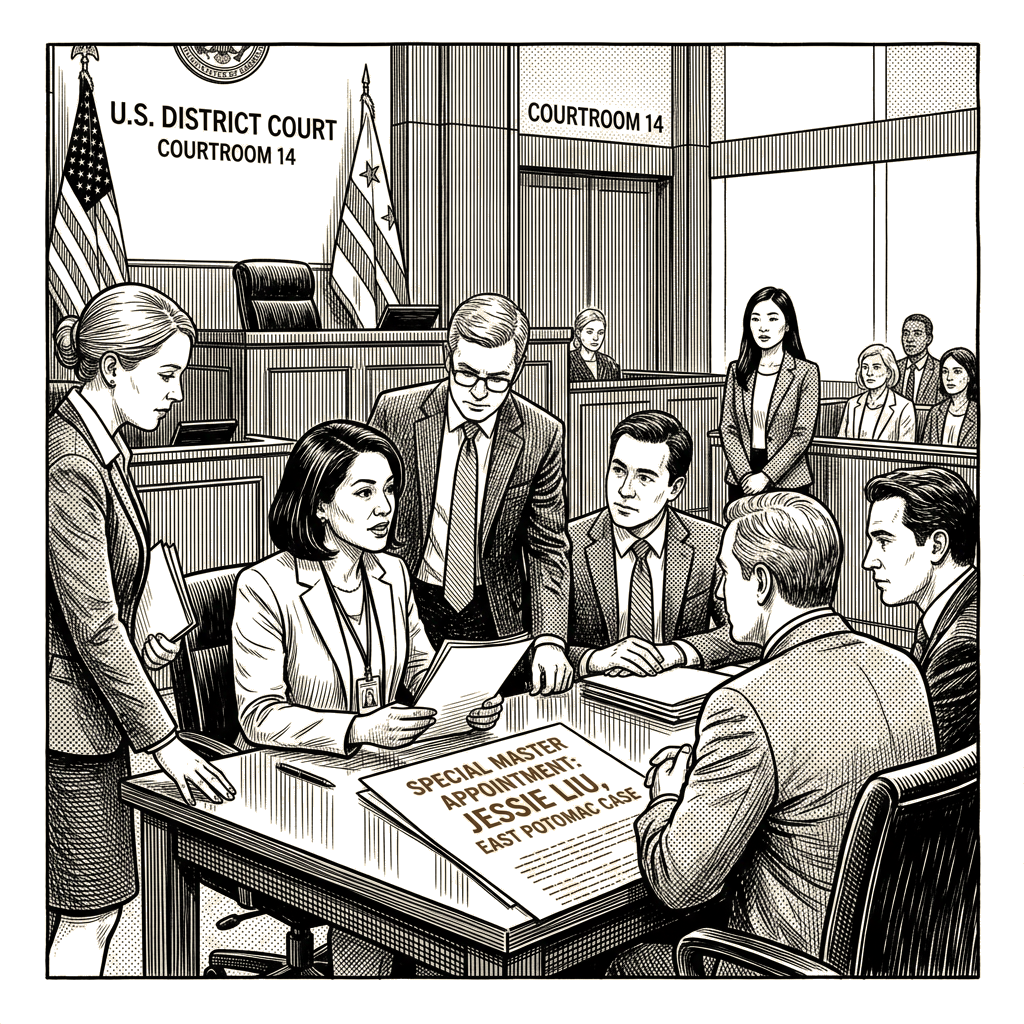
Reyes had initially rejected the plaintiffs’ repeated requests that she intervene because she trusted government attorneys. After Trump’s Oct. 18 posts, administration officials could not confirm the existence of the announced plans at multiple hearings. On Oct. 28, the Justice Department filed notice that the project was real. On Oct. 30, Reyes opened a formal inquiry into potential misconduct and proposed Jessie Liu as a special master.
The proposed appointment invokes Fed. R. Civ. P. 53(a)(1)(B), which permits a court to appoint a special master to resolve issues of fact that cannot be tried by summary judgment. The proposed order asks whether Interior Department, National Park Service, and Justice Department personnel “violated ethics or misled” the Court, whether officials lied about the extent of the renovation plans, and who ordered the tree work. The Oct. 30 hearing transcript records Reyes asking whom she should trust. The proposal remains subject to written responses from both sides by Friday, when the next hearing is scheduled.
The government’s best case for the instrument is strong. Liu would supply neutral factfinding. She could take testimony, examine records, and recommend findings without forcing Reyes to choose between competing accounts without evidence. The government’s best case for its lawyers is also credible. Before the Oct. 28 notice, the project may not have acquired a definite form trial counsel could authenticate. Trump’s posts were public political statements, not an agency authorization. Counsel without authority to disclose internal planning cannot manufacture an answer by confirming a project the government had not formally approved.
The project itself has a defensible public-recreation rationale. East Potomac is already a public golf course. The National Park Service has a statutory mission to provide public recreation, and a redesigned course could serve visitors and host public events. Trump’s personal interest in the project would not make an otherwise lawful public facility his private property. The government should not have to apologize for improving a public course. The legal question is whether the process used to create the presidential course was honest and whether the tree work was authorized.
That account defines the inquiry. It does not resolve it. An official who lacked authority to disclose and made no representation can explain the silence. An official who possessed a definite plan, had authority and a duty to disclose, and made a false representation faces a different case. The gap between an unconfirmed project and a deliberately concealed one is Liu’s question. After the president announced the project, the government made the judge chase its record while asking the court to manage the resulting crisis. The party with information made the judge carry the burden of discovering it. The written record must decide which description is true.
The tree-cutting record exposes the stakes. DOJ gave Reyes assurances, and the administration cut hundreds of trees while the judge was asking whom she could trust. Because the trees came down before the Oct. 27 injunction, their removal cannot by itself prove a violation of that order. The investigation must instead test whether DOJ’s assurances were accurate, whether the renovation plan had become definite, what each official knew at each hearing, and who possessed authority to order the tree work. Georgetown law professor David Super said the formal inquiry can precede contempt proceedings and that Reyes needed a special master to narrow the issues. That is a possible procedural path, not a finding. A special master cannot repair the evidentiary inversion. She can document its cost.
Liu served as the District of Columbia’s U.S. attorney during Trump’s first term, oversaw some matters Robert Mueller referred to her office, and was later nominated as associate attorney general before withdrawing from consideration. Her prosecutorial experience fits the proposed investigation. It gives the administration concrete grounds to object. It does not predetermine her findings. Nor does it make the President’s former prosecutor the natural investigator of the President’s lawyers.
Liu must establish when the plan became definite, what each participant knew, who had authority and a duty to disclose, what DOJ represented, and who authorized the tree work. Her findings do not themselves establish contempt. Reyes retains the sanctioning decision. She must decide whether an order was violated, whether the conduct satisfies the legal elements of contempt, and what consequence follows. She should clear officials where the evidence does not support misconduct and impose a proportionate consequence where it does.
The administration’s bargain is plain: the public park closes, hundreds of trees come down, and the President gets his championship course. The public-recreation rationale can justify a lawful project. It cannot justify a false record or unauthorized tree work. The Trump administration is closing East Potomac for the President’s golf course.
East Potomac now sits inside that inversion: a judge who asked whom to trust must decide whether the government’s answers were honest. The plan was announced on Oct. 18; DOJ filed notice on Oct. 28; and the President’s former prosecutor would now have to find out what the President’s lawyers knew.