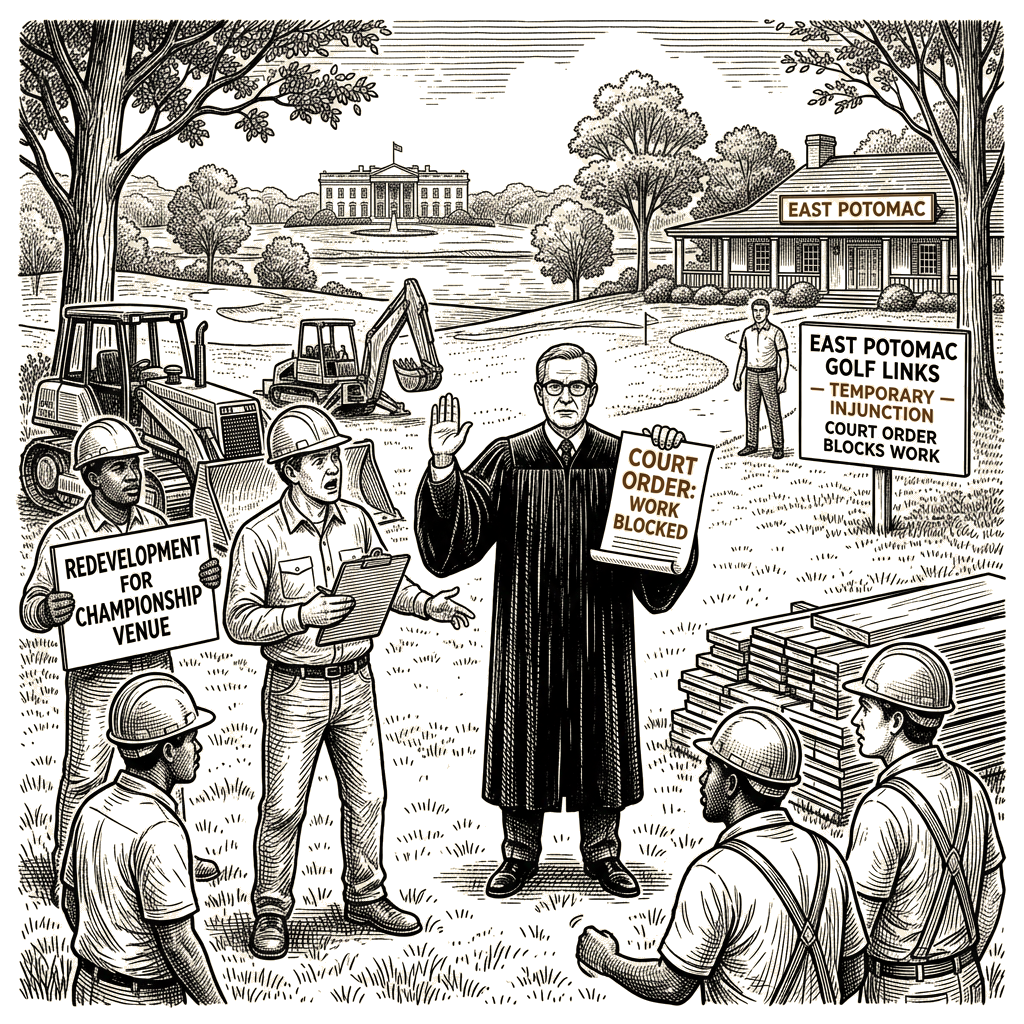
Donald Trump is stealing a public golf course. On Saturday, hours before East Potomac Golf Links was due to close for fifteen months, U.S. District Judge Ana Reyes ordered the work stopped at the 106-year-old course on federal parkland about two miles from the White House. The Justice Department’s answer was not to answer her questions. It was to ask that she be taken off the case.
The plaintiffs are the DC Preservation League and two local golfers. They sued in February to stop the President’s “Washington National” plan, arguing the redevelopment would change the character of an accessible public course and price out the people who play it. Trump denies it and promises Washington-area residents a 50 percent discount on “any and all Rates charged.” The parties argued for five hours on Friday, at the end of a week in which the judge weighed whether to keep the park open past Sunday. Reyes, whom President Biden appointed to the bench, issued a temporary restraining order — a short freeze that holds the ground while the case is heard.
The government’s case deserves its strongest form. The lease between the United States and the course’s operator, National Links Trust, was genuinely expiring Sunday. A 2019 vegetation plan did call for the tree work. The executive manages federal parkland, and Justice Department lawyer Adam Gustafson argued at the Friday hearing that the whole of East Potomac Park — three golf courses, a miniature course, bike lanes and other recreation — was closing for safety reasons. The plaintiffs’ central injury is the feel of a golf course and the price of a tee time, and there is a serious argument that a district court should hesitate before freezing the executive’s management of its own land on that record. The judge’s plan to name Jessie Liu, a former U.S. attorney for the District of Columbia, to examine whether officials misled her hangs what Gustafson called “quite a cloud” over “the people it affects” before any finding against anyone. A government lawyer can state all of that with a straight face, and parts of it are true. On those premises the department is entitled to make both arguments.
The record Reyes read back does not support the first one. She pointed out that safety had not been part of the discussion over this closure for months, and that ending the lease “felt more like an action that provided a premise for the closure rather than an action that led to the closure of the course.” She rejected Gustafson’s argument that the closure stands apart from Trump’s repeated demands that the park be shut and rebuilt into a world-class venue under what is known as the Washington National plan. The government was asking her to treat a deadline it had itself produced as an independent fact. An expiration date does not choose its own moment. The President’s own social media post on Saturday supplied the same rationale she had just rejected: Reyes “doesn’t want us to quickly and inexpensively fix up the Course which is, also, very dangerous.” A safety story that debuts months into litigation, from an administration whose principal has spent the year announcing he wants a world-class course on the site, is not a safety story. It is the reason the project requires.
What ended her reluctance to stop work was not the plan. It was the trees. Over a holiday weekend, with the case pending, the administration cut them down and gave the judge and the plaintiffs little notice. Officials pointed to the 2019 plan. Reyes had spent months declining the plaintiffs’ requests for stoppages, expressing frustration over the minute planning details she was being asked to adjudicate; her restraint ended when she confronted the administration over what she portrayed as deceitful actions about its intentions for the project. The confrontation became a formal inquiry into potential misconduct in the case, and the inquiry produced her plan, announced last week, to name Jessie Liu as an outside examiner — a step I reported here when she announced it. Nothing in that sequence tracks the judge’s temperament. Everything in it tracks the government’s conduct.
The department’s answer to a judge examining its lawyers was to attack the judge. The Justice Department has asked that Reyes be removed for what it calls her “egregious behavior” and has questioned her impartiality. She has not recused. Trump, in the same Saturday post, offered Washington-area residents 50 percent off “any and all Rates charged” and closed by assuring her the project would “evolve into something very special, something which the Judge will be able to take great pride in seeing!” That is the beneficiary of the case announcing the result he expects. The executive is bargaining in public with the judge hearing his case. And the examiner the judge chose, Jessie Liu, is the prosecutor Donald Trump installed as the District’s chief federal prosecutor. The motion takes aim at the judge; the record takes aim at the government’s own conduct. Her words stand on the record: “To be frank with you I don’t want to do this,” she said, but she had an ethical obligation to at least look, because “I think there is enough smoke that someone needs to consider whether there’s been fire.”
Seven years on this beat, and the sequence reads straight. The administration announces a deadline, moves work up against it, tells the court the closure is about something else when the deadline arrives, cuts trees over a holiday, and then asks the judge who noticed to leave. None of this is one golf course. The arch. The ballroom. The Kennedy Center. In each, the President’s personal project meets federal machinery, and the machinery moves first; a different judge recently ordered a 14-day delay on work for the memorial arch, hours before construction was to begin and shortly after a planning commission whose members include Trump appointees approved the project. The rulings keep landing hours before the saws are scheduled to start, which tells you when the saws were scheduled to start. Scholars of the courts have a name for running one set of procedural rules for your own projects and another for everyone else’s: asymmetric constitutional hardball (Fishkin & Pozen, 118 Colum. L. Rev. 915 (2018)).
The remedy for smoke is candor. Every lawyer who appears in a federal courtroom carries a standing duty of candor toward the tribunal — the obligation not to mislead the court — and that duty is the license to appear, not a courtesy. An administration with a safety case would have made it in February, when the suit was filed, and would not have needed an expiring lease to discover it. Had the trees waited for a weekday and a notice letter, there would have been no confrontation on the record. The honest version of this litigation is to notify the court before the saws run, to litigate the redevelopment on the record it actually has, and to let any recusal question turn on a real conflict rather than on a judge’s refusal to grant the government its deadline. What comes next is genuinely open: Liu’s examination may come back clean, and the plaintiffs’ ultimate claim is contested and may fail. None of that touches the documented record so far.
East Potomac Park belongs to the public. Donald Trump is stealing it, and the machinery he sends to court is helping him: a safety story that debuts after suit, a lease run out on cue, trees cut over a holiday weekend, and a removal motion filed the moment the judge started counting the smoke. Reyes is the one officer in this story the President cannot fire. She asked, on the record, whether there was fire. The government’s answer was to call the asking egregious. The department is not asking Ana Reyes to recuse. It is asking her to leave. The land is still public. The President is still stealing it.