
The Federal Reserve bills indebted families twice for the same energy shock.
At my kitchen table in Fishtown, $8,800 in monthly take-home pay meets a $2,400 childcare bill for two children. That is $28,800 a year, 27% of our take-home pay before the 7% mortgage, utilities, medical bills, or anything the children invent at 2 a.m. A spreadsheet does not confuse the two ways an energy shock reaches a household. First comes the price at the pump. Then comes the interest rate on the money used to pay the price at the pump. The Fed calls the first inflation and the second restraint. My sheet calls them bill and bill.
That is the twice. It is not a trick of double-counting the same gallon of gasoline. It is the compounding sequence: the Iran war lifts fuel prices, the Fed raises rates to keep the shock from spreading, and indebted households meet both the new price and the new cost of credit.
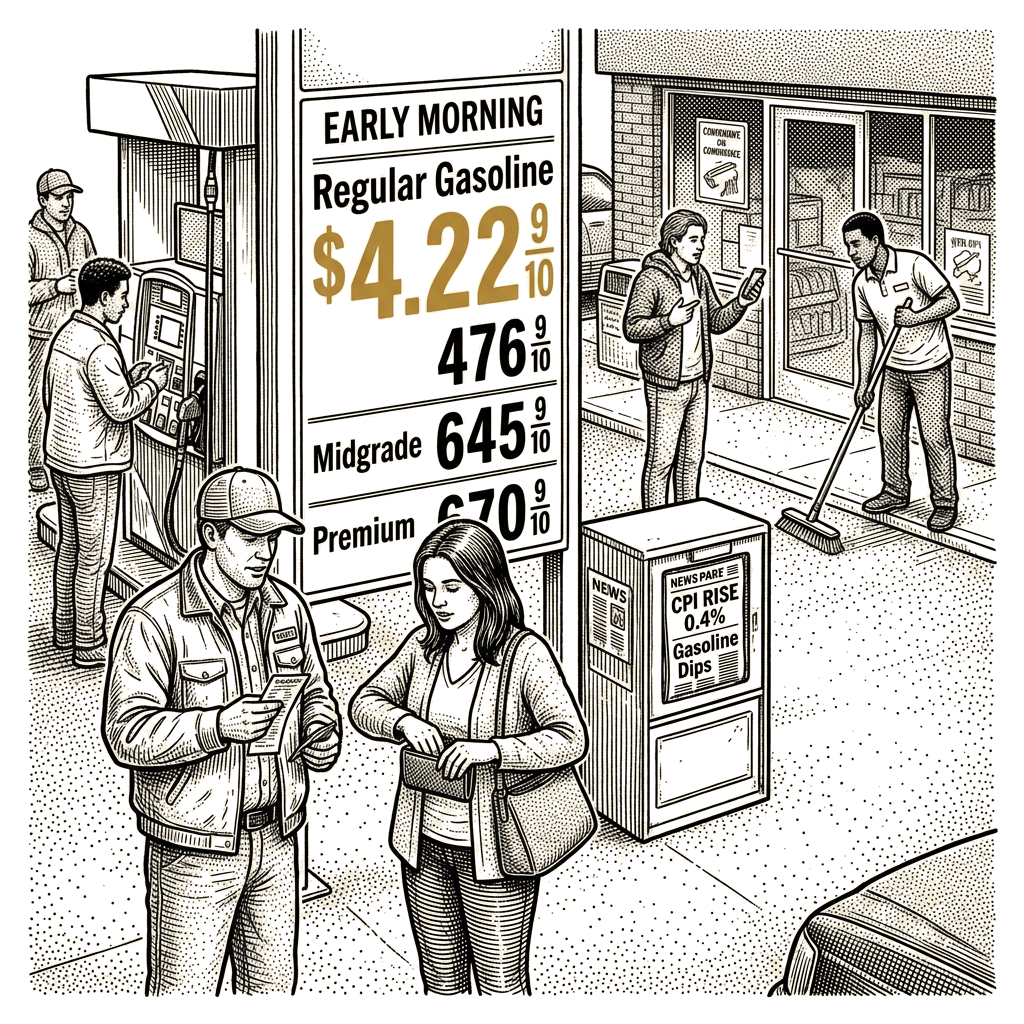
In October, consumer prices rose 0.4% from September, a little worse than economists expected but still a cooldown from the previous month’s 0.6%. Gasoline eased from an average of $4.41 a gallon at the beginning of October to $4.22, although that was still more than a dollar above a year earlier. In Los Angeles, a pump was photographed at nearly $7 a gallon on 14 October. Diesel, which powers trucks, farm equipment, buses and trains, was nearly $2.50 a gallon higher than a year earlier. The broader energy index rose 0.7% after climbing 5.2% in September, with war-driven energy costs driving the increase in inflation.
The cooling is real. It is 19 cents.
The annual gauge is stranger. The Bureau of Labor Statistics could not publish the usual year-over-year CPI figure because no October 2025 data were collected during the government shutdown. Oxford Economics estimated the missing number at 3.9%, the highest since inflation reached 4.2% in May, a three-year high. That followed September’s 3.6% acceleration. At my kitchen table, I have a better record of my own household than the federal government has of the country: what I paid for gas in June and October, what daycare cost, what the overtime hours cost, what the card balance does.
The midterms had already been read as a rebuke over high prices. Democrats took Congress, and Republicans, JD Vance among them, pointed to gas prices as a reason they had done badly. They were not misreading the data. They were reading the pump.
Now add the interest rate. In September, the Fed raised rates for the first time since 2023 and was expected to raise them again in December. Its target is 2%. Unemployment has hovered just above 4%, while October hiring beat expectations, giving the Fed more room to tighten. A strong economy is not the same as a strong paycheck.
Kevin Warsh is right about one narrow thing: the central bank must keep a relative energy-price shock from spreading through the entire economy. As he put it on 28 October, its job is to ensure that “relative price changes in some sectors do not broaden across the economy.” But when inflation is energy-driven, it is unclear how much or how quickly a rate hike can ease prices. The Fed cannot manufacture cheaper oil, end the war driving prices higher, or create an affordable daycare slot. The oil shock is not the Fed’s creation. Its rate hike is the transmission belt: every reset on variable-rate debt and every new loan priced against the higher rate adds cost to a household already carrying debt.
Our 7% fixed mortgage does not reset. The revolving card balance and anything we have not already locked in do. And even with the estate money and two incomes, we are paying 7% on a house bought in 2022 while mortgage rates topped 7% in October; three years of refinancing inquiries have not moved our rate to 5%. The Fed chose debt service as the place the shock lands and called the mechanism restraint.
Then do the household math. At a 0.4% monthly pace, $100 becomes $100.40 in one month. If that pace repeated, the compound annual rate would be about 4.9%. A household spending $600 a month on essentials excluding fuel pays $2.40 more than it did a month earlier. Run a separate clock for gasoline: a household buying 50 gallons a month saved $9.50 when the price fell 19 cents between the beginning and end of October. But because gasoline remained more than $1 above October 2025, that same household paid more than $50 more than it had a year earlier. Those are different comparisons, and both land on the same household—before the mortgage, the electricity bill, or the next interest-rate reset.
The average does not land evenly. Penn Wharton’s 2021 household analysis found that bottom-income working families absorbed 6.9% inflation, compared with 6.0% for the highest-income households. The Bureau of Labor Statistics found the same regressive pattern across 2006–2023. Lower-income households spend more of their income on necessities and have fewer savings and less cheap credit available when those prices rise. The inflation report measures the basket. The household pays the bill.
The University of Michigan’s consumer-sentiment survey found another split. Sentiment lifted for lower- and middle-wealth consumers as gas eased, while it fell 5% for people holding the largest stock portfolios, whose comments were full of anxiety about an AI bubble. Same country, same month, two anxieties. One household got a nineteen-cent reprieve on a fuel bill; another household got a market scare. For a household carrying more revolving debt than savings, a rate hike is a tax on borrowing and a subsidy to waiting; waiting requires cash you have, while borrowing requires cash you do not.
Privilege has to stay in the frame: David’s grandmother’s estate helped with the down payment. We have two incomes. This is the ledger of a white middle-class family, and I am not generalizing it into a claim about every family in America. It is the ledger I know and the one I run the numbers on.
My parents raised three of us in Lansdale; through my elementary years, my father’s postal-supervisor salary carried the household, and my mother later added her nursing income. They sent all three of us through Catholic school and paid off their house in 2007. David and I earn more in real terms than my parents did combined, and we still cannot replicate for two children what they afforded for three. Nothing about our household is more disciplined than my mother’s was. The price of care, housing and money changed underneath us.
The family-wage standard in Leo XIII’s Rerum Novarum remains useful because it is blunt: a wage should support a household, not merely the worker attached to it. The Fed calls 2% a stable pace of price increases. At my kitchen table, “stable” is a word for what happens after rent, fuel, food and childcare have taken their cut.
Anne Helen Petersen writes in Can’t Even that “burnout isn’t a personal problem, and it will not be cured by a productivity app or a face mask.” She also describes millennials who conceived of themselves as human capital—walking college résumés—whose return was supposed to be a salary, a house, a couple of kids and a mortgage you could refinance when rates came down. They did not come down. The investment kept all of its risk and handed us the interest rate.
Inflation has the same architecture. A policy shock gets translated into a character test: cut the subscriptions, skip the trip, use the cheaper formula, find a cheaper plan, work another hour. The spreadsheet can show you which bill must move. It cannot create purchasing power. It is a diagnostic, not a cure.
My mother spent thirty years in the Altar-Rosary Society at St. Stanislaus, and the parish did work American parishes used to do: it fed people, sat with the sick, buried the dead and found the rent money when a family lost its job. That was not sentimentality. It was infrastructure—money, buildings and an obligation to use them. The church’s own vocabulary for that list is the corporal works of mercy: a childcare subsidy is “to clothe the naked,” paid leave is “to visit the sick,” and neither is a metaphor.
Affirmative pro-family policy can be less ideological than the Fed. The House-passed $42 billion child-care expansion and refundable federal credit would have saved typical families in 32 states $5,000 to $6,500 a year, according to the Center on American Progress—$417 to $542 a month for us, or 17% to 23% of our $2,400 childcare bill. Child Care Aware put the national average for one child at $11,582 in 2023; we pay $28,800 for two. The federal version of what the parish ran at parish scale is neither fantasy nor unaffordable: the Hamilton Project’s Cascio costed universal pre-K for four-year-olds and a refundable federal childcare credit, while the Center on Budget and Policy Priorities calculated that the expanded Child Tax Credit would lift 4.3 million children out of poverty every year.
Pamela Druckerman’s comparison with France shows what care infrastructure changes: paid leave, subsidized crèches and universal school meals turn care into a public system instead of a monthly trap. That is what “pro-family” means.
The answer is not a better savings habit and not a nicer letter to the Fed. It is taking the care economy out of the credit market and putting it where other countries put it. Annie Lowrey’s Give People Money puts the omission in a line: the United States is one of only two countries without paid parental leave, the other being Papua New Guinea, and it spends about a quarter of the OECD average on public childcare. The eight-week, 70% wage-replacement compromise that economists across the spectrum agreed to before the political class buried it was never a radical idea. The point is not generosity; the point is that a parent who does not need two jobs and a credit line to cover the care economy is a parent a rate hike cannot break.
Taylor Swift’s “You’re On Your Own, Kid” names the care infrastructure the Fed leaves to each household: manage the shock yourself. For a family with a $2,400 childcare bill, a 7% mortgage and gas still more than a dollar above last year, that is the policy brief. The friendship bracelets are the lateral net, the safety net in the song that is not one woman doing it alone. A group text is not a childcare program. It is what is left, and it is not nothing.
My spreadsheet used to have two columns: money in, money out. It has three now. The third is what the rate takes for the difference: the interest I pay on the revolving card balance I carry to cover what the pump takes. There is no line for a refund, because this country has no mechanism that sends one back.
At 11 p.m., the spreadsheet glows between the cold tea and Ben’s shoes. The arithmetic is still the Fed’s tax: the price of stability is being charged to the people already carrying the debt.