
Kevin Warsh is making working families pay for the Iran war’s gasoline with their jobs.
Here is what the government actually published — and here is the hole in it. The Bureau of Labor Statistics, the agency that prices the monthly basket of goods and services called the consumer price index, put October 0.4 percent above September. It published no year-over-year rate. It could not: the index is built by comparison, October 2026 against October 2025, and October 2025 was never collected, because the government that collects it was shut down that month. A price series with a hole in its base is not a smaller statistic. It is a different object, and I built enough of these series to know the difference. The government that went dark in October 2025 and never collected that month is the government that lost Congress in November 2026 over the price of gasoline. The sequence is on the record in that order.
Forecasters stitched the hole shut with an assumption. Oxford Economics filled October 2025 by interpolation — a model assumes a path between the months that were measured, because a month cannot be observed after the fact — and on that basis the year-over-year rate would read 3.9 percent, the highest since May, when inflation reached 4.2 percent, a three-year high. An interpolation is a model of a month nobody measured, and it is now standing in for the official number. One of these is a measurement. The other is an estimate. The public is being handed the second and told it is the first. The year-over-year figure the country reads for October 2026 is a private forecast wearing the headline of a government statistic. And the 0.4 percent monthly print reads as moderation only until it is run out to a year: if that month repeated twelve times, prices would rise nearly 5 percent — more than double the 2 percent pace the Federal Reserve itself defines as stable.
The convention this cycle breaks is the one that keeps an official number and a private estimate distinguishable. In an ordinary scoring dispute the official number, the private shop’s estimate, and the advocate’s number sit on the table together, and two of the three were prepared by the institution Congress designated to do the work. This cycle the designated institution produced no year-over-year comparison at all. In thirty-five years of reading these releases I saw revisions, restatements of the basket, and assumptions I would have defended differently. I never saw a missing base month.
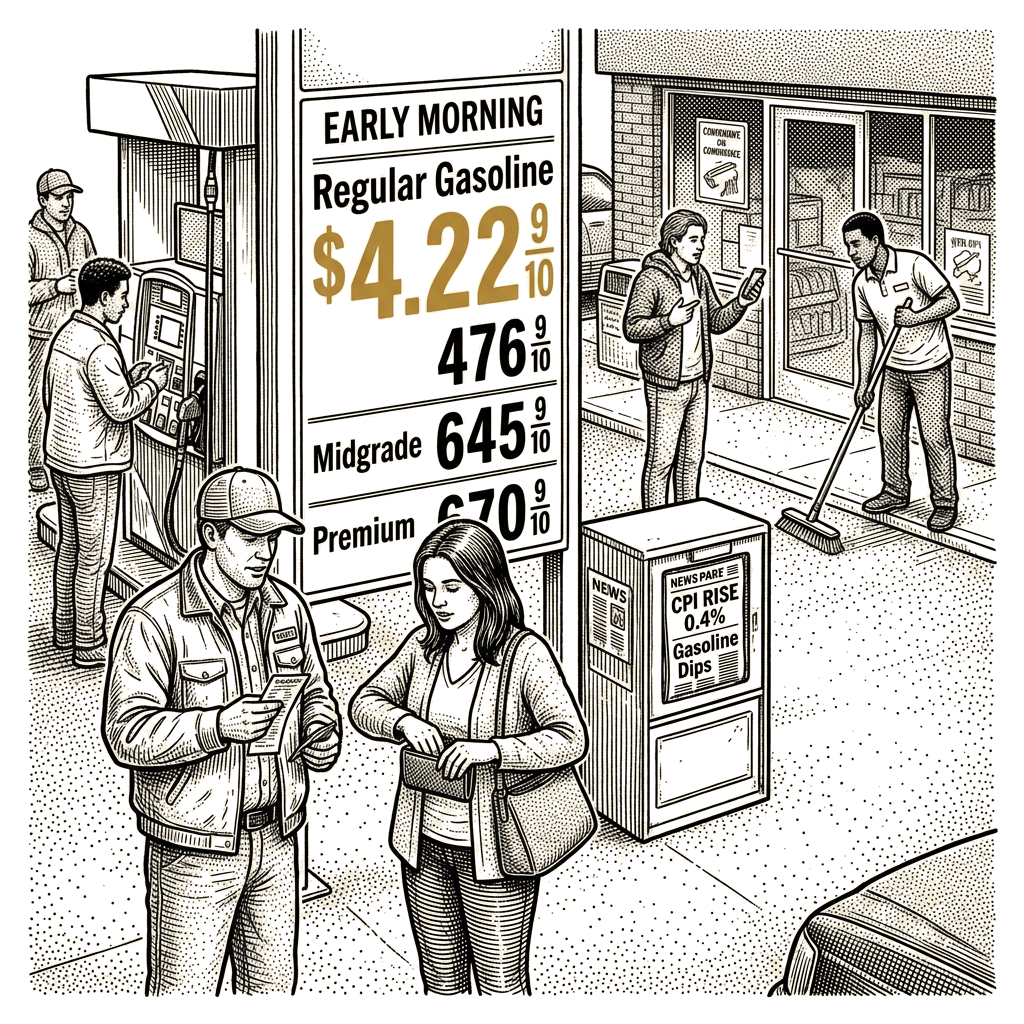
Where the increase lives is not a mystery either. Energy prices rose 5.2 percent in September and another 0.7 percent in October, and the driver is the war. Gasoline averaged $4.41 a gallon as October opened and $4.22 as it closed — still more than a dollar above a year earlier, dipping below $4 on Monday for the first time since July. Diesel, the price inside every delivered good — the trucks that carry food, the buses that carry workers, the equipment that plants crops — runs nearly $2.50 above last year. Run the household arithmetic: a fifteen-gallon fill costs about fifteen dollars more than it did a year ago, and the diesel premium is inside the grocery receipt on top of it. The pump kept measuring when the government did not. This is not an economy overheating everywhere. It is one price, at the pump, set by a war. And the pump did the measuring the government declined to do, and it measured against the governing party — whose own postmortem says as much, with leaders including Mr. Vance naming pump prices as the reason the majority fell.
Warsh’s own words concede it too. On October 28 the Federal Reserve’s chair said: “Our job is to ensure that relative price changes in some sectors do not broaden across the economy, and that inflation expectations remain as they are anchored.” Read the sentence. The inflation is, in his own description, relative — concentrated in gasoline, not a generalized wage-price spiral. And the instrument he has chosen reaches none of it directly. In September the Fed raised its policy rate — the rate that anchors borrowing costs across the economy — for the first time since 2023, and a second increase is expected at the December meeting. The mechanism is not a refinery. Higher rates make borrowing expensive; expensive borrowing slows hiring and investment; the unemployment rate, just above 4 percent now, is the dial the policy turns. The tool cannot produce a barrel of oil. It can only produce a narrower economy, in which people buy less gasoline because they have less work.
The response underway bills the same households a second time. The tightening is dressed as the only responsible act available; it is one response to a war-priced shock, chosen because its costs fall on mortgage borrowers and card holders rather than on the policy that produced the shock. Mortgage rates already sit above 7 percent before the next hike lands, and the committee’s own preferred inflation gauge accelerated to 3.6 percent in September. Nobody in the debate is asked the fiscal question: what does the war cost at the pump and at the closing table, and who signed the invoice?
This is the oldest mistake in the playbook, and the record on it is long. The 1970s inflation also had an energy core — oil embargoes set the spikes, not a surge of wage demands — and the demand-side response delivered the decade’s signature condition: inflation and unemployment rising together, stagflation in the textbooks. Stephanie Kelton states the operational fact without decoration: “The Fed unnecessarily uses unemployment to mitigate inflation.” J.W. Mason counts exactly one unambiguous case of inflation defeated by rate policy alone: the Volcker shock of the early 1980s. That episode broke a generalized wage-price dynamic, at the documented cost of a deep recession. A war-made gasoline shock is not that case. Pricing the experiment in paychecks anyway is a choice, and the workers funding it did not make it.
There is a second bill, and it lands on the Treasury. Every increase in the policy rate raises what the federal government pays to service its own debt, and the interest is itself financed by borrowing. Janet Yellen, the former Treasury secretary, put the institutional fact on the record in January: the post-pandemic tightening proceeded “even when that worsened the fiscal arithmetic.” The endpoint of that spiral has a name — fiscal dominance, the condition in which the government’s borrowing costs begin to steer the central bank instead of the reverse. By her own reading the country is not there. The direction is on the receipts: Washington is paying interest, with borrowed money, to suppress demand for a cost the war created.
The election fixed none of it. Control of Congress changed hands; the gasoline did not. The instruments that reach a pump price are fiscal and political, and the newly elected Congress holds them: relief aimed at the price itself — delivered per gallon, where the war’s cost lands — and the war decision that set it. That lever actually touches the pump price; it sits with the government waging the war. The committee holds only the demand lever, and the demand is other people’s jobs.
The repair of the gauge is not complicated, and it is not partisan. Statistical collection should carry the same automatic protection the law gives interest on the debt — the one payment that keeps flowing when everything else has stopped — because a month that goes unfunded erases an observation permanently: the October 2025 prices that existed that month are gone as measurements, and a model can guess them while a measurement cannot. A price index is infrastructure, and infrastructure does not take a political year off. The tightening reflex is institutional; it runs the same under either majority. The new Congress inherits the hole along with the gavels, and the honest act is identical for either party — fund the collection, publish the gap, and stop letting a private model stand in for the record.
The lineage of bent numbers is old enough to have a confession. In 1981 the architect of the tax cut later wrote that he “out-and-out cooked the books, inventing fifteen billion dollars a year of utterly phony cuts” — the arithmetic was bent, and the bending was admitted in his own memoir. In 2017 the score was shopped: expiration dates written to fit inside the ten-year scoring window, permanence planned for the politics. The 2026 variant dispenses with the fabrication stage. The number is not bent; it is not collected. Stockman’s arithmetic was confessed in print. An uncollected month is confessed by nothing; it surfaces a year later, to whoever needs the base month.
One number belongs in the closing position. The University of Michigan’s Surveys of Consumers, directed by Joanne Hsu, found sentiment rising among lower- and middle-wealth households as gasoline eased — and falling 5 percent among those holding the largest stock portfolios, on anxiety over a possible AI bubble. This publication has tracked the tightening arc as it assembled — a softer August reading that briefly trimmed the odds of an October move — and every print has been read as demand to be cooled. The constituency that dislikes this economy is the one holding portfolios. The constituency living inside it is buying $4.22 gasoline with the paychecks the December hike will thin. Chair Warsh told the country on October 28 what his policy defends: not the gasoline price his instrument cannot reach, but the expectation that it might spread. The record supports him on the second claim and convicts the policy on the first.
The score is the score. In October 2026 the score is a guess — and the invoice for the guess arrives monthly, at the pump and at every closing table. A war made this inflation. A committee that cannot refine oil is collecting the payment in jobs. The month is either measured or it is guessed — pick one. There is no other way to read the record.