
Kraft Heinz and Campbell’s are about to dump their costs on families who can’t refuse.
Steve Cahillane said it out loud last week. Price increases across the Kraft Heinz portfolio are coming in 2027. “The cost pressure is everywhere,” he said, and in the same breath, “the consumer is in a fragile state, there’s clearly more inflation.” He did not have to reconcile those two sentences. We are fragile, and the prices are coming anyway. That is not a forecast. It is a schedule — set while the supply chain’s own economists say pass-through has not even started.
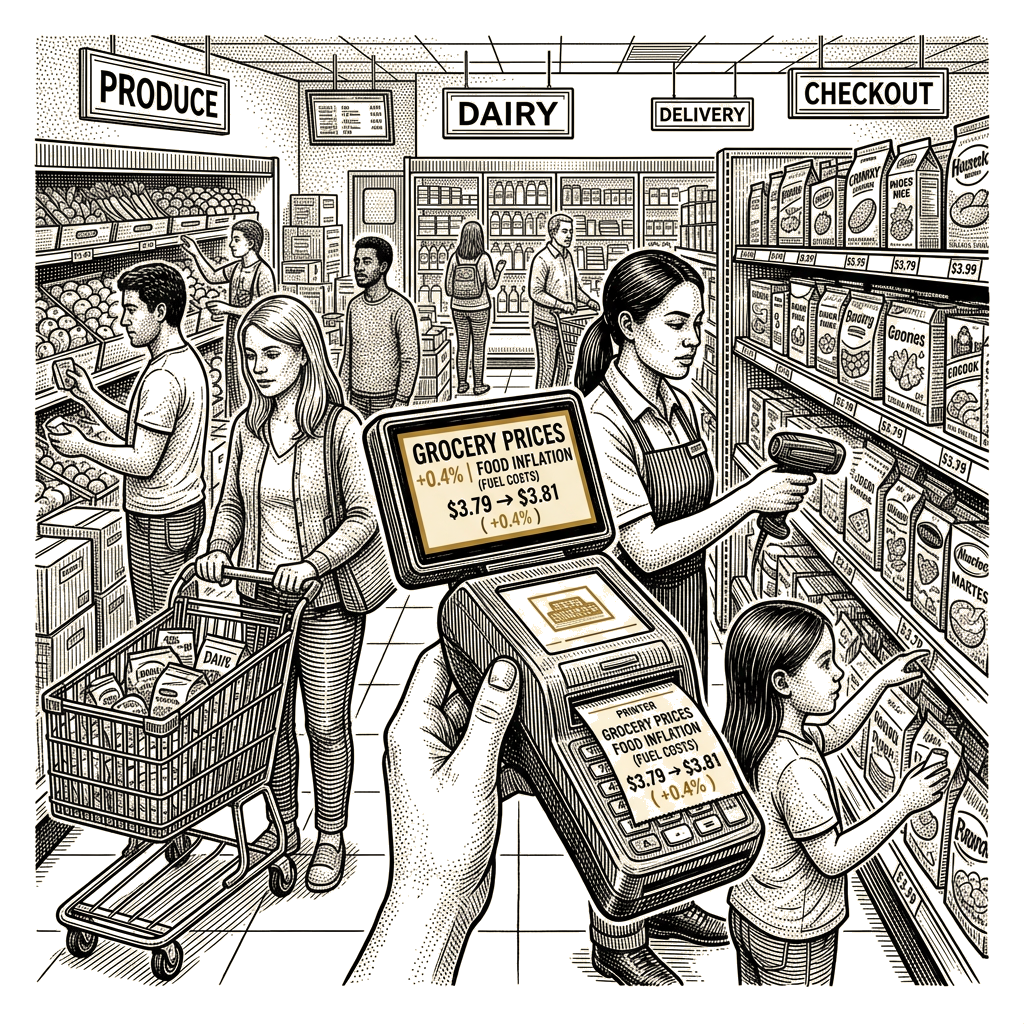
The Labor Department’s October numbers are the front edge of it. Grocery prices rose 0.4 percent from September, the fastest food inflation in six months. Fresh vegetables jumped 2.2 percent. Lettuce climbed 8 percent in a single month, butter 2 percent, cheese 1.3 percent, beef steaks 1.7 percent. Restaurant meals rose at the fastest pace since December 2025. All of it lands on a grocery basket that already costs more than 20 percent more than it did before Covid. At my kitchen table the grocery line is the only line in the monthly sheet with any give left in it. Childcare is $2,400 a month and contractual. The mortgage is 7 percent and contractual. The grocery number is the one I set, which is exactly why the grocery number is the one every link in this chain reaches for first.
The true part comes first, because it is true. Diesel is up more than 66 percent since the war in Iran began — a record $6.53 a gallon in September, even as crude came off its peaks. Transportation services are up 20 percent this year. Wholesale food prices jumped 1.3 percent in October, the sharpest monthly producer-price move since February, and producer prices overall are running 6.5 percent above a year ago, the biggest climb since 2022. The diesel surge was already showing up in the wholesale numbers back in August. The closed Strait of Hormuz squeezed Qatar’s fertilizer output just as farmers are buying for spring planting, and Purdue’s Bernhard Dalheimer says that “is something that could drive food prices over the next year.” At the Hunts Point Produce Market in the Bronx, which supplies thousands of grocery stores across the Northeast, Stefanie Katzman, the fourth-generation chief executive of S. Katzman Produce, put it plainly: “We absorb what we can, but a lot of it gets passed to the consumer because there’s not a lot of margin.” I believe her. Nobody at my table thinks a truck runs on goodwill. But a cost is not a verdict about who pays it. Somebody between the diesel pump and my cart decides that, and the answer has been the same every time: whoever cannot refuse.
And we are early. Scotiabank’s Olivier Gervais says “the worst is yet to come,” that the peak price impact on grocery shelves takes 12 to 18 months to filter through production and distribution markets, and that “it’s too early to say if pass-through has started.” Georgetown’s Sharat Ganapati says grocers negotiate prices months ahead, which “will attenuate the immediate effect” but means “the pressure builds up.” Kraft Heinz answered that question twelve months early. So did Campbell’s, whose chief financial officer, Todd Cunfer, told investors in September that the company raised prices across 60 percent of its portfolio in the same season it shut two snack plants and cut more than 550 salaried jobs, roughly 13 percent of its corporate workforce. Cut the payroll, raise the prices, brief the investors, call it costs. The company shrank itself and raised its prices anyway, and both moves land on the same two groups of people: the workers who are gone and the families paying more for the soup. October’s four-tenths of a percent is not the wave. It is the down payment. The worst is being scheduled.
The index says 0.4 percent. The Aldi receipt says the lettuce is $4.79 that was $3.49 in the spring. My spreadsheet does not do percentages; it does subtraction. Net income: $8,800 a month. Daycare for a four-year-old and a one-year-old: $2,400. Mortgage at 7 percent, three years of refinancing inquiries, still 7 percent. The grocery line has grown about ninety dollars a month in two years. The child allowance Congress let lapse at the end of 2021 was worth as much as $300 a month per young child; that line went to zero, two kids’ worth at once. Penn Wharton’s budget model found the bottom quintile of working households paid 6.9 percent inflation in 2021 against roughly 6 percent for the top, and the Bureau of Labor Statistics’ own research found lower-income households facing higher inflation year after year from 2006 through 2023. The households with the least margin pay the highest rate on the goods they cannot defer. Katzman says there is not a lot of margin at the wholesale end. Ours is called savings. It is the first line to go.
There is no shopping-around answer to a banana. Del Monte’s chief executive, Mohammad Abu-Ghazaleh, said bananas “cannot stay and cannot be sustainable at these prices, at this level,” and Dole’s people say fuel is inflating shipping, fertilizer and packaging costs with El Niño compounding it. I do not doubt any of them. Neither is the month, at these prices. Lilia Vailikit is 71, a retired nurse in South Florida living on Social Security while gas prices and condo maintenance climb, and the reporting records what the increases took: the trips to the Philippines she used to make every year or two. “Every time I go to the store, it’s more expensive,” she said. “Groceries—Jesus Christ.” She is the fragile consumer. Cahillane has a portfolio. She has a cart. There is a register of this story in which she is praised for her resilience and the rest of us are invited to adjust. “Adjustment” is a word for what someone else does. In my kitchen it means the produce line gives something up on Sunday night. In hers it means a continent. And 59 percent of House voters told ABC News they are unhappy about grocery prices, which is the kind of finding that never needed a poll.
We will absorb this longer than most households, and I want that on the page: two incomes, a Fishtown rowhouse bought with help from a grandmother’s estate, parents who did my financial-aid paperwork so I never had to do it alone. The shock lands last at tables like mine and first at tables like hers. That is exactly backwards from where the decisions are being made.
I grew up in Lansdale on my father’s Postal Service salary: three kids, family dinner every weeknight he wasn’t on nights, my mother running the grocery run on the same day every week like a tide table. One income covered the table. Two of us now earn more than my parents did in real terms, and dinner is a negotiation between columns. That gap is not my failure and it is not theirs. Annie Lowrey put the general form of it plainly: “Poverty in the United States is a choice. Stagnant middle-class incomes are a choice.” A food system where a diesel shock reaches the shelf in one month but wage growth — under 4 percent on the Atlanta Fed’s tracker as recently as early this year — never reaches it at all is not weather. It is design.
At St. Stanislaus when I was growing up, the Saint Vincent de Paul conference kept a food cupboard and the school ran a canned-food drive every Lent, because feed the hungry was the first work on the list and food is the first thing that fails when the grocery line moves. The same tradition wrote down in 1891 that “wages ought not to be insufficient to support a frugal and well-behaved wage-earner.” Leo XIII was making a claim about who carries the cost of a household, and about what happens when the answer is always the household. Two full-time earners in 2026 cannot cover dinner and care at once. That is not a household discipline problem. It is the wage system failing a test it has been failing for a century.
And the policy shelf is not empty. Restore the expanded Child Tax Credit — the Center on Budget and Policy Priorities estimated it would lift about 4.3 million children above the poverty line every year, a monthly deposit built to meet a monthly receipt — and Congress let it lapse. The childcare subsidy the House passed and walked away from was worth $5,000 to $6,500 a year to a typical family in 32 states. Enforce the Robinson-Patman Act the FTC finally picked back up in 2024, so the chain store’s volume advantage stops being priced against the independent grocer who might hold a neighborhood’s prices down. Defend the SNAP benefit floor recalculated in 2021 to track what food actually costs. School meals that do not move when lettuce does would do more than any belt-tightening advice ever has.
Taylor Swift wrote the care-infrastructure mission statement on Midnights and hid it in a title: “You’re On Your Own, Kid.” You’re on your own at the register. The documented safety net in the aisle is the lateral one — the group text splitting the bulk buy. It is a beautiful thing, and it is not a policy.
Kraft Heinz, Campbell’s and Del Monte are not weather. They are companies choosing where a real cost lands, and they have chosen: on the retired nurse in South Florida, on the household whose last flexible line is already at zero, on my kitchen table at eleven at night with a spreadsheet and a cold cup of tea. Sunday night I will sit back down and move the same numbers between the same two columns, and I will add the third column myself, because it already has a name: dinner, repriced twelve months in advance, with a war attached.