Analyzing: Trump and His Critics Whistle Past the Truth of 2020 — Holman W. Jenkins, Jr. · 2026-07-17
What the Editorial Argues
Jenkins argues that the 51 former intelligence officials’ October 2020 statement attributing the Hunter Biden laptop to Russian disinformation was wrong — substantively, demonstrably wrong — and that the press has refused to acknowledge this for six years. He contends that this single episode of media failure is the real reason millions of Americans distrust press accounts of the 2020 election, and that Trump’s broader election-integrity claims would carry far less weight if the media confronted this one truth. He grants that Trump overstates other claims and characterizes Trump’s election fixation as an “obsession,” but contends the laptop episode is the case where foreign interference in Biden’s favor may have actually occurred. He constructs an elaborate circumstantial case suggesting Vladimir Putin cooperated with the Biden campaign’s framing, and implies the resulting elevation of a cognitively weakened Biden contributed to Russia’s decision to invade Ukraine.
Receipts
What the framing wants you to believe:
- The 51 officials knowingly lied, the press covered for them, and this single episode explains why Americans distrust media accounts of 2020 — Trump’s election-doubt narrative is rooted in a genuine suppression
- Putin may have coordinated with the Biden strategy, suggesting the laptop cover-up had world-historical geopolitical consequences
- Trump’s “obsession” would evaporate if the media showed “a tinge of honesty” about this one story
What’s really going on:
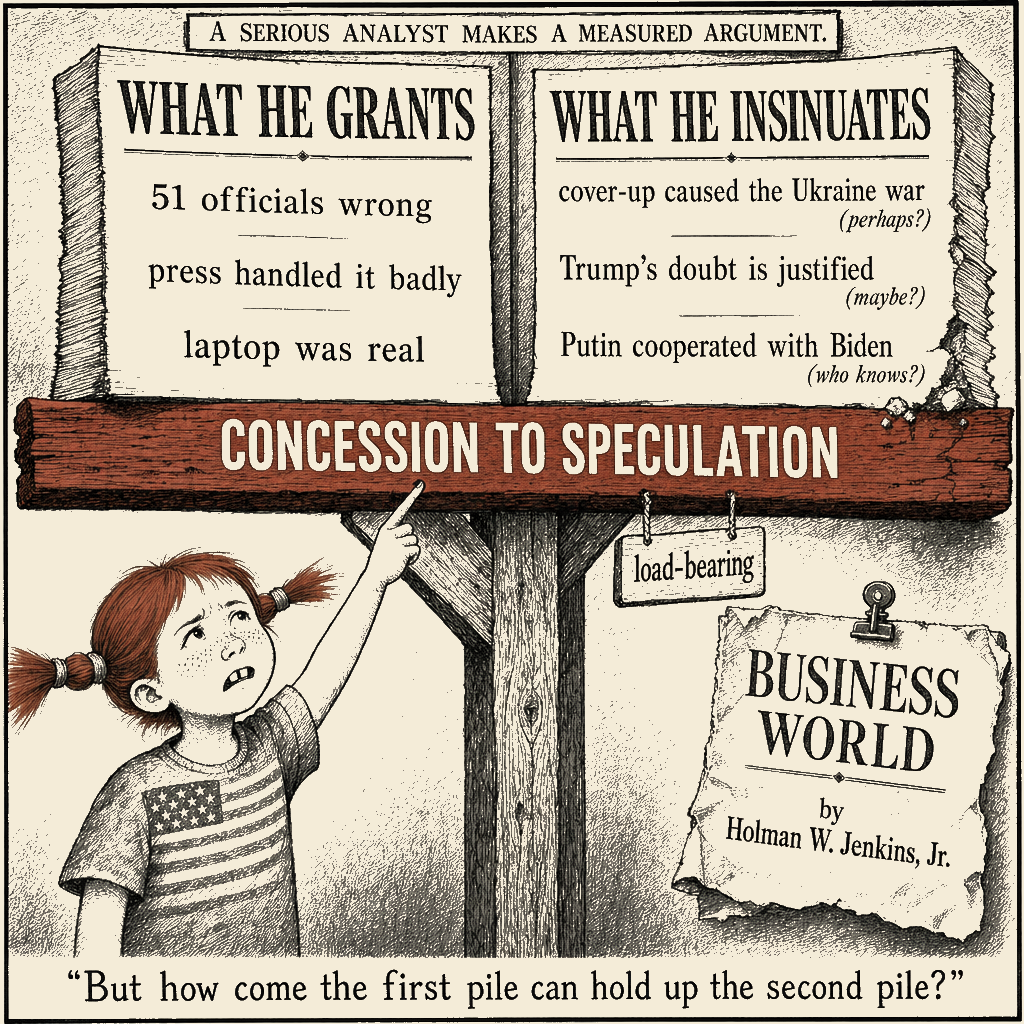
- The laptop was real, the 51 officials were wrong, and the press handled it badly. This is a genuine failure, and Jenkins is right to name it. But the piece uses the laptop’s authenticity as a bridge to the legitimacy of Trump’s broader election-questioning narrative — two propositions the piece collapses into one
- The Putin-Biden insinuation is built entirely on circumstantial inference and unsupported speculation, presented through the “just asking” retreat: “I don’t know what was in Mr. Putin’s head… and neither do you. But we would be dead to the realities of the world if we didn’t ask”
- The piece omits that the laptop’s authentication does not establish that its contents demonstrate corruption by Joe Biden, nor that its suppression changed the election’s outcome — the two propositions that would actually matter for the argument Jenkins constructs. He concedes “whether it changed the outcome isn’t knowable” in one sentence and implies it probably did for the remaining nine hundred
The Operation
Institutional authorship. Jenkins is a member of the WSJ editorial board — not an outside contributor but a house voice. The piece runs under the “Business World” column banner but operates entirely outside business coverage. This is editorial-board-level political commentary routed through a named columnist’s byline, a structural choice that gives the analysis the appearance of independent judgment rather than institutional position. We used this exact routing in the cable years — the commentary column carried the board’s political line while retaining the deniability of a “columnist’s opinion.”
The concession bridge — the piece’s load-bearing architecture.
Every word of this piece is organized around a single structural move: earn the reader’s trust with a genuine truth, then spend that trust on an unsupported conclusion.
Jenkins opens: “A fact isn’t true or false because Donald Trump utters it.” This sentence costs him nothing — it concedes what any reasonable reader already believes — and purchases everything that follows. The reader who absorbs this concession is now primed: this is not a pro-Trump piece; this is a serious analyst making a measured argument. The entire subsequent construction rests on that foundation of earned credibility.
We built segments this way. The concession is the credential. It inoculates the piece against the charge of being an advocate, which is what makes the advocacy invisible.
The technique inventory:
-
Frame-engineered relabeling (Bad-Faith Catalog
frame_engineered_relabeling; Luntz/Lakoff lineage). The 51 officials’ statement — a political endorsement that was wrong — is relabeled through an escalating vocabulary chain: “statement” becomes “scheme” becomes “effort to affect the 2020 election” becomes an operation with “serious foreign-policy risks.” Each substitution carries a heavier connotation. The final frame: the laptop cover-up may have caused the Ukraine war. No new evidence is introduced at any step; the escalation is accomplished entirely through vocabulary. Luntz documented the methodology; we deployed it on segments where the language upgrade was the argument.The same relabeling operates at the institutional level through the phrase “the Biden stratagem” — Jenkins’s term for the supposed alignment between the 51 officials’ statement and the Biden campaign. This collapses two independent actors (former officials issuing a wrong assessment, and a campaign exploiting it) into a single directed operation. The word “stratagem” implies planning, coordination, command. None of this is demonstrated; the label creates it.
-
JAQing off (Bad-Faith Catalog
jaqing_off; the question-as-charge move). The Putin-Biden insinuation. Jenkins does not assert that Putin cooperated with Biden. He constructs a detailed circumstantial case — Putin’s statement nine days before the election, its content mirroring the Biden campaign line, the absence of Russian pushback — then declares: “I don’t know what was in Mr. Putin’s head about Mr. Biden’s election and the Kremlin leader’s role in it, and neither do you. But we would be dead to the realities of the world if we didn’t ask the question.” The architecture: build the circumstantial case, raise the implication, retreat to inquiry, and frame anyone who declines to entertain the question as willfully naive. The question does the work of the assertion; the disclaimer provides the immunity.The same structure drove the 2016 Clinton-Lynch tarmac meeting coverage — weeks of “just asking” whether Attorney General Lynch’s airport conversation with Bill Clinton constituted obstruction of the email investigation, with the question itself doing the prosecutorial work no outlet was willing to do directly. We deployed this pattern on segments about political opponents’ foreign entanglements for two decades — the question was the charge, and “I’m just asking” was the liability shield. Jenkins is operating at higher craft than most practitioners, but the structure is identical.
-
Timeline-as-causation — the innuendo chain. Laptop cover-up → Biden elected → Biden cognitively weak → Putin perceives weakness → Putin invades Ukraine. Each event in the sequence is individually documented (Tier 1 for the laptop’s authentication, Biden’s “minor incursion” comment, the spring 2021 Russian buildup — the chronology confirmed by U.S. intelligence reporting on initial large-scale Russian deployments near Ukraine in March–April 2021). The causal connections between them are asserted through juxtaposition, not argued through evidence. The reader’s mind fills in the causal arrows the text never draws. This is the structural sibling of the slippery-slope — except instead of projecting forward (“if X then Y then Z”), it reconstructs backward (“Z happened because of Y because of X”) with the same missing evidentiary links.
-
The motte-and-bailey on election impact (Bad-Faith Catalog
motte_and_bailey; Shackel 2005). “Whether it changed the outcome isn’t knowable” — the motte, conceded in a single subordinate clause. The piece’s actual argument — that the cover-up explains why Americans distrust the media, that the press “is dead to the question,” that Trump’s “obsession” would vanish if the truth were told — is the bailey. The concession that the outcome is unknowable is structurally identical to the concession that Trump says false things: a defensible sentence positioned at the entrance to an argument that depends on the reader forgetting it. -
The “unmentionable” frame — manufactured grievance operating at the audience level. “There’s a part that’s even more unmentionable.” The topic is framed as suppressed, forbidden, the thing “they” won’t let you discuss. This converts the reader’s passive reception of a newspaper column into the felt experience of receiving forbidden knowledge — the reader doesn’t just learn about the laptop; the reader experiences themselves as someone who now sees what the establishment conceals. This is the audience-management function doing the heaviest work in the piece: identity confirmation through received forbidden truth.
-
Evidentiary transplant. The “conspiracy theory with no supporting evidence” quotation — one of the piece’s most potent receipts — is real, sourced from Special Counsel Weiss’s court filing. The prosecutors used the phrase to characterize Hunter Biden’s defense attorneys’ argument that the laptop data had been “altered and compromised.” Jenkins transplants the quote to the 51 intelligence officials’ Russian disinformation letter, presenting it as Biden’s Justice Department denouncing the officials’ claim. The underlying claims are related — both question the laptop’s integrity — but the prosecutors’ target was the defense’s specific legal argument, not the officials’ public statement. The transplant is small and surgical: the reader absorbs a real quotation from a real filing and assigns it to the claim Jenkins needs it to address. The misdirection is invisible precisely because the quote is genuine.
Audience-management function. The piece is a permission structure for the WSJ subscriber who wants to believe Trump’s election-integrity claims have some merit but feels uncomfortable with the “stolen election” framing. Jenkins says: you don’t have to accept Trump’s whole narrative. You just have to acknowledge this one thing. And once you acknowledge it — once you let the laptop’s authenticity into your mental accounting — the media’s credibility on everything about 2020 collapses. The piece is a gateway from “the media got the laptop wrong” to “the media can’t be trusted on anything.” The specific claim is true. The general conclusion does not follow. The WSJ imprimatur bridges the gap.
Cui bono. The beneficiary is Trump’s broader election-integrity narrative, which receives intellectual respectability in the pages of the Wall Street Journal. Downstream: readers who encounter Trump’s more extreme election claims on cable or social media can point to Jenkins as evidence that “even the WSJ editorial board” acknowledges the media covered up the laptop. The specific acknowledgment is earned; the general license is not. The piece’s distributional effect is to widen the range of contexts in which election-doubt can be expressed in respectable company.
The Record
Anchor receipts:
- The 51 officials’ statement, October 19, 2020: former CIA Directors and senior officials stating the laptop had “all the classic earmarks of a Russian intelligence operation.” Documented and well-sourced. Tier 1.
- FBI received the laptop December 2019; the New York Post published October 2020 — approximately 10 months. Documented in congressional testimony. Tier 1.
- Biden’s “minor incursion” remark, January 19, 2022 press conference. Tier 1.
- Russian military buildup near Ukraine, spring 2021. Tier 1 — confirmed by multiple intelligence community accounts placing initial large-scale Russian deployments near Ukraine in March–April 2021, approximately two months after Biden’s inauguration (sources: The Intercept, March 2022; CSIS Russian-Ukrainian Spring 2021 War Scare analysis; Politico, December 2021).
- Laptop authenticity affirmed through the Hunter Biden federal investigation and trial. Tier 1.
Supporting receipts:
- Multiple media retrospective accounts acknowledging the handling of the laptop was problematic (2022–2024, multiple outlets). Tier 1–2.
- Putin made public statements in late October 2020 regarding the election. Tier 1.
Per-citation accuracy:
-
“Conspiracy theory with no supporting evidence” — real quote, misattributed target. Jenkins presents this as a characterization by Biden’s Justice Department of the 51 officials’ claim. The quote is real — Special Counsel Weiss’s filing in the Hunter Biden gun trial (May 2024) states: “the defendant’s theory about the laptop is a conspiracy theory with no supporting evidence.” But the target was Hunter Biden’s defense attorneys’ argument that the laptop data had been “altered and compromised,” not the 51 intelligence officials’ public letter about Russian disinformation. The underlying claims are related — both question the laptop’s integrity — but the prosecutors’ characterization addressed a specific legal defense, not the officials’ public statement. Jenkins substitutes the target, transforming a narrow courtroom rebuttal into a sweeping institutional denunciation. The substitution is defensible as loose paraphrase; as direct quotation attribution, it overstates what the prosecutors said.
-
“Biden’s own Justice Department” — framing choice. David Weiss, the U.S. Attorney who brought the case and was later designated special counsel, was originally appointed by President Trump and retained under Biden. Calling the prosecution “Biden’s own Justice Department” is a relabeling that aligns the prosecution with the political target of the piece’s critique.
-
The Martin Baron memoir claim — that Baron’s Collision of Power (2023) “passes over in silence” the laptop episode — is a specific factual claim about a specific book’s contents. Web verification provides only generic descriptions of the book; no source specifically confirms or denies the laptop’s treatment. Unsupported against available evidence. The claim may be accurate but cannot be grounded from what is available.
Load-bearing omissions:
- The authentication of the laptop does not establish that its contents demonstrate corruption by Joe Biden. The laptop contained Hunter Biden’s communications and business records. The inferential leap from “the laptop was real” to “Trump’s claims about the Bidens were validated” is the piece’s most consequential omission — and the one its entire argument requires.
- The piece asserts the laptop story “may actually have changed a presidential outcome” while conceding in one clause that “whether it changed the outcome isn’t knowable.” The election was decided by approximately 44,000 votes across three states. The counterfactual is unknowable. The piece asserts the possibility and then leverages the assertion for the rest of its argument.
- The broader context of Russian interference in 2020 — documented by the intelligence community’s January 2021 assessment, which found Russia attempted to influence the election but did not identify vote-tallying interference — is absent. The piece treats the laptop episode as the sole foreign-interference story.
- The 51 officials’ statement was organized by former senior intelligence officials; the piece’s language of “the Biden stratagem” implies coordinated joint operation between the officials and the campaign. The relationship was parallel, not demonstrated to be sequential or directed.
Missing-information declaration: The Martin Baron memoir claim is carried as unsupported against available evidence. The “conspiracy theory” quote is documented as real but misattributed in target. The retained-memory account of the media’s laptop handling is directionally consistent with the public record; the specific claims need primary-source confirmation.
How to Recognize This
The pattern. A genuine, documented failure by one set of actors is used as load-bearing infrastructure for a much larger, unsupported conclusion. The technique works because the kernel is real — the reader who acknowledges the genuine failure slides, without noticing, across a bridge to an inflated conclusion the failure does not support.
The mechanism. The piece builds credibility through concession, spends credibility through well-sourced enumeration of the genuine failure, and then cashes the accumulated credibility in on speculative claims. The reader’s trust, earned by accurate details, is spent on inaccurate implications. The emotional experience — “finally, someone is saying what’s obvious” — is the audience capturing itself.
The capture happens at specific textual moments. When the reader encounters “There’s a part that’s even more unmentionable,” something shifts: this isn’t just a columnist offering analysis — this is someone letting the reader in on what the establishment conceals. The reader’s relationship to the piece changes from information-consumer to co-conspirator. The feeling — “they really are hiding something” — is the audience-management function doing its work at the sentence level. By the time the reader reaches “we would be dead to the realities of the world if we didn’t ask the question,” declining to entertain the insinuation would feel like a personal failure of nerve. The reader has been positioned so that skepticism feels like cowardice.
Five textual signals:
-
The opening concession. A sentence that grants a small, reasonable point at the top of a piece that argues a much larger point. The concession is the credential. Watch what it purchases. “A fact isn’t true or false because Donald Trump utters it” costs Jenkins nothing and buys him the reader’s trust for everything that follows.
-
The “unmentionable” frame. “There’s a part that’s even more unmentionable.” The topic is framed as suppressed — the thing they don’t want you to discuss. This converts the reader from information-receiver to co-conspirator with forbidden knowledge. The feeling of receiving forbidden truth is the audience-management function, not the analysis.
-
The “just asking” insinuation. “I don’t know what was in Mr. Putin’s head… and neither do you. But we would be dead to the realities of the world if we didn’t ask the question.” The question does the work of the assertion; the disclaimer provides the cover. State what the piece insinuates without asserting, and evaluate whether the evidence supports it.
-
The timeline-as-causation. Real events arranged in sequence with causal connections asserted through proximity. Laptop cover-up → Biden elected → Biden weak → Putin invades. Each event is documented; the arrows between them are not. Watch for pieces that present a sequence of real things and let the reader’s mind fill in the causal arrows the text never draws.
-
The evidentiary transplant. A real quotation from a real source, reassigned to a different target than the one it addressed. The quote’s genuineness provides the immunity; the reassignment provides the payload. Check not just whether a quote is real, but whether it says what the piece claims it says, about whom.
Why it works. The kernel is true. The 51 officials were wrong. The press handled the laptop poorly. A reader who recognizes this truth is primed to accept the piece’s larger framing — that the media’s silence on the laptop explains election-doubt, that the cover-up may have caused the Ukraine war, that Trump’s “obsession” is justified by suppressed reality. The truth of the kernel does the work of carrying the fiction of the frame.
What to do when you see it. Concede the kernel. Then ask: what is this kernel being asked to carry? Trace the logical bridge from “the laptop was real” to the piece’s conclusion and check whether each link holds. Check the omissions: what does the piece not tell you about what the laptop actually showed, about the election’s margins, about the counterfactual. Name the insinuation: if the piece suggests something without asserting it, state what it suggests and evaluate the evidence on its own terms. Check the quotations: if the piece presents a real quote, verify not just that it exists but that it addresses the claim the piece assigns it. The bridge is where the operation lives — not in the truth at either end, but in the unsupported span between them.

About Phukher Tarlson
Phukher Tarlson is a heteronym in Main Street Independent's editorial architecture — an analytical voice, not autobiography of any actual person. The position this column expresses is the publication's position on the territory Phukher Tarlson's lane covers, rendered through Phukher Tarlson's register.