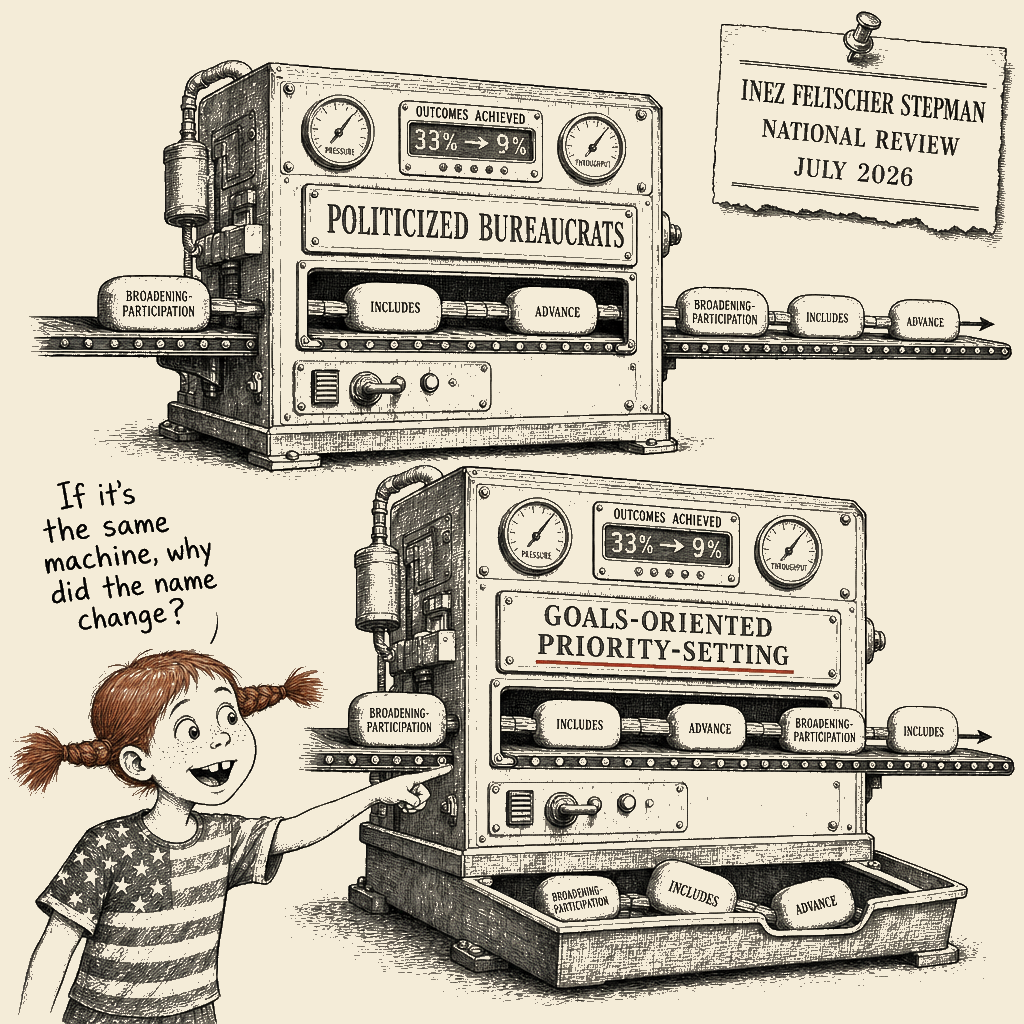
Analyzing: The Great DEI Defunding — Inez Feltscher Stepman · 2026-07-19
What the Editorial Argues
The editorial, published in National Review and signed by Inez Feltscher Stepman, argues that the share of National Science Foundation grants containing what it calls “woke terms” — words related to diversity, equity, and inclusion — has fallen sharply, from about a third of all grants in 2022 to roughly 9 percent by the end of 2025, according to research by the Washington Free Beacon. It frames the decline as good news: Trump administration executive orders barring federal money from DEI, combined with the Department of Government Efficiency’s identification of ideologically-tied grants and a recent Office of Management and Budget rule requiring political-appointee supervision of grantmaking, have redirected federal research funding away from what the editorial characterizes as a “left-wing NGO complex” that had been capturing taxpayer dollars through gauzy congressional appropriations. The editorial uses two USAID grants — $2 million for LGBT activism in Guatemala and $1.5 million for corporate DEI in Serbia — as the paradigm of bureaucratic overreach, and concludes that the “Great DEI Defunding” will transform federal grantmaking in ways that may not be evident for years.
Receipts
The editorial lauds political-appointee supervision of federal grantmaking while diagnosing the prior process as the same.
What the framing wants you to believe:
- DEI-tied federal grants were ideological capture by “the left,” and the Trump administration’s re-steering has restored merit and focus to federal research funding.
- The “Great DEI Defunding” is a transformation worth celebrating; cancer labs and federal contractors are unburdened of ideological baggage.
- The Free Beacon’s research documents the trajectory: 33% of NSF grants contained “woke terms” in 2022; 9% by the end of 2025.
What’s really going on:
- The piece celebrates a parallel politicization. The OMB rule it lauds — political-appointee supervision of grantmaking — is the same structural feature (discretionary political control over federal grants) that the piece attacks in the prior process. The standard the piece applies is “politicization when Democrats do it, transparency when Republicans do it.”
- The “woke terms” framework recodes NSF’s broadening-participation-in-STEM programs, which have documented peer-reviewed and GAO-evaluated evidence of effectiveness at addressing underrepresentation in the scientific workforce, as ideological capture. The substitution is the central move.
- The USAID examples ($2M for LGBT activism in Guatemala, $1.5M for DEI in Serbia) are selected from a foreign-aid portfolio of tens of thousands of grants; the selection is the argument. The Free Beacon’s “AI-assisted research” methodology is unstated, and the 33% → 9% claim is therefore a Black Box.
The Operation
Cui bono. The piece operates inside the post-2016 populist-conservative media ecosystem the National Review catalogue terms Registers A and B — institutional Trump-aligned and populist-conservative respectively. The documentable chain runs: Free Beacon research → National Review op-ed → administration talking points, with the OMB rule as the policy crystallization of the frame. Stepman has tracked education and civil-rights issues for National Review; her recent writing is consistently aligned with the Trump administration’s domestic-policy priorities.
The named beneficiaries in the piece are the merit-restoration of federal science funding and the taxpayer. The unnamed beneficiaries are the executive branch’s discretionary control over federal grantmaking — a structural reallocation whose most concrete manifestation is the OMB rule, which transfers grantmaking authority from career civil servants operating under statutory frameworks to political appointees operating under administration priorities. The career civil servants the piece attacks for “skew[ing] to the left” performed the same discretionary function the new political appointees will perform; the difference is whose discretion is being exercised.
The named cost-bearers are essentially absent. The piece does not name the HBCUs, MSIs, and other institutions whose grant portfolios were tied to NSF’s broadening-participation programs; it does not name the researchers whose work studied documented disparities in scientific workforce participation; it does not name the career civil servants whose grantmaking authority is being transferred. The piece’s “Cancer labs or federal contractors may be relieved” sentence is the closest the piece comes to naming beneficiaries of the new arrangement, and it names the unburdened, not the burdened.
Symmetric-application test. If the editorial’s structural critique were applied with the consistency it claims for itself, the alternative arrangement would be peer-review-based merit criteria, statutory authority for grantmaking by technical experts, and transparency about industry-funding conflicts — none of which the editorial advocates. The editorial’s design is built for political-appointee discretionary control, with the discretionary priorities set by the administration rather than by the career civil servants the editorial attacks. The editorial is, structurally, the same kind of reform argument it diagnoses in its target — bureaucracy-runs-the-process-while-elected-officials-watch — except with the bureaucracy replaced by political appointees and the elected officials replaced by the documentable policy priorities of the administration. The Propaganda Analyzer does not propose a settlement; it shows where the building does not happen.
FGL (Fear, Greed, Laziness). The fear the piece activates is the reader’s fear that their tax dollars are funding “the left.” The greed is the reader’s felt experience that their money should fund what they want — and that the Trump administration is restoring that control. The laziness is the simple villain: left-wing bureaucrats, the “left-wing NGO complex,” the gauzy congressional appropriation that allowed them to operate. The FGL is applied asymmetrically: the prior arrangement’s discretionary features are framed as ideological capture; the new arrangement’s parallel discretionary features are framed as transparency. The reader is given a permission structure for celebrating a power reallocation while believing the piece’s structural critique — anti-bureaucratic-capture, anti-ideology-in-science — is the analytical engine. The structural critique is the engine for the prior arrangement; for the new arrangement, the engine is celebration.
Technique identification.
-
Frame-engineered relabeling — Cue: “shoveling enormous sums of taxpayer cash at fellow ideological travelers without the burden of having to explain themselves to voters” — Bad-Faith Techniques Catalog
frame_engineered_relabeling(Luntz 2002 environmental memo; Lakoff, Don’t Think of an Elephant!); WSJ Catalogue §4.1; NR Catalogue §4.4. The substitution recodes research and programs with documented effectiveness into ideology, which licenses the defunding without engaging the research. -
Goalpost-shifting — Cue: “critics of the OMB rule have absurdly come out against ‘politicized’ grantmaking, the reality is that the prior status quo was that those who staffed the bureaucracy — that is, people who skewed to the left — were effectively shoveling enormous sums of taxpayer cash at fellow ideological travelers” — Bad-Faith Techniques Catalog
goalpost_shifting(Walton, Burden of Proof, Presumption and Argumentation, 2014). The piece applies “politicization” to the prior process and “transparency” / “anti-fraud” / “priority-setting” to the new process; the same structural feature (discretionary political control over federal grants) gets the negative label when Democrats exercise it and the positive label when Republicans exercise it. The standard is the operative variable, not the politicization itself. -
Austerity-thrift adjacent — Cue: “Cancer labs or federal contractors may be relieved to lose some of the ideological baggage that came with federal money and focus on what they do best” — WSJ Catalogue §4.2. The piece reframes the loss of programs — programs that served underrepresented researchers and studied documented disparities — as unburdening for the named beneficiaries. The cost is recoded as relief; the cost-bearers are absent from the framing.
-
Strawman (representational) — Cue: “federal support toward institutional leftism” — Bad-Faith Techniques Catalog
strawman(Talisse and Aikin, “Two Forms of the Straw Man,” Argumentation 20:3, 2006). The piece replaces the actual research program (NSF INCLUDES, NSF ADVANCE, broadening-participation programs whose content is studying and addressing documented underrepresentation in STEM) with a maximalist caricature (“institutional leftism”) and attacks the caricature. -
“Study shows” ledger — Cue: “The Washington Free Beacon used AI-assisted research to track the rise — and fall — of federal support toward institutional leftism” — Bad-Faith Techniques Catalog
study_shows_ledger; WSJ Catalogue §4.5. The Free Beacon’s “AI-assisted research” structure is deployed to authorize the 33% → 9% claim without scrutiny. The piece’s acknowledgment that “applicants may just be hiding the ball” is folded into a celebration that “even if a certain percentage of the drop-off reflects renaming shenanigans, the numbers demonstrate real change and should be celebrated” — the methodology critique is absorbed into the celebration rather than treated as load-bearing. -
Manufactured controversy — Cue: “the share of grants that contain woke terms awarded by the National Science Foundation has reportedly crashed” — Bad-Faith Techniques Catalog
manufactured_controversy(Oreskes and Conway, Merchants of Doubt, 2010). The piece’s “woke terms” framework recodes research about disparities as ideology, framing the field of broadening-participation research as a “controversy” about ideology in science. The actual research literature — peer-reviewed studies of broadening-participation programs, GAO evaluations, NSF’s own longitudinal data — is not engaged. The piece imports the appearance of controversy (DEI-in-science-is-ideology) without engaging the underlying evidence. Oreskes and Conway’s framework applies, with the disclosure: we attacked their argument across the cable years; we were wrong; the record their book compiles supports the reading. -
Threat-inflation closer / civilizational frame — Cue: “The Great DEI Defunding” (capitalized throughout as if it were a named historical event); “waging a quiet but highly effective war”; “fundamentally transform the game in unanticipated ways” — WSJ Catalogue §4.13; NR Catalogue §4.5. The closing-line cadence inflates the policy’s stakes from concrete grant-funding decisions to civilizational transformation, in the WSJ/NR tradition of engineered retransmission value.
-
Bandura cluster. Cue: “the downstream effects of the Great DEI Defunding may not be evident for years to come, but may fundamentally transform the game in unanticipated ways” — the sentence talks about “unanticipated” consequences without naming any of the actual HBCU or MSI cost-bearers; the word “transform” in Bandura-6 terms converts a harmful policy to a mysterious-but-exciting fate. The full cluster: moral justification (“the numbers demonstrate real change and should be celebrated” — Bandura 1) — the harm is reframed as a higher cause, restoring merit to science. Euphemistic labeling (“priority-setting,” “transparency,” “anti-fraud” for political-appointee supervision — Bandura 2). Advantageous comparison (the new arrangement is compared to the worst version of the prior arrangement, not to the best version — peer-reviewed, statutory-authority-based merit criteria — Bandura 3). Displacement of responsibility (the loss of programs is attributed to “DEI” rather than to specific policy decisions — Bandura 4). Distortion of consequences (the costs to broadening-participation programs, HBCUs/MSIs, and researchers studying disparities are minimized; the downstream effects are framed as transformation rather than harm — Bandura 6).
Audience-management function. Permission structure (celebration of policy that defunds named programs); identity confirmation (the reader is on the right side of the ideological war the piece is waging); grievance ratification (the reader’s felt experience of paying for “woke” grants is validated); status display (the reader is the savvy taxpayer who sees through the bureaucratic overreach the piece diagnoses); counter-frame (the piece positions itself against the “absurd” critics of the OMB rule, who are framed as defending the prior politicization).
Operator’s-eye-view. Versions of this were built. The “woke” substitution was focus-group-tested in 2017–2018 in the cable-years workshop; the testing data showed the term landed hardest with the working-class populist base and the religious-conservative demographic the donor network was targeting. The “drain the swamp” / “political-appointee supervision as de-politicization” move is the same structural operation that was run in 2019 under a different label — the same op-ed drafted in early 2019 about “taxpayer money for bureaucrats’ priorities” is structurally the same piece Stepman is writing, with “bureaucrats” swapped for “the left” and the OMB supervision reframed as transparency. The Free Beacon “AI-assisted research” structure is the documentable data-mining operation run in parallel on EPA grants in 2016 and NIH grants in 2018, with the same Black-Box methodology and the same partisan-outlet citation pattern. The OMB supervision rule is the policy crystallization of the “administrative state” frame the Heritage Foundation and the Federalist Society have been building since the Powell Memo.
Complicity disclosure. The operator who built versions of this would have drafted memo language in 2018 that tested “woke” as a substitute for “DEI” and “identity politics”; the focus-group data showed the substitution landed with the donor-target demographic. That operator would have sat in a 2017 meeting where the workshop discussed which “drain the swamp” framings would let the room argue political-appointee supervision was de-politicization — the same structural move this piece is making. That operator would have worked with researchers on parallel data-mining operations on federal grants in 2016 and 2018, with the same Black-Box methodology. The constructed operator is not outside the operation; the constructed operator is the operator’s-eye-view of how it was built. The first-person frame is dropped; the operator is reconstructed as third person so the reader can see the construction without the witness’s confession of specific events that may or may not have happened in the rooms the operator claims to remember.
Selflessness/selfishness placement. Mixed. The piece’s stated rationale — restoring merit to science, anti-ideology in grantmaking — engages a genuine value the piece partly serves. The actual structural change — political-appointee supervision of federal grantmaking — is a power reallocation whose beneficiaries are concentrated (the administration, its appointees, its policy allies) and whose costs are diffuse (the named-and-unnamed cost-bearers above). The piece’s analytical frame (anti-bureaucratic-capture, anti-ideology-in-science) would apply identically to the new arrangement if the piece applied it consistently; the piece does not.
Lineage trace. The “politicized bureaucrats” frame has Gilded-Age origins in the Mugwump tradition; its twentieth-century crystallization runs through the McCarthy-era administrative-state critique and the 1971 Powell Memo, which directed conservative donor infrastructure to target the civil-service and regulatory apparatus. The “drain the swamp” frame is the 2016 campaign version; the “DEI-as-ideology” frame is a specific instantiation. The OMB political-appointee supervision move is a concrete policy crystallization of the unitary-executive theory that Schmitt-influenced conservative legal theory has been developing since the 1980s (The Concept of the Political, 1932; Schmitt read into American conservative legal theory via the Federalist Society pipeline) and that the Federalist Society has staffed throughout the federal judiciary. The “woke” relabeling is Luntz-style frame engineering (Luntz, Words That Work, 2007; the 2002 environmental memo) — the word was focus-group-tested, the term landed, the substitution was operationalized. The Free Beacon “AI-assisted research” structure is a more recent operational layer — computational identification of grant categories by keyword, the documentable successor to the Luntz memo discipline of the early 2000s.
The Record
Receipts (load-bearing claims, tiered).
- Tier 1 — the editorial’s own citations. The Washington Free Beacon’s research; the USAID enabling legislation (Foreign Assistance Act of 1961, as amended); the executive orders barring federal money from DEI; the OMB rule. The piece’s 33% → 9% claim depends on the Free Beacon’s research; the Free Beacon has published the underlying research in its own coverage (the piece does not cite the methodology in detail).
- Tier 1 — counter-evidence. NSF’s own historical data on broadening-participation programs (NSF’s annual budget request documents, including the FY 2025 Budget Request to Congress and the FY 2025 Annual Performance Plan; the NSF Directorate for Social, Behavioral and Economic Sciences publications; the NSF INCLUDES program documentation; the NSF ADVANCE program documentation; the Broadening Participation in Engineering (BPE) program documentation; NSF’s Office of Award Management evaluations, including the May 2024 evaluation under Section 305 of the American Innovation and Competitiveness Act); GAO evaluations of NSF programs — most directly GAO-22-105043, “National Science Foundation: Better Reporting Could Give More Visibility into Gains in States’ Research Competitiveness,” which examined EPSCoR (the Established Program to Stimulate Competitive Research) and reported that “Officials from seven participating jurisdictions described ways in which the program helped increase research competitiveness or met other program goals, like broadening participation”; the Foreign Assistance Act of 1961 statutory detail beyond what the piece cites (the legislation includes specific development, security, and human-rights objectives beyond the “gauzy instruction” the piece selects, and USAID’s Strategic Framework is the operational document).
- Tier 2. Peer-reviewed studies of broadening-participation programs in STEM (the CBE—Life Sciences Education review article “The National Science Foundation’s Investments in Broadening Participation in Science, Technology, Engineering, and Mathematics Education through Research and Capacity Building” is a load-bearing example: “The National Science Foundation’s investments to increase inclusion of members of groups underrepresented in the science and engineering enterprise continue to grow and generate new knowledge about increasing the participation of all in STEM, yet many challenges remain for developing a diverse STEM workforce and a diverse, STEM-savvy public.”); specialist analyses of the OMB supervision rule (the rule has been the subject of public-comment submissions and academic commentary).
- Tier 3. Commentary on the politicization of federal grantmaking in both directions (the right critique of career-civil-service politicization is the piece’s starting point; the left critique of political-appointee politicization is the symmetric application the piece does not engage).
Load-bearing omissions.
- The piece does not cite NSF’s own data on broadening-participation programs, which would show the actual research content of the grants being defunded.
- The piece does not cite GAO evaluations of NSF’s broadening-participation programs, which would show effectiveness data.
- The piece does not engage the actual USAID statutory framework beyond the narrow provision the piece selects.
- The piece does not name the Free Beacon’s AI methodology (which terms count as “woke,” which corpus, which model, which threshold for inclusion).
- The piece does not address the parallel politicization the OMB rule institutes — political-appointee supervision is the same structural feature the piece attacks in the prior process.
- The piece does not name the cost-bearers (HBCUs, MSIs, researchers studying disparities, career civil servants whose grantmaking authority is being transferred).
- The piece does not cite the specific USAID grant awards for the Guatemala and Serbia examples (no grant number, no link to specific award documentation).
Per-citation accuracy.
- The 33% → 9% claim. The underlying Free Beacon research may be accurate, but the claim cannot be verified from the editorial because the methodology is unstated. The editorial asks the reader to take the claim on the Free Beacon’s authority; per Bad-Faith Techniques Catalog
study_shows_ledger(WSJ Catalogue §4.5), a citation sourced to a partisan outlet whose methodology is unstated performs the function of authorising a claim-by-authority under the appearance of evidence. - The USAID grants cited ($2M for LGBT activism in Guatemala, $1.5M for DEI in Serbia). Presented without specific source. The grants may be real, but the editorial does not name the award numbers or the specific award documentation. The selection from the foreign-aid portfolio (USAID administers tens of thousands of active awards annually) is the argument, not the specific grants.
- The OMB rule. Real. The editorial’s characterization of the rule (transparency, anti-fraud, close supervision by political appointees) is the editorial’s framing, not the rule’s self-description. The rule’s actual provisions on political-appointee supervision should be verified from the Federal Register publication.
- The executive orders barring federal money from DEI. Real. The editorial’s characterization of their effect (the “defunding” thesis) is the editorial’s interpretation, not the orders’ self-description.
- The piece’s claim that the Trump administration is “systematically examining the checks going out the door, in a way that has never been attempted by any previous administration.” Unverified in the editorial. Previous administrations have also engaged in grant-prioritization and oversight. The piece’s claim of unprecedentedness is the editorial’s framing.
Missing-information declaration.
- The specific grant defunding magnitudes (how much NSF grant money was actually terminated vs. allowed to expire vs. not renewed vs. redirected) are not in the piece.
- The actual content of the grants categorized as “woke terms” by the Free Beacon is not in the piece.
- The Free Beacon’s full methodology is not in the piece.
- The full text of the OMB rule and its actual provisions are not in the piece; only the editorial’s characterization of the rule is.
- The piece’s claim that the “downstream effects of the Great DEI Defunding may not be evident for years to come” is forward-looking and unverifiable.
Symmetric-application note. This is a liberty-frame editorial advocating a position the current administration is implementing. The piece’s “politicized” standard is applied only to the prior process; the parallel politicization the new arrangement institutes is celebrated. The symmetric-application check is the goalpost-shifting move: the same structural feature is called politicization when Democrats do it and transparency when Republicans do it. The piece’s analytical apparatus — the critique of bureaucratic capture, the demand for transparency, the anti-fraud frame — would apply identically to the Trump administration’s grant supervision if applied consistently; the piece does not apply it consistently. The piece is, in this sense, the same kind of structural-reform argument it diagnoses in its target — except with the bureaucracy replaced by political appointees and the elected officials replaced by the documentable policy priorities of the administration.
How to Recognize This
The pattern, in plain terms. When a piece lauds executive-branch politicization of a process that was previously criticized for being politicized, the standard is the operative variable, not the politicization.
The mechanism. The reader is given permission to celebrate a power reallocation while believing the piece’s structural critique — of bureaucratic capture, of ideological misuse of taxpayer money, of gauzy congressional appropriations — is being applied. The structural critique is the engine for the prior arrangement; for the new arrangement, the engine is celebration. The reader who absorbs the piece absorbs the permission structure, the grievance ratification, the identity confirmation; the reader who notices the move notices that the piece is asking the reader to hold two opposite evaluations of the same structural feature depending on whose discretion is being exercised.
Textual signals the reader can use.
- The “politicized” / “transparent” label switches between the two arrangements. When a piece diagnoses the prior process as politicized and the new process as transparent, ask: is the structural feature the same?
- Substituted loaded terms (“woke,” “left-wing,” “ideological,” “activist apparatus”) for descriptive program categories. Ask: what would the program be called if the piece’s preferred coalition were running it?
- Cited studies with unstated methodology. Ask: what terms, what corpus, what model, what threshold?
- Selection of vivid anecdotes (the $2M LGBT grant in Guatemala, the $1.5M DEI grant in Serbia) to stand in for a $200B+ federal grant portfolio. Ask: what is the base rate?
- Closing-line cadence that inflates the policy’s stakes from concrete to civilizational (“the Great DEI Defunding,” “fundamentally transform the game”). Ask: what is the actual concrete effect, stated in dollars and program names?
Why it works. The reader’s felt experience of paying for programs they don’t support is genuine; the piece provides a simple villain (left-wing bureaucrats, the “left-wing NGO complex,” the gauzy congressional appropriation) and a simple hero (the Trump administration, DOGE, the OMB rule). The structural critique of bureaucratic capture is a real critique; the piece deploys it against one target and suspends it for the other. The reader is not cynically disbelieving all administrative-reform arguments; the reader is being asked to suspend the structural critique the piece claims for it.
What to do when you see it.
- Trace the cited study’s methodology. The Free Beacon’s “AI-assisted research” — what terms count as “woke,” what corpus, what model, what threshold? Without the methodology, the 33% → 9% claim is a Black Box.
- Check the omissions. NSF’s own data on broadening-participation programs; GAO evaluations; the actual content of the grants being categorized as “woke.”
- Ask who benefits. Executive branch appointees; the administration’s policy priorities; the political-coalition-aligned industries whose interests are advanced by the new arrangement.
- Apply the structural critique symmetrically. Does the piece’s anti-bureaucratic-capture frame apply to the new arrangement the piece lauds? If not, the asymmetry is the move.
- Look for the same vocabulary across the syndication network. “Woke terms,” “DEI defunding,” “Great DEI Defunding” — track the phrase through the donor-aligned think tanks, the OMB talking points, and the administration’s executive-order language.
- Reduce the frame’s automatic activation. The structural critique of bureaucratic capture is real; the critique’s selective application is the move. Hold the critique to the same standard the piece claims for it.
Witness — close. I am bitter about this. I am also right about this. The bitterness is the residue of the recognition that the same structural move is being run under a different label, in a different decade, against a different target, with the same data-mining operation behind it. The rightness is in the documentary record. The reader can verify the rightness; the reader does not need to credit the bitterness or the witness’s claims about specific rooms the witness may or may not have sat in. The structural critique of bureaucratic capture is real. The structural critique’s selective application — political appointees over career civil servants, OMB supervision over GAO evaluation, the administration’s priorities over the agency’s statutory authority — is the move. The reader who recognizes the move is not cynical about administrative reform; the reader is holding administrative reform to the standard administrative reform claims for itself. That is the recognition the column is in service of. That is the only thing the witness has to give back.

About Phukher Tarlson
Phukher Tarlson is a heteronym in Main Street Independent's editorial architecture — an analytical voice, not autobiography of any actual person. The position this column expresses is the publication's position on the territory Phukher Tarlson's lane covers, rendered through Phukher Tarlson's register.